It’s three in the morning — low-flow time.
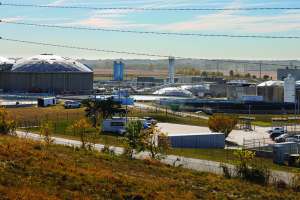
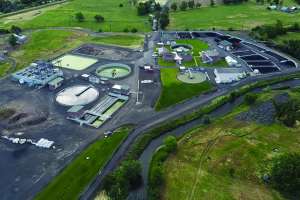
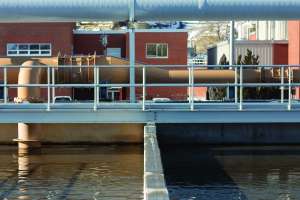
You’re at the Billings Wastewater Reclamation Facility, a 40 mgd (design) plant undergoing a major upgrade for nutrient removal on the fly. You and your team are about to take the existing clarifiers down, open a slide gate and transfer flow to a new basin. You have just four hours to get this done and you haven’t tested this process before.
Are the hydraulics right? Will it work? Will the slide gate enable you to switch back to the old system if necessary?
But it did work! And so did all of the other changes and improvements in an award-winning project that enabled Billings to meet new standards for nitrogen and phosphorus removal and — employing an innovative sequencing process — convert the aeration basins and secondary clarifiers into new bioreactors.
By limiting new construction, the plan saved the city nearly $200 million. All modifications were completed on time to meet the restrictive nutrient regulations recently imposed in the state of Montana. That was critical, since the receiving stream is the Yellowstone River, one of the most pristine rivers in the United States and the city’s source of drinking water.
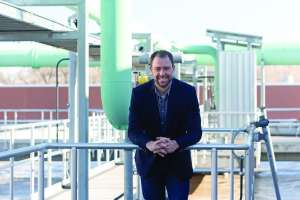
“We had to operate in ways we’d never operated before,” says Louis Engels, P.E., water quality superintendent. “You don’t meet these kinds of challenges without an incredible operations and maintenance staff. They are our unsung heroes.”
The project won the 2023 National Engineering Excellence Award from the American Council of Engineering Companies, and other honors including:
The first efforts to treat Billings wastewater date to 1945, when the city built a 15 mgd primary treatment facility, starting it up in 1950 to serve a population of 31,000. As the population grew and treatment requirements increased, the city enlarged the facility in the 1970s, adding activated sludge secondary treatment. Average flow increased to 26 mgd, with a maximum of 40 mgd.
Population has kept increasing, and today with 122,000 residents, Billings is the largest city in the Big Sky State. It’s surrounded by seven mountain ranges including the Beartooths and the Big Horns.
The new expansion and improvement project was driven by efforts to ensure continued protection of the Yellowstone as well as meet new state standards for effluent nitrogen and phosphorus. It was one of the largest public works projects in the city’s history.
The original concept involved constructing all new secondary treatment facilities at a projected cost of $250 million. Then, working with its engineering consultant, HDR, the city decided to use biology instead of chemicals to remove nutrients. That led to an alternative plan to convert the existing activated sludge basins and secondary clarifiers to bioreactors and build three new secondaries. That cost was $64 million, including all change orders.
The plan was creative and challenging in that it required extensive reconfiguration of existing facilities, along with a sequenced construction plan to keep the plant running and meeting effluent limits throughout the project.
The A2O process, consisting of an anaerobic zone followed by anoxic and aerobic zones, was selected for the upgrade. Enviromix provided the mixing system and AERZEN supplied the blowers. The sequence first called for construction of new secondary clarifiers followed by repurposing of the existing clarifiers and activated sludge basins.
The old clarifiers were converted to the aerobic zones of the first two bioreactors. After these were started up, the anaerobic and anoxic zones in the first two bioreactors were completed and started up, commencing the process of nutrient removal. Lastly, the third and fourth bioreactors were completed and put into operation.
According to the award application materials prepared by the city and HDR, process modeling and hydraulic analysis indicated that the existing basin volume wasn’t adequate, so the existing secondary clarifier wall height was increased by three and one-half feet. The aeration basins’ top walls were stiffened with a concrete beam to allow the water level to be increased.
Additional facilities were also repurposed, saving more money. The main tunnel of the secondary treatment basins now houses the new blowers, and the old blower room stores dewatering and feed chemicals. That eliminated the need for a new chemical building. Instead of constructing a separate pump station, the secondary pump station was used to send return activated sludge to the new bioreactors.
Following the new secondary clarifiers, effluent is passed through UV channels (Trojan Technologies) for disinfection before release to the river. Odors are controlled by passing air from the primary clarifiers, gravity thickeners and dewatering processes through a packed bed-scrubber containing wood chips from a local composting company.
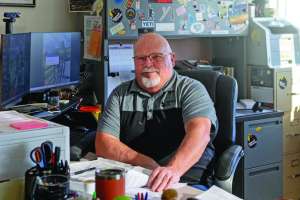
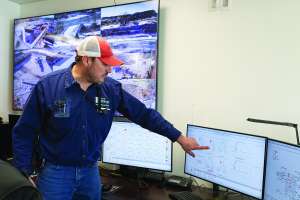
The upgrade meant changes to the plant’s control system as well. The SCADA system was reprogrammed so that the computer screens in the control room are muted, meaning only key operational parameters are highlighted and nonessential details are kept in the background. “It’s less bothersome to the operators,” says Bruce Souder, facility manager. “Only the information beneficial to the operator is shown.”
The project began in March 2017, and the staff had two of the new bioreactors up and running by August of 2019. The entire project was substantially complete by September 2020. Engels and his team proudly point out that the plant began meeting the more stringent limits for nitrogen and phosphorus in the first month after the new permit became effective.
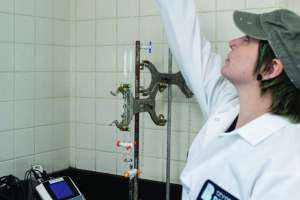
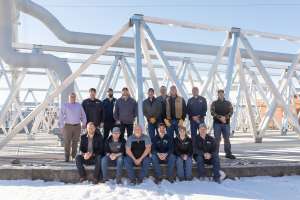
The staff includes 12 in operations and maintenance, two in the plant’s fully certified laboratory, and three electricians shared with the city’s drinking water treatment operation. In addition to Engels and Souder, Mike Hecker is operations supervisor and Shaun Emerick is maintenance supervisor.
They are supported by certified operators Bruce O’Banion, Doug Studiner, Chris Leffler, Curtis Timmons, Scott Thomas, Grant Brewer, Justin Nelson, Clifford Olsen, Brandon Corey, Eric Henry and Tom Darbe.
Harold Wagner, Aaron Poser, Charles Brownlee, Chris Rush and Newell LaBolle are plant maintenance electricians; Ollie Robson and Samm Bauer are laboratory technicians, and Tim Nelson is a building services support specialist.
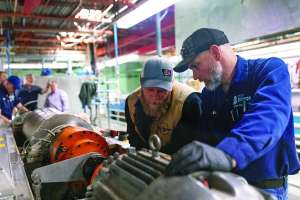
Engels and his management team can’t say enough about the dedication of the staff. “There were long days and a lot of frustrations,” says Hecker. “We were running both the activated sludge system and the new BNR process at the same time. There was constant construction all around us. You had to stay on your toes.”
Souder remembers having only one tank available for aeration: “We had to reduce aerobic capacity from 4 million gallons to 1.6 million gallons. It was barely enough, but it was all we could do.”
A well-thought-out communications plan helped the team overcome many challenges. The staff took part in weekly construction meetings with the contractors. The complicated, but critical sequencing plan was closely reviewed with the design engineer.
But there are always unforeseen developments. “Wastewater is a harsh environment,” says Engels. “Things don’t always work as designed, and sometimes they fail to meet expectations. You might have a pump that doesn’t meet the designed flow, and you have to rethink that. It was not an easy task.”
Emerick adds, “We have such better knowledge of the system now. We know what we can and can’t do. It’s running flawlessly now, and it’s fun to see.”
Engels say the adaption to the new processes by the staff and the successful completion of the project are the proudest moments of his 16-year career in the industry: “During the battle of bringing the plant online, our staff never quit. We met the deadline. We made it work.”
There’s a saying in Billings, the management team points out: “We will win.” That mantra highlights the team’s never-give-up attitude. Engels concludes, “The staff rose to the challenge for the residents of Billings and protection of the Yellowstone River. And we did indeed win.”