Microbes do the real work of wastewater treatment. The right microbes can do the job with optimal efficiency and effectiveness.
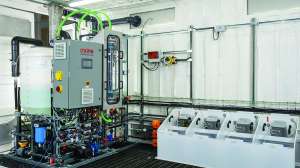
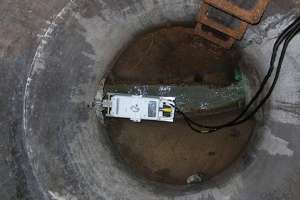
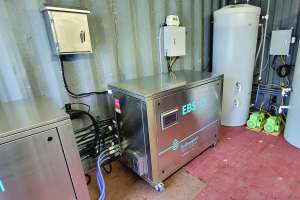
That’s the idea behind the EBS-Di microbial generator offered by EnBiorganic Technologies. The device is deployed in wastewater collection systems to introduce naturally derived active microbiology in formulations to target site-specific organic matter in the wastewater flow.
The company says its bioaugmentation process can enhance wastewater treatment in lagoon systems as well as mechanical treatment facilities. The EBS-Di system includes a compact and durable generator that is compatible with existing infrastructure.
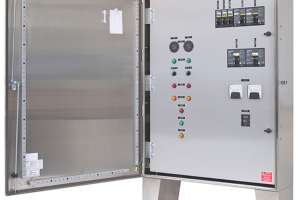
An automated remote monitoring system optimizes treatment by fine-tuning the dispensing of microbiology to match changes in flows and conditions. The microorganisms are derived from soil and are nonpathogenic. They are trained to feed on the actual diet present in the waste stream before release to the treatment environment.
The company says the process reduces odor and degrades FOG in the collection system while reducing organic loadings to the treatment process and lowering energy costs for aeration. Darrell Liski, EnBiorganic CEO, talked about the technology in an interview with Treatment Plant Operator.
TPO: What was the reason for bringing this technology to market?
Liski: In municipal wastewater treatment, whether lagoons or sophisticated treatment processes, the operators sometimes struggle because things happen upstream that are out of their control. They may face major sloughing events or have overflows related to hurricanes or other storm events. If they have the right microbiology in play, their collection systems are clean, making the overall treatment more predictable and resilient with more capacity.
TPO: What makes this technology different from other offerings with similar purposes?
Liski: We are able to generate microbiology on site using an autonomous generator. It produces massive quantities of active-state natural soil Bacillus at a very economical cost. We don’t sell microbes by the pound or by the gallon. We offer a service and charge by results. For example, if a customer wants to desludge a lagoon, the price will be X dollars and will be much more affordable than a bug-by-the-jug or mechanical solution.
TPO: In basic terms, what is different about the microbiology used in this process?
Liski: The bugs that humans defecate on a daily basis are not adapted by nature to accomplish what every mechanical system or facultative lagoon is designed to do. What we do is introduce the right microbiology, derived from the soil. Having the right microbiology increases the capacity of a treatment plant or lagoon and keeps it cleaner. In the collection system it creates a biofilm that is very thin and will not trap materials like rags, wipes and other debris.
TPO: How is the microbiology adapted to specific wastewater streams?
Liski: In our generator we create the ideal environment for the microbes. They are exposed to what their food source will be, and they adapt to it. They multiply, we concentrate them, and then we release them into the waste stream. When they almost run out of nutrients, that’s when we release them. As the wastewater changes, they adapt inside the generator every two hours.
TPO: Can you describe the process flow in this system?
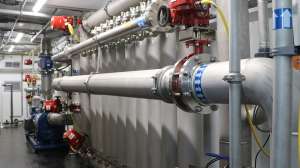
Liski: We draw water directly from the wastewater stream into the EBS-Di generator through an in-hose. Nutrients from the water are used to grow, activate and adapt the Bacillus bacteria in massive quantities. Once grown and adapted, the microbes are dispensed through an out-hose into the water where treatment occurs. The entire process reacts autonomously to ever-changing influent conditions. And our firmware allows us to monitor and remotely control each step of the process.
TPO: How easy is the technology for plant personnel to learn and operate?
Liski: We provide the treatment as a service, so there is very little for operators to learn or to do, other than know what to watch for. For example, if the grinder pump in the wet well rags up, we’ll get a notification and we may ask the operators to pull it out for us. If they prefer not to, we can send a service technician to do that. Otherwise, we service the system on a regular basis to make sure that the tanks are clean inside and that the pumps are functioning.
TPO: Do treatment facilities have the option to purchase and operate the system?
Liski: At present, we do not sell the unit itself. However, that is likely to change in the near future, now that we have the use cases and data showing what our generator can do. We are in discussions with engineers about enabling them to include our product in their specifications for new plant construction or upgrades. So we will have a purchase option, but we will still offer the service.
TPO: How much energy does this technology use?
Liski: It has very low electricity consumption. It requires a 50-amp electrical service to drive the pumps and handle the spikes where all pumps may kick on at the same time. But the draw on a continuous basis is about 15-20 amps on 220-240 volt single-phase service. Typical power consumption is in the range of 80-100 kWh per day.
TPO: What sizes of facilities is this offering best suited for?
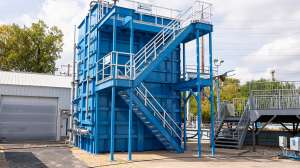
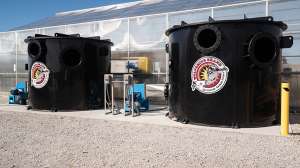
Liski: The technology is not limited in terms of facility size. One EBS-Di unit can easily accommodate a flow of 1 mgd, and we can scale up readily from there. With our small generator and our standard Max tank that sits beside it, we can dispense up to 240,000 pounds of active microbiology, or 30,000 gallons, on a monthly basis.
TPO: Can you give an example of a municipality that has used this system successfully?
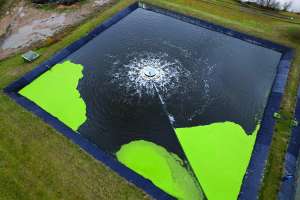
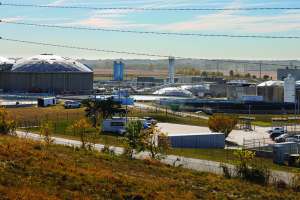
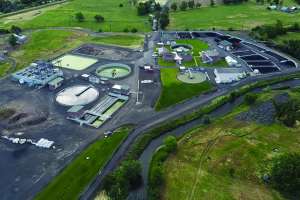
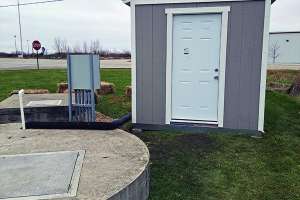
Liski: The wastewater treatment lagoon in North Utica, Illinois, had operational challenges that led to occasional NPDES permit violations. The facility needed to maintain acceptable levels of effluent CBOD, TSS and ammonia. The EBS-Di system was deployed in a 120-day performance demonstration. CBOD stayed below discharge limits, and influent and effluent TSS peaks were reduced, as were effluent ammonia levels. The facility was brought into compliance and saw a reduced need for aeration, saving significant energy.