Phosphorus. PFAS. Biosolids regulations. Monthly reports. Stricter permit limits. Equipment maintenance. Lab testing. Life is complicated for clean-water operators and is only becoming more so.
If you’re watching global trends, you may have noticed that greenhouse gas emissions from clean-water plants are coming under more scrutiny. There are two main culprits. One is the familiar release of methane (biogas) from various steps of solids processing.
The other — less familiar and more challenging — is nitrous oxide, produced in the reactions that biologically remove nitrogen from the wastewater. It appears at three points on the conversion pathway from incoming ammonia to the release of harmless nitrogen gas.
N2O is coming under the microscope because as a greenhouse gas, it is 310 times more potent than carbon dioxide and therefore can account for more than half of a plant’s greenhouse gas emissions, exceeding CO2 and methane combined.
Capturing Methane
Methane is also a significant greenhouse gas, some 80 times more potent than CO2 in trapping heat at the earth’s surface. Methane emissions from sewers can be significant, hard to measure and harder to control. Sources at treatment plants are better defined and easier and less expensive to regulate.
Recent research suggests that the Intergovernmental Panel on Climate Change has underestimated methane emissions from wastewater treatment plants. If results from a 2022 study of 63 large plants are representative, then the sector’s actual emissions across the United States would be about 1.9 times higher than estimates made using IPCC guidelines.
The underestimate would be equivalent to 5.3 million metric tons of carbon dioxide per year, equivalent to annual emissions from about one million cars.
Anaerobic digesters are a major source of methane. If airtight, these vessels enable the capture of biogas to generate heat and electricity, or for flaring. But digesters that are not gas-tight or operate inefficiently can allow substantial methane to escape. Researchers found that plants with anaerobic digesters emitted more than three times as much methane as those without.
On the plus side, methane has a relatively short lifetime in the atmosphere, and so cleaning up those emissions would have a quick and lasting impact toward mitigating climate concerns.
Fugitive N2O
Nitrous oxide is a different issue. The remedy is not to confine and collect it after it forms but to attack the root causes, which are reactions that occur with the help of microorganisms in the aeration basins of activated sludge treatment plants.
Countries like Denmark, Australia and New Zealand are on the leading edge of mitigating and ultimately regulating these emissions. The trick is to optimize the aeration process so that N2O releases are reduced without compromising treatment. South Australia Water has a brief but excellent video on this topic on YouTube, Combatting Greenhouse Gas Emissions from Wastewater Treatment Plants.
The amount of N2O a plant emits depends on how it is designed an operated. In the video, SA Water staff members describe a four-step process for minimizing emissions:
- Develop a mathematical model
- Collect data from full-scale plants to calibrate and validate the model
- Run the model to identify the main causes of emissions and propose mitigation steps
- Implement the mitigations and measure the benefits
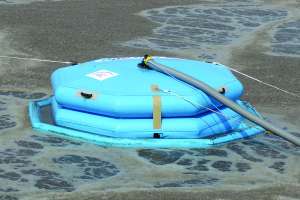
To measure emissions, researchers collected N2O in special floating hoods placed in aeration basins and piped it to a gas analyzer. Using the data collected, they developed an advanced model that accounts for all N2O production pathways.
This model can enable operators to predict the causes of emissions at any place and time as well as identify and tailor methods of control. At one major treatment facility, an operations team used the model to reduce N2O emissions by 30% while improving total nitrogen removal and saving energy.
The technique has potential to inform regulatory policy and equip water utilities around the world to reduce N2O emissions. So maybe when the time comes for your facility to face limits on greenhouse gas releases, you’ll already have a blueprint in hand to do so — and in the bargain make your plant function more cost-effectively.