
Leaders in the southern Iowa city of Osceola grew concerned as persistent drought caused the level to drop in the lake that supplies homes and businesses with water.
West Lake, about three miles from the city, had receded by as much as nine feet. Owners of a floating casino feared it might run aground. Daily water usage at 1.4 mgd was exceeding the safe withdrawal rate of 800,000 to 900,000 gpd. Residents and businesses faced sometimes severe water use restrictions.
But help is on the way. Within a few years, the city’s new $44 million wastewater treatment plant will send about half of its highly treated effluent through a pipeline to the lake, instead of discharging its entire output to White Breast Creek.
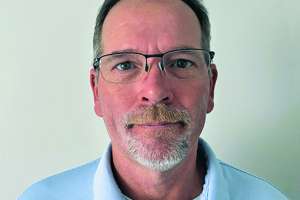
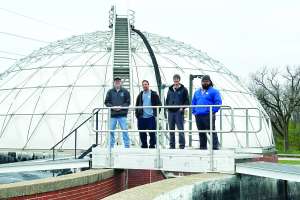
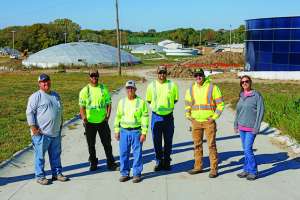
Secondary effluent from the plant will undergo a three-step treatment process in what city leaders say is the state’s first indirect potable water reuse project. Wastewater superintendent Donnie McCuddin and his five team members operate the new plant, which began treating wastewater in mid-July last year.
The original treatment plant was built in 1974. An upgrade completed in 2003 added a new motor control center, biosolids and secondary effluent pumps, and projects to address corrosion of lines and concrete and modernize infrastructure. But two decades later, “The structures and a lot of the equipment were getting worn out again,” McCuddin observes.
The new plant replaces the old facility and essentially doubles treatment capacity. It’s designed to meet current effluent permit limits and to prepare for new limits on nutrient discharges. The plant serves a community of about 5,600, but pretreated effluent from a major pork processing facility and a metal finishing plant make the total influent equivalent to that of a city of 30,000 to 40,000, according to McCuddin.
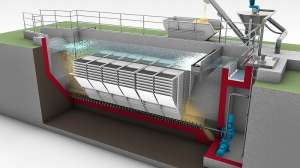
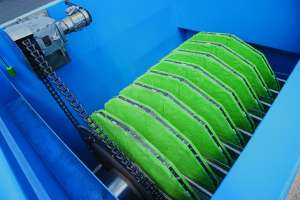
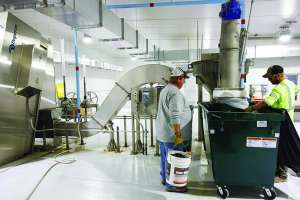
Influent first passes through a FlexRake screen (Duperon) and a PISTA grit system (Smith & Loveless). From there it is pumped uphill to an EcoSieve microscreen (Mitcherson) that replaces clarifiers for primary treatment.
McCudden notes, “It has the same function as a primary clarifier, except it has belts with different mesh sizes. The belts turn and the suspended solids are taken out. Whatever is removed goes through a strain press and to our anaerobic digesters. Right now we’re using a 300-micron screen. Our other microscreen is 168 microns and will take out more solids if we need to. We can switch belts around however we need to, depending on the flow coming in.”
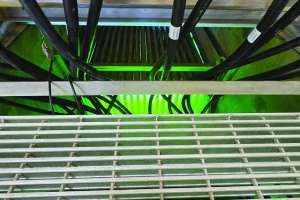
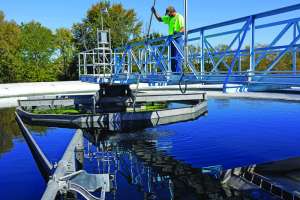
Primary effluent moves on to an OxyStream oxidation ditch (WesTech Engineering) followed by two 82-foot-diameter secondary clarifiers (also WesTech). The flow is then UV disinfected in an open-channel system (WEDECO - a Xylem Brand) with covers, followed by post-aeration before discharge. Some of the effluent is used in place of potable water for washdown and other in-plant purposes, and to fill the city’s jet-vacuum sewer cleaning truck (Sewer Equipment).
Biosolids pass through a disc thickener (HUBER Technology) to increase the solids content to 4-6% for digestion before application on area farms.
Effluent discharge to West Lake (320 acres, maximum depth 28.7 feet) will require advanced treatment, for which the city is seeking approval from the state Department of Natural Resources. The lake is entirely dependent on stormwater runoff and is therefore significantly affected by drought.
“We’re doing a 1,000 gpm, three-step treatment,” says Mark Seip of Veenstra & Kimm, the city’s engineering consulting firm. “We’ll start with dual-media tertiary filters with anthracite and sand (WesTech or equal).” The structure will consist of 316 stainless steel to resist high effluent chlorides from the meat processing plant.
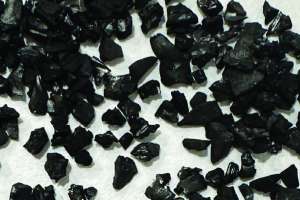
The second step will pump the filtrate through pressure filters with granular activated carbon (Calgon Carbon Corporation or equal) to remove traces of atrazine (a farm herbicide used on crops including corn and soybeans) and other organic compounds.
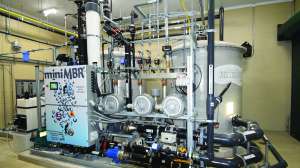
The final step is reverse osmosis (WesTech or equal) to remove the chlorides as well as copper, some of which will also be captured in the activated sludge process. “There will be three 500 gpm RO units,” says Seip. “Our peak RO capacity will be 1,000 gpm, and we will probably run 400 to 500 gpm on average. The permeate will be suitable for pumping to West Lake.”
About half the RO permeate will be blended with secondary effluent to dilute it to within the plant’s permit limit for chlorides. (At present the plant is out of compliance for that parameter.)
During high wet-weather flows, more water from the RO system can be sent to the plant’s three equalization basins (total capacity 35 million gallons) and will be available to boost flow to West Lake if necessary. McCuddin says some of the water may be available to local industries for cooling and other purposes; the pipeline to the lake will pass the city’s industrial park.
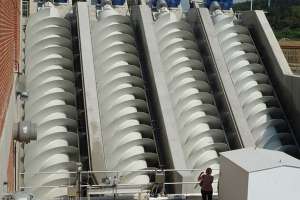
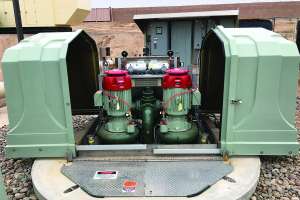
To handle high flows, the plant has two screw pumps (Lakeside) with combined 30 mgd capacity. “From our headworks, anything we can’t handle at the plant will gravity-feed to the screw pumps, which will pump into our three EQ basins,” says McCuddin. “From there it will feed by gravity back to the wet well at the headworks.”
Reject water from the RO system will need to be managed. At first it will be captured in salt cells on the plant site, but that is only a two- to three-year solution. For the long term, “We’re proposing a high-pressure injection well that we would pump 4,500 feet underground into the Mount Simon Aquifer, which lies under the Jordan Aquifer,” Seip says.
“The water in that confined aquifer is not drinkable. We’re working through U.S. EPA Region 7 in Kansas City as the authority on that. We plan initially to drill a test well in early 2025.” Like the indirect potable water reuse, the injection well solution will be a first in Iowa, Seip observes. Both systems are to be completed by 2027.
As for the new plant, team members were trained up on the job with help from equipment vendors and the engineering firm. One big improvement for operations is a SCADA system (Jetco). “We never had that before,” says McCuddin. “It’s a little bit of a challenge getting adjusted to it.”
A computerized maintenance management system (MAPCON) is being loaded with the various equipment and recommended maintenance schedules. Standby diesel generators (Cummins) add assurance that the plant will operate despite utility power outages. A 350 kW unit can power the headworks, the administration building, the digesters and the pump house. An 850 kW unit can run the liquid treatment process. Two other Cummins units are installed at lift stations.
To McCuddin, the challenges of starting up and operating a new plant have been a high point in his professional life. “There’s a lot of learning, a lot of hands-on, and unique events that happen once in a lifetime,” he says. “You figure it out and keep going.”