Standards are very high — very high — at the Urbana & Champaign Sanitary District.
A vendor offering a one-year guarantee on a piece of equipment needs to think again. When team members at this district in east-central Illinois looked to upgrade the pumps on three anaerobic digesters, they expected a lifetime of about 20.
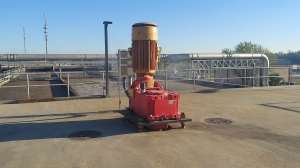
Almost eight years in, the chopper pumps (Landia) installed on the 500,000-gallon digesters are “very dependable, reliable and durable,” according to Justin Profancik, director of operations.
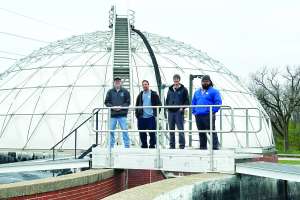
Created more than a century ago by voter petition, the district is an independent municipal body that provides wastewater treatment for the cities of Urbana (population 38,000) and Champaign (90,000), the villages of Bondville and Savoy and the University of Illinois (56,000 students). It employs 50 people including a 10-member operations staff.
The district’s digesters were built separately over the years at the Northeast Treatment Plant which opened in 1924. (The Southwest Treatment Plant opened in 1968.) In 2016, it was time for an upgrade at the Northeast plant, especially since the existing digester pumps were clogging up more or less on a quarterly basis.
“The old units had done a pretty good job, but they weren’t chopper pumps,” Profancik says. “Solids, rags and grit would gradually accumulate, causing them to clog. We had to take them apart and clean them out, so there was a lot more maintenance then compared to now.
“When we’ve inspected the Landia pumps (each 7.8 hp) over the past seven years, there hasn’t been anything of major significance to worry about. On the external knife system, you can change the blades easily. Our maintenance department really likes the design.”
At the Northeast plant, the solids process handles thickened waste activated sludge from both treatment plants, waste activated sludge from industries, high-strength waste from grease-hauling contractors, a small amount of food waste from a Hershey’s chocolate factory truck wash and waste from the University of Illinois food service.
A tank blends these materials with sludge from the primary clarifiers. Chopper pumps serve three of the facility’s four anaerobic digesters. The digested material goes to a storage tank and then to three centrifuges that dewater it to about 20-22% solids. The resulting Class B biosolids cake is applied to farm fields.
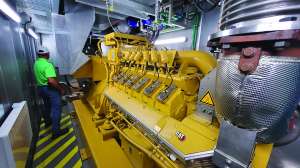
Biogas from the digesters is burned in two engine-generators with a total 440 kW capacity in a combined heat and power system the produces hear for the plant and electricity for export to the utility grid.
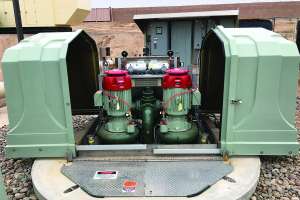
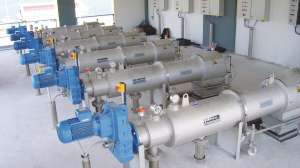
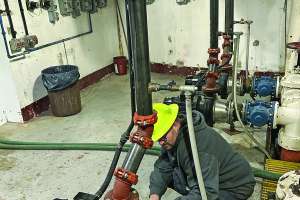
The chopper pumps, in the basement of the anaerobic digestion complex, are part of the heating cycle, working to recirculate solids through heat exchangers to heat the digesters, Profancik says.
“We used to have to clean the heat exchangers out about once per month, but with the new pumps continuously chopping and reducing the particle sizes of the sludge, that is only required about once per quarter. And in those quarters, we usually don’t find anything, even in the small vanes of the heat exchangers. It shows that top-quality pumps play a big part in protecting downstream equipment.”
Since the chopper pumps were installed, biogas production has increased, averaging about 190,000 cubic feet per day and hitting a record high of 400,000 cubic feet per day. Food waste contributes meaningfully: “Although the waste we take in from the Hershey truck wash is less than 1% of our feedstock, we can see the difference in gas production immediately.”
As a frugal entity, the district did its research on the new pumps for its digesters. That included a visit to Landia’s manufacturing facility in Denmark, which came about through the Water Technology Alliance, an outreach program to share water technology solutions between the North American and Danish water sectors.
Wade Lagle, the district’s previous director of operations with more than 40 years’ experience in wastewater treatment, observes, “Seeing where and how the pumps were made gave us very positive reassurance. The quality control and cleanliness of the facility was second to none.
“We could see that the chopper pumps were very well designed and would be a very good fit for our digesters: low on maintenance, highly effective and with a long life. Total cost of ownership is very important to us.”
The design principle of the pumps, invented by Landia in 1950, remains unchanged. A replaceable external cutting system at the inlet prevents it from becoming blocked. Originally created to chop straw in liquid animal manure, the heavy-duty pumps are typically suited for hard-to-handle applications that require moving solids.
Pumping and chopping occur in one function to continuously reduce solids particle sizes in wastewater and digester feedstock. Small objects such as gravel can pass through without causing damage.
“Installation was very straightforward,” Profancik says. “And because the pumps have had no major issues, we’ve not had to make much contact with Landia. But but when we do, they’re always there with help and advice. We’ve had really great success.”