The Glenbard Wastewater Authority has significantly reduced electricity consumption while increasing power production and changing its culture — one project at a time.
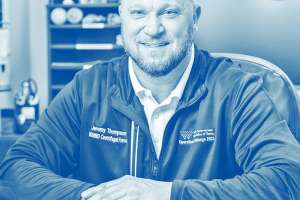
“We’ve developed a culture of energy efficiency,” says Matt Streicher, executive director of the utility, which serves the Illinois villages of Lombard and Glen Ellyn. “For example, we have redundant pumps for everything. If one pump runs a little bit more efficiently, our staff will notice and favor that pump more.”
Since it took part in a Department of Energy ISO 50001 Ready program, the authority established an energy management system to track the rated and actual power usage of every piece of equipment. Every request for proposal for design or construction is evaluated for energy efficiency. “We formed an energy committee, and we keep a lot closer track of what we’re doing,” Streicher says.
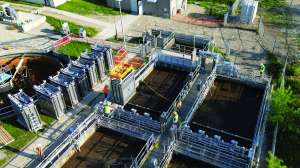
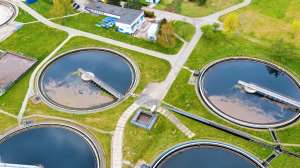
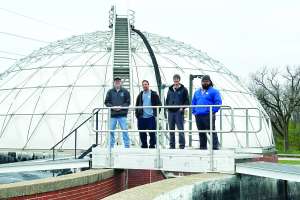
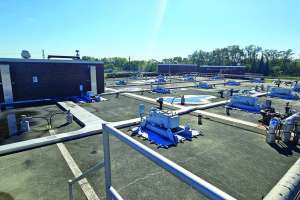
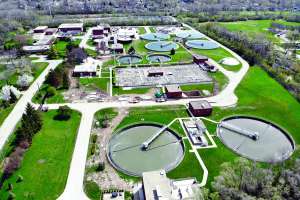
The authority’s Advanced Wastewater Treatment Facility in Glen Ellyn (16 mgd design, 12 mgd average) uses a two-stage high-purity-oxygen activated sludge process. Instead of blowers, it uses liquid oxygen vaporized and mixed into both stages of the activated sludge process in an enclosed aeration basin. The wastewater passes through the oxygenated stage once to remove BOD and again to remove ammonia.
Such treatment systems are relatively rare, Streicher says, but they treat efficiently in a small space. The time to treat the water is relatively short, enabling the plant to perform well in wet-weather events.
“We have a 58 mgd satellite Combined Sewerage Overflow Facility that alleviates conditions here if we really have heavy rains,” says Streicher. “The beauty of our high-purity oxygen process is that it’s a little bit more robust to handle those peaks. We still meet our BOD and ammonia limits easily. The footprint of our basins is small compared to other plants our size.”
Glenbard has gained some of its energy efficiency with big projects, such as installing a combined heat and power system in 2016 with two 375 kW NISSEN generators that run on scrubbed biogas. The authority also co-digests high-strength food waste and FOG from area collectors to increase methane biogas production.
Another big project was the shutdown of a cryogenic plant that produced high-purity liquid oxygen by compressing and cooling air. The system was original to the treatment plant, built in the 1980s. Since 2017, the utility purchased oxygen from Airgas at less than it cost to produce its own.
The cryogenic system produced 32 tons per day of pure oxygen, and there was no way to throttle that back. “When we started hauling in liquid oxygen, we saw that we only needed 9 to 11 tons per day,” Streicher says. “We had been over-oxygenating our mixed liquor.”
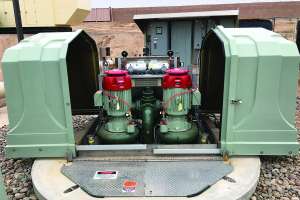
The utility also gained efficiency by fine-tuning operations. For example, team members cut back on some of the pumping required in the two-stage aeration process, letting part of the primary effluent bypass the first stage and flow by gravity directly into the second stage.
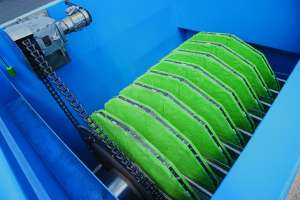
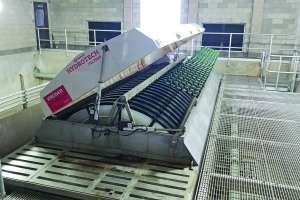
Besides reducing pumping, that enabled better flocculation and settling, which reduced the suspended solids in the secondary clarifier effluent. The Kruger Hydrotech tertiary disc filters (Veolia Water Technologies) then operate more efficiently and need less energy-intensive backwashing.
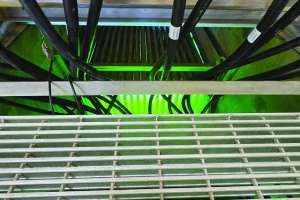
Tweaking of the UV system also yielded some efficiency gains. That Fischer & Porter system (ABB Group) was installed in 1994 and refurbished in 2017. It has four channels, although usually only one is operating. For years the staff opened a second channel anytime the flow exceeded 14 mgd.
“When we refurbished, we found that we could actually run 19 mgd through the first channel, so we wouldn’t have to turn on a second channel with its two banks of UV lights so soon,” Streicher says. “That yielded quite a bit of energy savings during those high-flow events.”
Not all proposed efficiency projects turn out to be worthwhile. For example, the utility considered replacing the UV system with a more efficient one, but found the payback would take too long.
“That was an instance where we looked at the return on investment,” Streicher says. “We weren’t going to achieve enough savings from the greater efficiency. We would have had to modify the hydraulics in our channels to accommodate the new system. Instead, we refurbished the existing system to last another 30 years at a much lower cost.”
On energy-saving projects, the authority shoots for a payback time of eight years or less, but that varies depending on how secure the energy savings will be. Streicher estimates the cost to replace all light fixtures to LEDs would be paid back in three years through power savings.
On the other hand, the combined heat and power system is estimated to pay for itself in eight to 16 years. The system had a shaky start, especially after co-digestion with high-strength food waste, which upset the digesters and degraded biogas quality so much that for a time the generators could not be operated.
“In the past two years, we’ve had probably close to 90% uptime, but in the overall life of the system we’re closer to 45%,” Streicher says. “Co-digestion was a learning curve.”
With all projects, big and small, the authority sometimes achieves net-zero energy. “We’ve hit net-zero, but we don’t consistently hold it,” Streicher says. “We first hit net-zero in October 2019. We kind of teeter in and out of it.”
Amid the culture of energy efficiency, the staff hasn’t lost sight of the authority’s main job. “Our primary role is to treat the wastewater,” says Streicher. “Our mission is to protect the environment for tomorrow. We’re trying to use the resources we have and then optimize our treatment process as best we can. It’s a balance of what we can do and what makes the best use of our ratepayers’ money.”