In the end, it’s not the bugs or the plant machinery that clean wastewater. It’s the people.
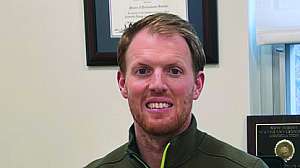
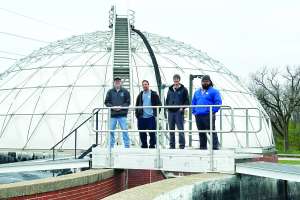
Jeremy Thompson approaches his job with that in mind. As supervisor of the North Texas Municipal Water District’s South Mesquite Creek Regional Wastewater Treatment Plant, he puts top priority on developing his team members’ potential and helping them reach their goals.
Right now, the district is focused on some $290 million in upgrades and expansion at South Mesquite Creek plant to ensure continued high-quality service in the fast-growing area. As each phase wraps up, Thompson concentrates on training his staff on new processes and helping them get the most success and satisfaction from their careers.
“I put a lot of emphasis on training our operators to understand the industry, how important it is, why we have these jobs and what our goals are,” Thompson says. “I want them to understand our discharge permit and why it’s so essential to meet it. We go into depth on understanding our processes.
“We’re always looking for ways to develop people early in their careers, to understand their goals, both short- and long-term, and to provide the resources they need to meet them. We have all kinds of career opportunities here at the district, from engineers to electricians, from operators to mechanics. This is a career where the sky is the limit.”
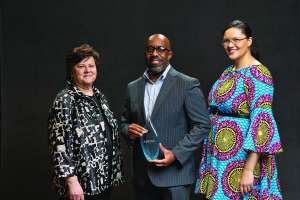
In large part for his work promoting staff advancement, Thompson received the first-ever Bill Tatum Operations Excellence Award from the Water Environment Association of Texas. Tatum, who died in 2023, was a widely respected clean-water professional for more than 50 years and was a project manager with the Trinity River Authority of Texas.
Thompson, a native of Ennis, Texas, started his clean-water career at that city’s wastewater treatment plant, working up in eight years from assistant lab technician to operator, pretreatment coordinator and finally lab technician.
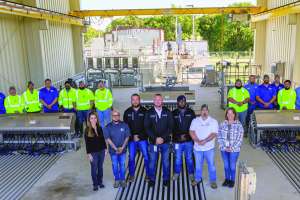
He then joined North Texas district as a senior operator at one of its smaller treatment plants and steadily advanced to larger plants with bigger staffs, taking on increased responsibility. He is now a Supervisor III, the district’s highest supervisor level. The South Mesquite plant (33 mgd design, 23 mgd average, 82.5 mgd peak) has 38 team members and is being expanded to 41 mgd to support growth in the area.
Along the way, Thompson earned his Wastewater Class A license, the state’s highest level. He learned the trade largely through experience, but also with help from mentors and various training classes. “It was learn as you go,” he says. “I plugged myself into different things to become a jack-of-all-trades and an ace of none. I met a lot of people who helped me get to where I am today and enabled the success I now get to share with others.”
His mentors within the district have included Randy Barton, an assistant wastewater manager who taught him about budget discipline and staying focused; and Morgan Dadgostar, regional wastewater systems manager: “She has taught me a lot about how to deal effectively with people in various situations.”
Another mentor, Dan Spradlin, supervisor III, supported his promotions up through the operation ranks and into progressive supervisory roles.
His key team members today include Dadgostar; Sharon Miller, assistant wastewater manager; Erick Green, supervisor of liquids operations; Larry Whitus, supervisor of solids operations; Caeleb Butler, Joshua Pettit and Richard Rose, lead liquids operators; Maurice Keys, dewatering lead operator; and Elvis Gonzalez, maintenance lead.
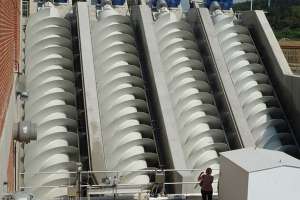
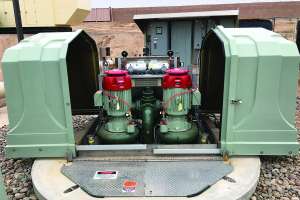
At the South Mesquite plant, influent passes through four perforated-plate fine screen units with Muffin Monster grinders (JWC Environmental). A second headworks building in the expansion project will contain three STEP SCREEN units (HUBER Technology). Screening is followed by a HeadCell grit removal and classification system (Hydro International).
The flow then moves on to three primary clarifiers (a fourth is under construction) and then to the biological processes. Thompson and his team operate two secondary treatment trains, one conventional activated sludge and the other biological nutrient removal.
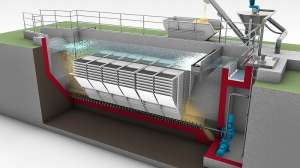
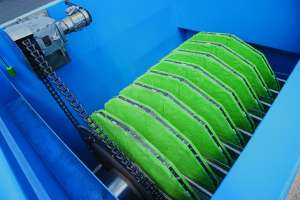
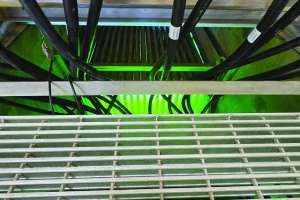
The secondary clarifier effluent from each then flows through 11 Kruger disc filters (Veolia Water Technologies) and UV disinfection (Trojan Technologies). On the solids side, the plant expansion includes three Westfalia centrifuges (GEA Group). Dewatered biosolids at 25% solids or greater are landfilled.
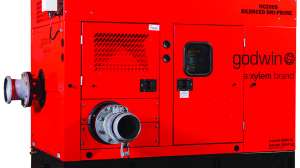
Wet-weather flows are a persistent challenge. “We’re a regional facility serving multiple cities,” says Thompson. “When it rains, I&I from the cities’ collection systems and our own conveyance system can challenge our treatment plant. We’re expanding our capacity because we’re at our peak capacity during some rain events.
“Our operators work diligently through rain events and high flows. We have pushed up the plant capacity while still meeting permit, which is amazing. Our goal is to minimize any spills or overflows and meet our permit.”
Part of the remedy is the addition of a second 7 million-gallon peak-flow basin: “We’re going to have about 10 million gallons of peak storage for I&I treatment.” Another component is working collaboratively with the cities to tighten sewer lines and repair and upgrade manholes.
Thompson enjoys dealing with that and other technical challenges, but in recent years he has taken a deep interest in the human side of the profession. He encourages people at all levels of leadership to take advantages of career development classes the district offers.
At the same time, he realizes that not everyone is interested in moving up the career ladder. “I discovered that everyone doesn’t see the job or the career the same way,” he says. “Some people here don’t want to be a supervisor or a manager.
“They’re perfectly happy being a mechanic, an operator or an electrician, and that’s OK. As long as they’re meeting expectations, that’s perfectly fine — we need people at all levels. Realizing that people have different drives has opened my eyes and changed the way I approach them.”
When recruiting team members, he looks for personal characteristics as well as industry experience and technical qualifications. “It’s about having a good feel for how well someone will mesh with our team,” he says. “I can teach someone how to run centrifuges or presses or pumps, but are they willing to learn? Are they looking for a career? Anyone with a good positive attitude is going to bring a good vibe to the team, and they’re going to flourish. That’s the bottom line.”
Among his greatest rewards is watching people he hired advance from the trainee level through the ranks to take on progressive roles at district facilities or move into leadership at other organizations: “That’s what brings me joy, watching these people grow in their careers.”
More recently, Thompson has focused on helping team members deal with issues that affect their performance: “When people here are doing a good job and suddenly their behavior changes, I’m trying to understand and recognize that. We want to help them whether they’re struggling in their personal or professional lives.”
“We still have a job to do every day, but at the same time, we can show our people some empathy and understand what their needs are. I try to teach that to our other supervisors. We can help people maintain focus on their work and maybe even tailor their work so that they can meet expectations until they get their issues resolved and get back on track.
“It helps everyone’s job go smoother when people see that you’re trying to meet them at least halfway, that you understand whatever they’re struggling with. We’ve had really good successes and great feedback. I’ve had people make a big turnaround and then come to me and say, ‘Man I really appreciate it; thanks for your empathy and support as I was going through XYZ.’
“Our supervisors’ attitudes have changed as well. It helps things work out a whole lot better on both sides of the fence. When we see a change in behavior, we’ll have a one-on-one with the person and say, ‘Hey, what’s going on? If it’s professional, let me know. If it’s personal, I can reach out to HR and get you some assistance.’”
Another team-building venture for Thompson is the annual Operations Challenge — he’s the coach of the district’s Centrifugal Force team, which also includes operators Zachary Jackson, Chris Legg, Butler and Keys.
Last August the team captured first place in four of the five events and first place overall in a regional competition in Ocean City, Maryland. Then it was on to the national competition in October, where they took second place for the third year in a row, finishing first in the lab, maintenance and safety events and third in process. Says Thompson, “I will tell you that sitting on second place for 364 days made us want to go win first place. We were definitely hungry.”
As for winning the inaugural Bill Tatum Award, Thompson says, “I was shocked that I was nominated. It was definitely a great honor. It took a while to sink in. My dad worked with Bill, and I got to know him in the last several years through the Ops Challenge. I would always talk to him at the event.”
As he thinks about the next step in his career, Thompson is busy at home, largely with watching his kids’ sports events: daughter Blakley (12) in volleyball and son Bentley (14) in tennis. He might look to join the district’s upper management ranks: “That would require an associate or bachelor’s degree, which I’m considering pursuing.”
Whatever path he may choose, it’s a sure bet he’ll be helping others excel along the way.