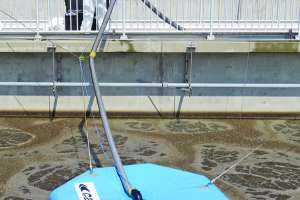
Aeration is a critical component of biological treatment at clean-water facilities. It is also the most energy-intensive process.
Aeration typically accounts for more than 50% of a treatment plant’s total energy consumption. That makes it essential to optimize aeration for cost efficiency and environmental sustainability, which includes limiting greenhouse gas emissions.
Toward those objectives, Carollo Engineers now offers Inflatable Fast and Lightweight Off-gas Analysis Technology (I-FLOAT), a system designed to monitor oxygen transfer and greenhouse gas emissions from aeration basins and support decisions to maximize aeration efficiency.
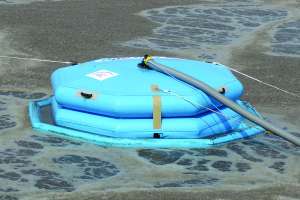
The system includes a self-contained, ballasted hood that enables the rapid deployment of off-gas sampling equipment with minimal disruption to plant operations. After use the hood can be deflated and carried in a compact case for testing across multiple facilities.
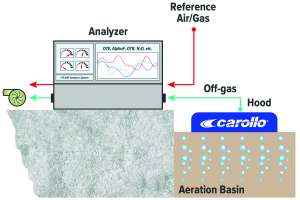
The technology also includes a dedicated, custom-designed data analyzer and streaming connection that allows Carollo’s team to monitor aeration performance and greenhouse gas emissions in real time. Off-gas testing is a method to quantify greenhouse gas emissions directly leaving the aeration tanks (Scope 1).
By accurately measuring gases such as methane and nitrous oxide from aeration tanks, utilities can gain insights to support informed decisions on process tuning, maintenance and introduction of new technologies. Sam Reifsnyder, technology developer and off-gas testing leader, and Malachai Woodiwiss, I-FLOAT designer and fabricator, talked about the technology in an interview with Treatment Plant Operator.
TPO: What is the value of off-gas testing on aeration basins?
Reifsnyder: The main motivation for off-gas testing is for benchmarking the energy efficiency of the aeration step by monitoring the oxygen gas concentration left in the off-gas. This gives an idea how much is being transferred under actual process conditions. A more recent trend is looking into greenhouse gases leaving with the off-gas. Several studies indicate that some emissions of methane can be released from aeration processes, along with nitrous oxide, which is a very potent greenhouse gas.
TPO: Where is the impetus coming from to monitor for greenhouse gases?
Reifsnyder: Some countries in Europe, including Denmark, are considering regulating nitrous oxide emissions from water resource recovery facilities. Others, like the United Kingdom and Switzerland, have been conducting long-term campaigns of monitoring nitrous oxide emissions to gain more insights on the patterns and underlying mechanisms driving their production. In the United States, municipalities are just starting to look into this.
TPO: Are some municipalities and utilities looking to monitor greenhouse gas emissions voluntarily under their sustainability initiatives?
Reifsnyder: Absolutely. We have early adopters here in the U.S, who are ahead of the game and are eager to test and see what they are emitting.
TPO: What differentiates I-FLOAT from methods typically used for off-gas measurement?
Woodiwiss: The words that come to mind are portability and light weight. Those attributes help us perform testing and monitoring faster and more affordably. Our off-gas measuring system is completely portable — both the collection hood and the analyzer kit.
TPO: In basic terms, how is this technology deployed and put to work in the field?
Reifsnyder: When we get to the facility we unpack everything from two cases. We inflate the hood, which is made of material similar to that of a river raft, though not as heavy. One person can deploy the hood and get all the tubing and hosing connected to the analyzer. Then it’s a matter of positioning the hood atop the aeration basin. You start the analyzer and it automatically begins measuring and logging the oxygen, CO2 , nitrous oxide and air flux rate. After use we remove and deflate the hood, clean and dry it, and put it back in the case, ready for more testing.
TPO: How big is the hood?
Reifsnyder: I-FLOAT can cover a large surface area in an aeration basin because of its portability and light weight. Large hoods are ideal as they allow us to collect more off-gas, thus providing a more representative picture of the performance of the overall aeration process. Right now we have two hoods. The larger one is 63 square feet. We have another that has around half that surface area. It’s a little bit more portable and much easier for one person to deploy. Hoods can be made in custom sizes.
TPO: Before this technology became available, how was off-gas typically measured?
Reifsnyder: There was no standard way of building hoods. They were typically built out of plywood, plastic or even metal. These hoods typically require one or more days for pre-assembly on site. Once built they can be quite heavy and may have to be deployed with a lifting crew or a crane. Afterward these hoods are typically abandoned and are not reused. In some cases, the hoods are disassembled and recovered, but that takes additional labor.
TPO: What holds the inflatable, floating hood in place during testing?
Reifsnyder: We need only three connection points. We tie ropes to it and secure them in place. Once the hood is deployed, one of the main features that it is self-ballasting.
TPO: How does the self-ballasting feature work?
Woodiwiss: Because the hood is so light, on its own it wouldn’t make a robust seal against the water. It then would be possible for ambient air to get into the off-gas sample, or for some of the off-gas sample to be lost to the ambient air. To create a reliable seal, we have designed and incorporated a moat around the perimeter of the hood. We take a hose and fill that moat with water. It creates a very effective seal.
TPO: How long is the hood left in place for conducting a test?
Reifsnyder: We can do a sweep test or a continuous test. In a sweep test we deploy the hood in the first zone of a basin for typically 15 to 30 minutes. We may need to do multiple sampling locations in a single zone. The American Society of Civil Engineers standard recommends sampling at least 2% of the area of each zone. Then we move to the next zone. A sweep test gives us a resolution of oxygen transfer efficiency and other parameters spatially across the tank.
TPO: What is involved in a continuous test?
Reifsnyder: For a continuous test, we position the hood in one place, leave it there and log over time the dynamic and temporal variations associated with the oxygen transfer efficiency and the other metrics that we monitor. All those metrics are dynamic and change with the load coming into the treatment plant. The hood could be deployed for seven days or longer, even for months, depending on client requirements. During that time, we may have to do some maintenance and some periodic calibration of the gas sensors.
TPO: What is an example of an application where this technology performed successfully?
Reifsnyder: On a consulting project with Metro Water Recovery in Denver, our team tied in with an aeration assessment at their Northern Treatment Plant. As part of that, we did an off-gas test to assess their aeration efficiency. We demonstrated that there were no significant issues associated with their system and that it was performing up to standards.
TPO: Can you give an example of a practical case where this technology could help support sound decision-making for a plant team?
Reifsnyder: After installation of a new diffuser system, oxygen transfer degrades over time because of fouling by contaminants layering on the diffusers. Using I-FLOAT we can determine for example that oxygen transfer efficiency has decreased by X percent. We can develop a curve showing how much in energy consumption a utility is spending. They can use that data to define the break-even point for taking a tank offline to service the diffusers and so recoup part of the oxygen transfer efficiency that has been lost.
TPO: How was this technology proven reliable and effective before its release?
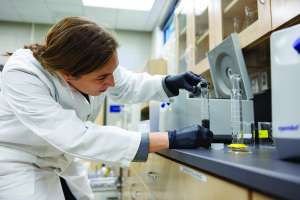
Reifsnyder: We performed extensive preliminary testing before we started running it with our clients. For this technology we worked with one of our partnering clients who allowed us to test our innovation on site. We also tested it at our Water Applied Research Center (Water ARC), which is our in-house facility for laboratory-based bench treatability testing and full-service support for field, pilot and demonstration studies. It also supports equipment testing, staff and operator training, troubleshooting and quality control review. Without the team at Water ARC, I-FLOAT would not have been possible.