Seacoast Utility Authority was using belt presses to dewater biosolids to 13-15% solids and hauling it to a facility to be composted for agricultural use.
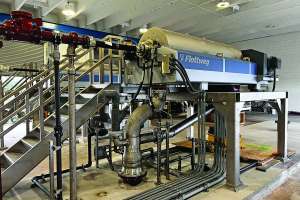
A challenge came when the composting facility converted to pelletizing the biosolids. For optimal performance that process required cake at 20% solids. The authority then was faced with finding a dewatering technology that could reach the required cake dryness in a footprint the same size as or smaller than the belt presses. After a careful evaluation of alternatives, the authority chose a decanter centrifuge manufactured by Flottweg.
Seacoast Utility Authority is a wastewater and reclaimed water utility that furnishes potable water to 47,000 households and 2,700 commercial establishments in a 65-square-mile service area in Palm Beach, Florida. To select a dewatering method, the authority ran pilot tests with screw and rotary presses, which did not meet the performance requirements. The team then tested centrifuge decanters from several manufacturers to compare features and performance.
Ultimately the authority team selected Flottweg C-series centrifuges, which could dry biosolids to several percentage points higher than the 20% requirement. Because the machines’ maximum solids content level was too dry for the pelletizing company, control adjustments were easily made to consistently achieve 20% solids.
Flottweg engineering staff worked closely with a third-party engineering firm to make sure the transition from belt presses to centrifuges and installation and startup went smoothly.
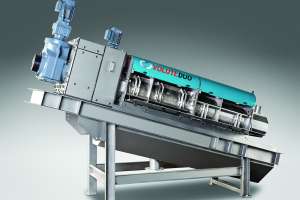
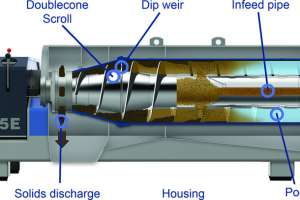
C-series centrifuges are designed to deliver high dewatering performance with low energy consumption. During the process, solids are thrown to the inner wall of the centrifuge bowl by G-force created from acceleration. The material is discharged by way of a scroll through the conical section of the bowl, and the clear water (centrate) is discharged at the opposite end.
The C-series decanter’s scroll has a double cone and a baffle plate. The double cone reduces the distance between the decanter bowl and the scroll and presses the solids against the baffle plate. This increases the dryness and separates the solids discharge end from the centrate, creating a deeper pond inside the bowl.
The deeper pond enables lower energy consumption, greater capacity, and longer residence time for the solids to separate from the free water. A specially designed scroll maximizes cake solids content, and a seemingly small increase can mean significant savings.
For example, a solids content increased from 23% to 25% means an 8% reduction in cake volume. That in turn reduces transport and disposal costs by 8%. The C-series centrifuges include a Simp Drive feature that allows the bowl speed and the scroll differential speed to be controlled independently. This ensures constant cake dryness under varying feed conditions.
Automation enables the centrifuges to operate continuously with minimal attention from authority staff. Bowl and differential speeds can be automatically controlled with the Simp Drive. Flocculant dosing can also be automated; polymer demand is monitored in real time to optimize consumption.
Multiple remote monitoring and service options are available. Centrifuge control can be integrated with the treatment plant control system for efficiency and operational safety.
The C-series centrifuges are designed for easy maintenance access. The bowl and scroll can be quickly removed and reassembled, minimizing downtime. Worn parts can be easily replaced on site. In addition, the centrifuges have a comprehensive wear protection package. The inlet and outlet openings are engineered against wear, and all components in contact with the biosolids are made of stainless steel, extending service life.
For the past several years the Seacoast Utility Authority has operated its centrifuges and conveyor system three days per week, 24 hours per day, with minimal maintenance. The machines have consistently produced material meeting pelletizing company requirements.
The authority has reduced maintenance time and expense and saved money by reducing hauling costs. Previously, about 15 truckloads per week were taken to the composting site. Now, seven to eight loads are hauled for pelletizing. The centrifuges are enclosed systems, enabling clean and safe conditions within the building.
John Yatcilla (jyatcilla@flottweg.net) is environmental industry manager for Flottweg Separation Technology.