If there’s a technique for saving or making power at a wastewater treatment plant, chances are good that it has been adopted or at least tried in Essex Junction.
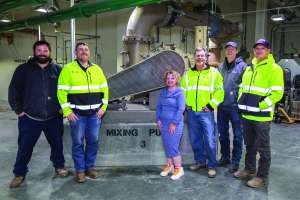
That’s one reason the city’s wastewater treatment facility received a 2021 Energy Leadership Award from Efficiency Vermont, an organization that helps state residents and businesses save energy.
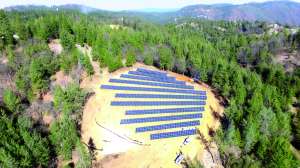
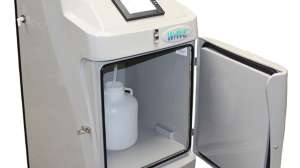
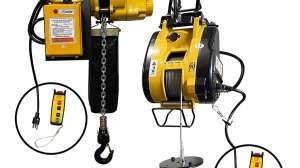
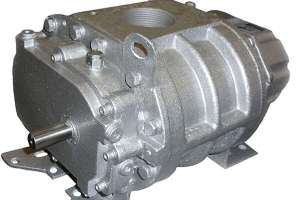
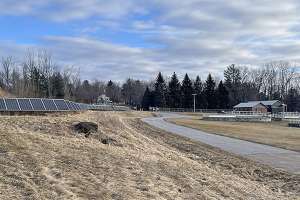
The treatment plant has a 150 kW solar array on site, harvests methane from its anaerobic digesters, and burns it in a 150 kW electric generator (2G). Solar energy and cogeneration fulfill about 58% of the facility’s power demand. Numerous smaller projects include:
These projects, part of an $15.3 million upgrade, have helped the plant reduce overall power consumption even while adding processes for nutrient reduction.
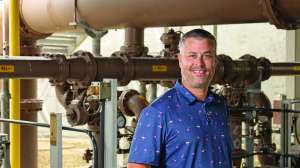
Chelsea Mandigo, water quality superintendent, says efforts to reduce power consumption continue and believes the plant now generates more than 58% of its power on site: “That was a 2018 number. I’d like to say we’ve moved the needle by a couple percent since then.”
The latest power-saving project is taking part in a Green Mountain Power program to reduce demand from high users during peak windows — times when grid-wide demand is expected to be high. The treatment facility can temporarily shut down certain processes during peak windows in return for incentives from the utility.
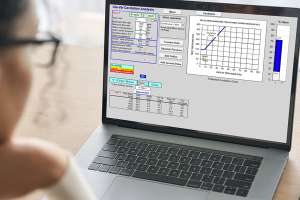
The plant usually receives a day’s notice to curtail demand; the shutdown strategy is programmed into the SCADA system and can be modified as needed. Essex Junction was the first treatment facility in the state to take part; it has gone well enough so that other plants are considering participation.
“What makes us successful with that program is our cogeneration system,” Mandigo says. “These events are typically at night when everyone is home using power. We take our cogen system off for the day to store as much gas as possible. Then at night when that peak window comes, we run the cogen system at the full output. We almost hit net zero when that happens.”
While reducing power consumption, the plant team added treatment steps to reduce nutrients in the effluent. “We added biological phosphorus removal, because in Vermont, at least on this side of the state, reducing phosphorus discharges to Lake Champlain is a major goal,” Mandigo says.
Essex Junction is just outside Burlington. The treatment plant (3.3 mgd design, 2 mgd average) has an activated sludge process with chlorine disinfection before discharge to the Winooski River, a Lake Champlain tributary. Biosolids are land applied; liquids go to a farm field and dewatered cake is shipped to a facility in upstate New York.
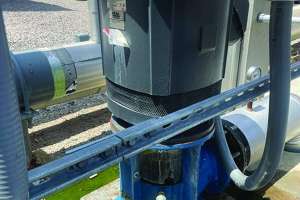
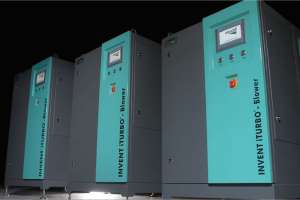
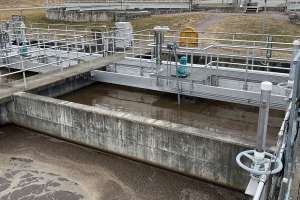
Biological phosphorus removal involved creating an anoxic zone with low-power mixers (INVENT) that operate slowly, limiting aeration while keeping solids suspended.
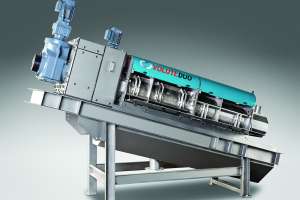
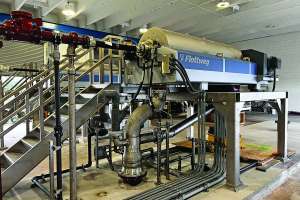
The plant upgrade also added a centrifuge (Alfa Laval) for biosolids dewatering. Centrate from the centrifuge can be piped back to the front of the treatment process, but it is rich in nutrients. The plant is pilot-testing a process for harvesting nutrients from the centrate.
“We’ve found that we cannot recycle that centrate in the quantity we produce it, because it’s too strong,” Mandigo says. “It kills our bugs. We have to net meter it back in over a week’s time.” The PePhlo nutrient harvesting process, developed by the University of Vermont and supported by a state Phosphorus Innovation Challenge grant, involves adding magnesium to the centrate and then applying an electrical charge to the centrate pipe.
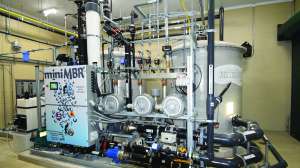
The electric charge causes struvite (magnesium ammonium phosphate) to form, and the struvite crystals are collected on membranes (Kubota). The struvite can be used in fertilizers, and the centrate then contains less phosphorus and ammonia.
“Our goal is to treat our centrate so it doesn’t have to be net metered and become our limiting factor, because right now, it only allows us to do one trailer a week,” Mandigo says. “That’s fine since we still have a land application program, but if that goes away with the PFAS regulations that are only a matter of time, we won’t be able to keep up with our solids management.”
Early indications are that the project is working. “The question is: Can we treat the sidestream from dewatering and get the phosphorus out of there?” Mandigo says. “We’re in the pilot stage, but tests found 85% to in some cases 90% removal from that sidestream.”
If the process scales up successfully, it will represent another in the long list of efficiencies applied in Essex Junction.