A dozen years ago, the Iowa city of Council Bluffs needed more water treatment capacity to accommodate industrial and commercial growth.
Instead of expanding its 20 mgd conventional treatment plant or building a similar new plant in another location, the Council Bluffs Water Works chose a membrane treatment technology using ultrafiltration and reverse osmosis.
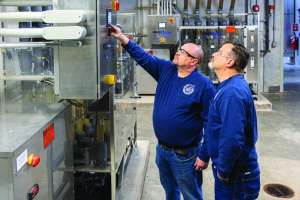
The result is the newly expanded 10 mgd Council Point Water Treatment Plant on the city’s southern edge. It includes such a high level of automation that staff members can monitor and operate it remotely from the Narrows Water Treatment Plant. Operators visit the newer facility for just a few hours each day to run laboratory tests, top off chemical feeds and perform routine checks of the equipment and process.
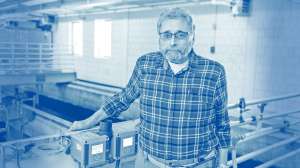
“We’re very happy with that water plant,” says Brian Cady, water works CEO and general manager. “It has performed very consistently, and it is easy for the operators to understand.” The facility received a pair of 2023 awards: the Grand Award for Engineering Excellence from the American Council of Engineering Companies of Iowa, and a National Recognition Award from the American Council of Engineering Companies.
The Council Bluffs Water Works serves its home city of 62,000 and delivers water wholesale to a rural utility and the city of Crescent (population 650). The utility draws source water from the Missouri River and the Missouri River Alluvium, a major sand aquifer.
In the early 2010s the utility faced growth in demand that it could not meet with the 1952 Council Bluffs Narrows plant, which treats mainly river water with coagulation, sedimentation and lime softening. At the same time, the distribution system could not handle growth in the southern part of the service area.
Engineering studies showed that the most cost-effective solution was to tap the aquifer with a new wellfield and build a new 5 mgd treatment plant. The water works team, the HDR engineering firm and the former GE Water and Process Technologies (since absorbed by Veolia Water Technologies and Solutions) worked together to strengthen the water system and to design and build the Council Point plant.
The building was constructed to enable easy expansion to 10 mgd. That project was completed in 2022, and the plant now produces about 3.7 mgd on average. (The two water plants combined produce about 11 mgd.) The Council Point plant site and wellfield can accommodate further expansion to 20 mgd.
A key challenge in design of the plant was the quality of the groundwater, which is high in iron (up to 7 mg/L), manganese (up to 1 mg/L) and hardness (about 300 mg/L). Today the plant provides a second water source for the community and improves water supply redundancy and reliability. It also helps cut transmission main costs for servicing the city’s growth areas.
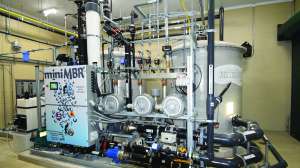
The GE Water technology was chosen after a pilot test against a competing vendor’s system. Membrane treatment isn’t new to the industry, but the process at Council Point is unique in using low-pressure and high-pressure membranes in sequence.
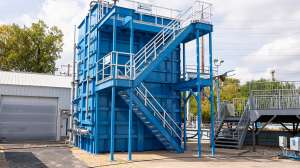
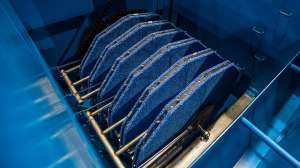
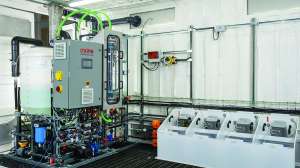
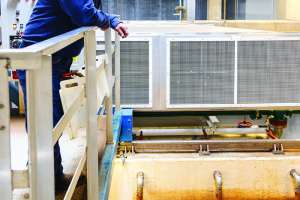
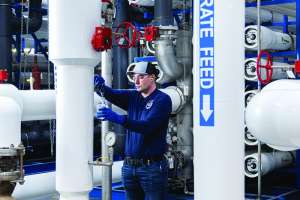
Well water first passes through a strainer (Eaton Filtration) and then through draft aerators (Siemens, now Evoqua Water Technologies) where iron is oxidized and sodium permanganate is added to oxidize manganese. The low-pressure ZeeWeed UF membrane system (Veolia) with five treatment trains and 1,600 total modules removes the oxidized iron and manganese particles. Waste from this system is sent to a plate settler (Parkson Corporation). Most treated water is then returned to the head of the plant.
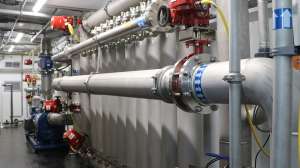
A portion of the UF filtrate is delivered to six RO membrane trains with 1,296 modules (also Veolia) to remove hardness and dissolved solids. The resulting reject water is discharged to the Missouri River. The RO permeate water is blended with UF filtrate to achieve the desired hardness in the finished water. The water is then treated with sodium hydroxide to adjust the pH to 7.5, dosed with fluoride, and disinfected with sodium hypochlorite produced on site (Cleanwater1).
Some mixing of water from the two plants occurs inside the interconnected distribution network and in the water towers and reservoirs that comprise 9 million gallons of system storage. An iFIX SCADA system (GE Digital) provides monitoring and control of the distribution system pumps, tanks and both treatment plants from the Narrows facility.
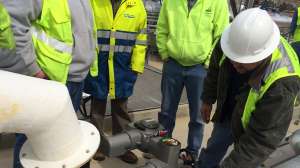
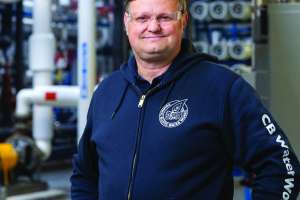
Membrane technology was new to the Council Bluffs operation and maintenance staff, most of whom had more than 10 years of experience when the new plant’s first phase was built. Tim Parker, purification manager, who has been with Council Bluffs since 2004, says extensive and timely training helped prepare the team.
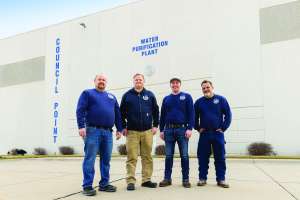
Staff members in addition to Cady and Parker include Rodney Scott, purification coordinator; Ian Cassidy, lab technician; plant operators Chase Reed, Dean Redinbaugh, Joshua Hannan, Chris Anderson and Noah Gilliam; Robert Sekera, maintenance manager; Tate Brandon, maintenance coordinator; Cody Neighbors, equipment mechanic; and Shane Ruckman, facilities and grounds foreman.
“There was a lot of training involved because it was a totally different process,” Parker says. “The engineers set up a training program where all the operators went through the facility and gained an understanding of how each process worked.” That included training in the clean-in-place procedures for the UF and RO membrane modules.
“GE Water sent a trainer who worked with us for about a week and really got into the nuts and bolts of everything,” says Parker. “Once we were all trained up, we had to change our staffing around. We had to add a relief operator to make everything work.”
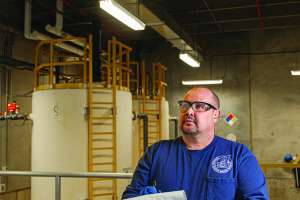
The Narrows plant is staffed around the clock, seven days per week; operators work 12-hour shifts on variable days of the week. The additional staffing freed operators to make their daily visits to the Council Point plant. Cross-training ensures that all six operators are familiar with both plants.
On any given day, the Narrows plant is staffed by one operator on each 12-hour shift and a relief operator who works from 7 a.m. to 3 p.m. It’s usually the relief operator who makes the daily visits to Council Point.
Staff members monitor the membrane plant from the Narrows facility around the clock by way of the SCADA system. “It helps there’s a lot of computer programming in the membrane plant,” Cady says.
As water goes through the plant it is tracked by level indicators, flowmeters and other instrumentation. Well output ramps up or down automatically to meet demand or to accommodate backwash cycles. “The automation controls multiple functions, and we monitor to make sure all the parameters look right,” Cady says.
Parker adds, “The SCADA system shows the layout of the whole plant so we can easily monitor everything — the flows, the transmembrane pressures for the UF and RO. We can remotely adjust the blend and change the hardness.
“We get alarms if something is not right with the membranes. The chemical feeds are trended so we can monitor to make sure the chemicals are feeding as they should. We monitor the pH, the turbidities, and conductivity going into and out of the RO.” Finished water typically measures about 0.04 NTU turbidity and 160 mg/L hardness.
Cady and Parker agree that the operations and maintenance teams adapted well to the new facility, despite the major change in treatment technology. “It wasn’t that difficult, really,” says Parker. “It was a steep learning curve, but it really just became part of the routine, like any other change that happens.”
All in all, the membrane plant has been a rewarding experience for the Council Bluffs Water Works team and a solid investment for the future of Council Bluffs.