Efficient dewatering of sludges and biosolids matters a great deal. Materials at the optimum dryness can significantly reduce hauling costs for recycling or landfilling and can enable peak performance in a further drying processes.
But not all sludges are created equal. Some contain high concentrations of fibrous, inorganic or adhesive material that when dewatered yield a hard and compacted product.
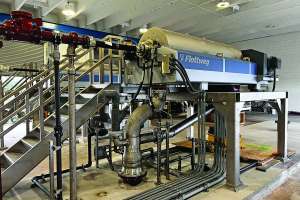
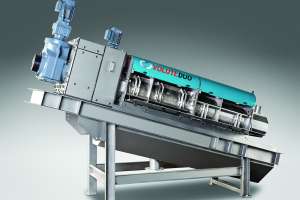
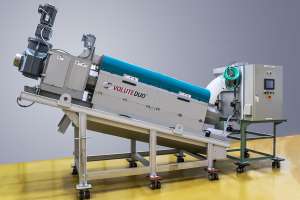
To solve that problem, Process Water Technologies (PWTech) last year introduced the Volute Duo dewatering press to the North American market. Based on the company’s Volute screw press technology, it is designed to prevent solids binding and to maximize solids dryness.
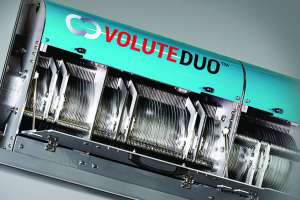
The Volute machine has a dewatering drum that surrounds the screw with a casing made of a series of fixed and moving rings that keep the fine gaps where water is released from blinding with solids.
To deal with difficult sludges, the Volute Duo uses twin counter-rotating screws in a single drum to break up and move material for dewatering. In a design similar to the original Volute, a series of fixed and moving plates create a nonblinding screen.
The rings are pulled up by a cam shaft system to create an opening between the moving ring and fixed ring to allow filtrate to escape. Chris Hubbard, business development and regional sales manager with PWTech, talked about the Volute Duo press in an interview with Treatment Plant Operator.
TPO: What was the motivation for introducing this technology to North America?
Hubbard: Treatment plants need a better way to handle sludges that dewater to a hard material, including many industrial sludges and lime, alum, or ferric sludge from water treatment plants. Screw presses can dewater this material, but the cake would become too firm or dry and bind around the screw or plug the press and overload it. The Volute Duo enables a screw press to dewater cake to its full potential without clogging the machine.
TPO: What advantages does this press have over other methods for dewatering difficult materials?
Hubbard: Many of these sludges are dewatered in batch processes that are very labor and maintenance intensive. They fill a machine, press the material, shovel or scrape it out, put it in a barrel, and send it on its way. The Volute Duo dewaters those materials in a continuous process that does not require operator labor or supervision.
TPO: Why are materials like wastewater treatment primary sludge and water treatment lime sludge difficult to handle?
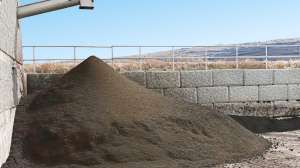
Hubbard: They can be very fibrous, and they can very easily give up the water — in a screw press they can be dewatered to 30% to 60% and even 70% cake solids. The problem is that when the cake gets that dry, a standard screw press and even our Volute press has difficulty pushing the hardened cake out the end of the press.
TPO: How does the Volute Duo press deal with these challenging sludges?
Hubbard: Instead of a single conveying screw running through the center of the cylinder, it has two interwoven scrolls in barrel with a configuration similar to a figure eight. The two scrolls create a cutting action to break up solids that would bind up a single screw.
TPO: What percent solids can this press typically achieve?
Hubbard: That depends on the material, but for sludges we would target with the Volute Duo, I would say a low end of 25% and a high end of mid-60s. For pure primary sludge, cake solids typically would be in the mid-40s; for lime sludge the mid- to high 40s.
TPO: What is the volume capacity of the machine?
Hubbard: Depending on the sludge consistency, it can dewater up to about 2 tons of dry solids per hour.
TPO: Is there a way to increase the capacity?
Hubbard: The original Volute press can accommodate two or more drums in a single frame. That enables an extremely high-capacity dewatering systems in a small footprint. Another advantage is that it provides built-in redundancy so that if a customer were to lose one rotating assembly because of a motor failure or some other event, the other assemblies would keep on running. Units can be built with space to add more dewatering drums in the future.
TPO: What is involved in day-to-day operation of the press?
Hubbard: Operation is very simple. The sludge and polymer are fed into an atmospheric tank that can be covered or not. It is very easy to open the cover for inspection to verify that a good sludge and polymer mixture with good flocculation is forming. The machine then handles the process automatically. It monitors the torque and watches the flow rate. Depending on the level of instrumentation the customer desires, it can also automatically monitor the feed solids and cake solids levels. Power consumption is extremely low at up to 95% less than for other dewatering technologies.
TPO: What maintenance does the press require?
Hubbard: It needs very little maintenance. There are no internal wipers, brushes or seals and no high-pressure water. We recommend a daily visual inspection as the press is being started up for the day. Depending on the complexity of the system, monthly or quarterly calibration and alarm testing may be advisable. And there is a cassette of rings that may need to be replaced somewhere between 20,000 to 25,000 hours of operation. The design actually eliminates a wear area when handling very dry material. It’s at the interface between the moving rings and the scroll near the discharge end where the cake is the driest. Very abrasive sludges can be aggressive on the scroll. That issue has been eliminated.
TPO: How well does this device fit the spaces inside treatment facilities?
Hubbard: It has a very compact footprint. The original Volute press has roughly half to two-thirds the footprint of other screw presses. The Volute Duo, for the same throughout, has on the order of three-quarters the size footprint of a Volute press, and so it is worth considering in applications where users need high capacity in a tight space.
TPO: What was done to prove out this technology?
Hubbard: The technology is owned by Amcon Japan, and PWTech is the exclusive distributor in the United States and Canada. Machines have been in operation for several years throughout Asia and Europe, where there are quite a number of installations operating with manure and with sludge from wineries, breweries and other industrial facilities.
TPO: How can prospective users explore how the technology might suit their operations?
Hubbard: We have a trailer-mounted pilot unit with capacity from 5 to 25 gpm. We can set up the trailer outside a building, or easily unbolt the skid for indoor applications.