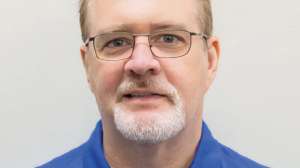
When Mark Hierholzer joined the United States Air Force he had no thought of becoming a wastewater operator.
“In 1984, I started college and I didn’t really know what I wanted,” he recalls. “I was going to burn up some money if I couldn’t sort out what degree I wanted. So I thought, ‘I’ll go ahead and join the Air Force. Maybe they can help me make up my mind or postpone the decision.’”
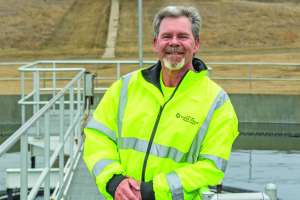
As it turned out, the Air Force put Hierholzer on a career path that had nothing to do with flying, but it all worked out for the best: Today, he is operations manager for the Sioux Falls (South Dakota) Water Reclamation Facility.
Last year he received the William D. Hatfield Award from the South Dakota Water Environment Association. “I knew I was being put in for a longevity award, but this award was the first one they read that night,” says Hierholzer. “My name got mentioned and my heart stopped. I was completely surprised and emotionally moved, in a very good way.”
Hierholzer was born in Oxnard, California, in 1964. His father Frederick Hierholzer was involved in the aerospace business, and “worked on a lot of top-secret stuff,” he recalls.
“My dad would go out on the ship that tracked ballistic missiles launched from Vandenberg Air Force Base and make sure the trajectory and where the warhead landed was on point in the South Pacific.” The family lived at the base until Hierholzer was five years old, at which point they moved to Lompoc, California, just east of Vandenberg.
Hierholzer attended Lompoc Senior High School and spent his spare time with his buddies at the beach. “One of my buddies had a dune buggy, and we would take off and go ride that to the sand dunes whenever we had a chance,” he says. “I was a typical Southern California high school student, just going through school and not sure what I was going to do.”
It was after he left Alan Handcock College in Santa Maria, California, and joined the Air Force that he encountered wastewater treatment. “Usually when you think about the Air Force, you think jet bombers,” he says. “But they also have a public works department called a Civil Engineering Squadron, and it does the same thing that public works does for municipalities.
“They have to maintain the streets, the electrical systems, the water systems, utility systems, everything. When I went to the processing center, they looked at my school transcripts, and said, ‘Oh, you like chemistry and physics and science. Do you want to work inside or outside?’
He replied: A little bit of both. “Their computer analyzed my answers and then put me in a career field called environmental technician with a job description that basically said something about helping ensure that Air Force installations comply with water and environmental regulations through potable and nonpotable water treatment processes.”
With his assignment Hierholzer attended an Air Force technical school with courses designed by Texas A&M University: “It was a really good school that went into water and wastewater treatment.” After graduating, he was first assigned to water and wastewater treatment at Blytheville Air Force Base in Arkansas, followed by a stint in the Azores Islands.
“I was a sergeant at that time, and I was responsible for replacing all the old wells,” he recalls. “We got to the point where we could replace a 200-foot well in one day.” He then ended up at Tyndall Air Force Base in Florida, first as a staff sergeant, crew leader and superintendent of the water/wastewater systems during Desert Storm.
“And then in 1992, the Air Force decided that the environmental compliance regulations were getting too much for the military to handle, so they outsourced it to the civilian communities and my job pretty much went away,” Hierholzer says.
That led to a civilian job at the West Sacramento Wastewater treatment plant as a senior wastewater operator. “It was a conventional activated sludge plant, and we reconfigured it to a biological nutrient removal process, one of the first in California.”
Then it was on to the University of California, Davis, as lead wastewater operator of the campus oxidation ditch plant, followed by a stint in the private sector at the university’s Hydro Science Membrane Bioreactor Plant as operations supervisor.
Hierholzer later became chief plant operator and then superintendent at the city of Woodland (California) Water Pollution Control Facility. He left California in 2010 to join the Sioux Falls Water Reclamation Facility.
Hierholzer started there as operations supervisor and then moved up to operations manager at the city’s 1980s vintage plant, which started at 13 mgd design flow and was expanded to 21 mgd.
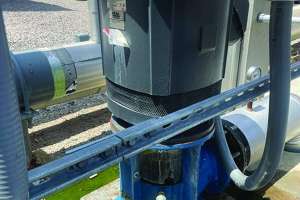
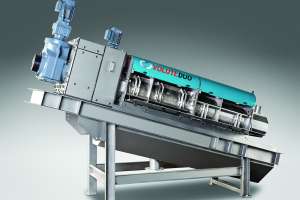
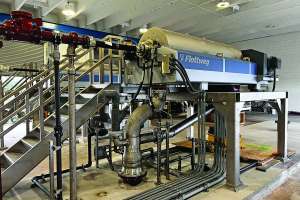
The headworks is equipped with three 13.5 mgd rotary drum bar screens (HUBER Technology), four circular primary settling tanks with Penn Valley double-disc sludge pumps, and two gravity thickeners, also with Penn Valley double-disc pumps. Four 830,000-gallon anaerobic digesters use Hayward Gordon pumps for mixing and Alfa Laval spiral heat exchangers for temperature control.
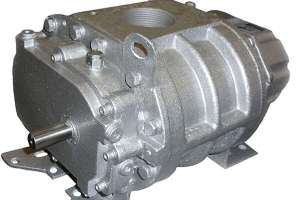
The plant operates two 800 kW total capacity Caterpillar engine-generators for cogeneration fueled with biogas. The gas is pumped into a storage sphere by way of a compressor (Unison) with of 450,000-
cubic-feet-per-day capacity. The generators deliver about 12,300 kWh per day.
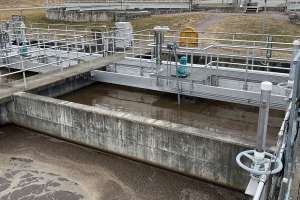
“Primary effluent goes through four first-stage trickling filters and then first-stage intermediate clarifiers,” says Hierholzer. “It then continues to four second-stage trickling filters and on to the second-stage intermediate clarifiers.
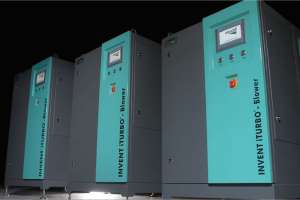
“The flow is next pumped into six aeration basins with coarse-bubble diffusers. These basins are being expanded to a total of nine, with fine-bubble diffusers (Sanitaire, a Xylem brand). The air is provided by four 800 hp centrifugal blowers, which will be replaced by seven Aerzen AT-400 turbo blowers of about 400 hp each.”
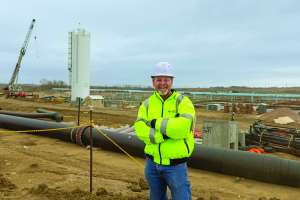
The blower replacement is part of a plant expansion and overhaul that began in 2022, and that Hierholzer is leading. “Around 2014-15, I noticed that we were hitting capacity limits and that we were starting to roll through all the reserve capacities we had,” he says.
“So we did a master plan: It took us about a year and a half to do growth projections in Sioux Falls for the next 20 to 30 years. In 2018 we went out for bid on a contract to expand the plant. We worked out the details and broke ground in 2022 with a completion date of 2025.
“We found that we needed 30 mgd and about 66,000 pounds of BOD treatment per day to make this plant serviceable to about 2035 to 2040,” Hierholzer says. “We are also expanding from four to eight final clarifiers served by cross collectors (WesTech Engineering).”
The final clarifier effluent flows to eight anthracite filters. Disinfection is provided by 12.5% sodium hypochlorite; dechlorination is with sodium bisulfite. The chemical storage building will be fully upgraded in 2024-25 to house five 5,000-gallon sodium hypochlorite storage tanks and two 5,000-gallon sodium bisulfite tanks.
Finally, the chlorine contact chamber is being expanded with two additional channels on each side of the contact chamber, to comply with the state standards for the capacity expansion.
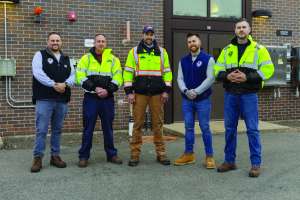
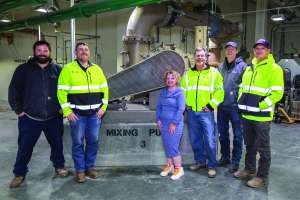
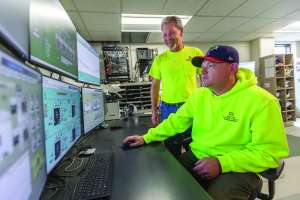
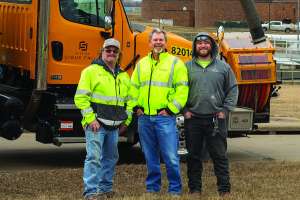
Hierholzer credits the success of the project, and the facility in general, to the quality of his 69-member team. Key players include: Mark Hierholzer credits the success of the project, and the facility in general, to the quality of his employees:
Biosolids team members Phil Greenwood, supervisor; equipment operators Bryan Runge (lead) and Matt Voltz
Lead wastewater operators Jesse Groen, Robert Baker, Sam Slaby and Eric Watson
Wastewater operators Tyler McCallum, Zach Nase, Roxie Kierst, Miranda Stefanich, Jordan Bosch, Conner Mesman and Darren Stotesbery
“These guys are miracle workers,” Hierholzer says. “We’ve gone through blizzards, ice storms, floods, high-flow events and capital projects, and everyone here has really integrated well with each other. There’s no ego on this team. If someone feels that somebody’s better at a job than they are, they will just ask them for help, and they’ll get it.”
The upgrade to the Sioux Falls facility will be the last major achievement of Hierholzer’s clean-water career: “I’ve been in this business for some 40 years,” he says. “I plan to retire in June (2024), take the summer off and relax.” It’s a fitting conclusion to a career entirely unexpected, but nonetheless rewarding.