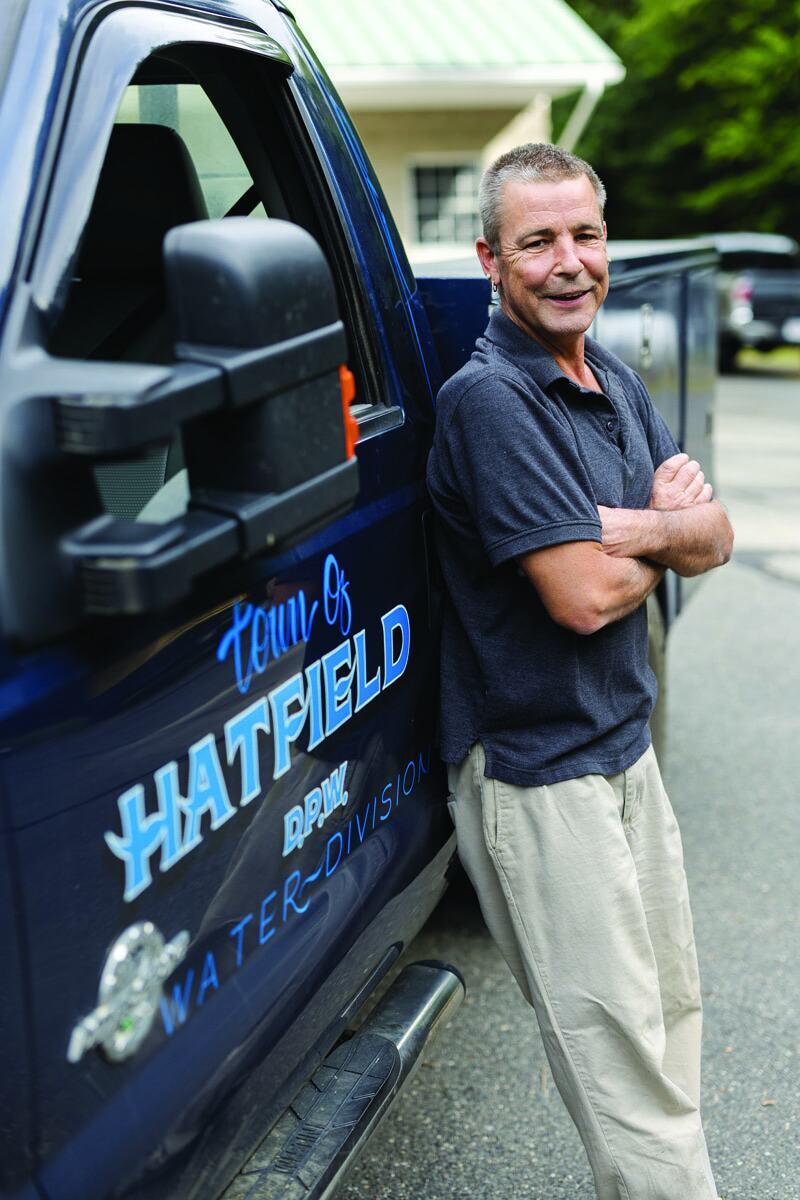
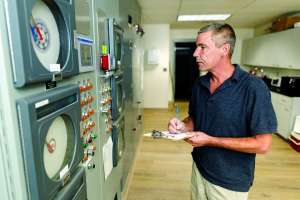
Managing the water system in one community isn’t enough for Tony Lastowski.
While serving as water superintendent in the town of Hatfield, Massachusetts (population 3,300), he also manages the distribution system and has a general oversight role in the nearby town of Williamsburg (2,500).
At the request of the state Department of Environmental Protection, he helped the town of Chester (1,200) quickly make improvements that ended a boil water order. And he has helped arrange an informal mutual aid system by which Hatfield and three other water departments share expertise and equipment when problems arise.
Describing his experience in Hatfield, where he has worked for 18 years, he observes, “It has been quite the experience. It’s a 24-hour job, seven days a week. For the first five years I worked here in Hatfield, I was by myself.”
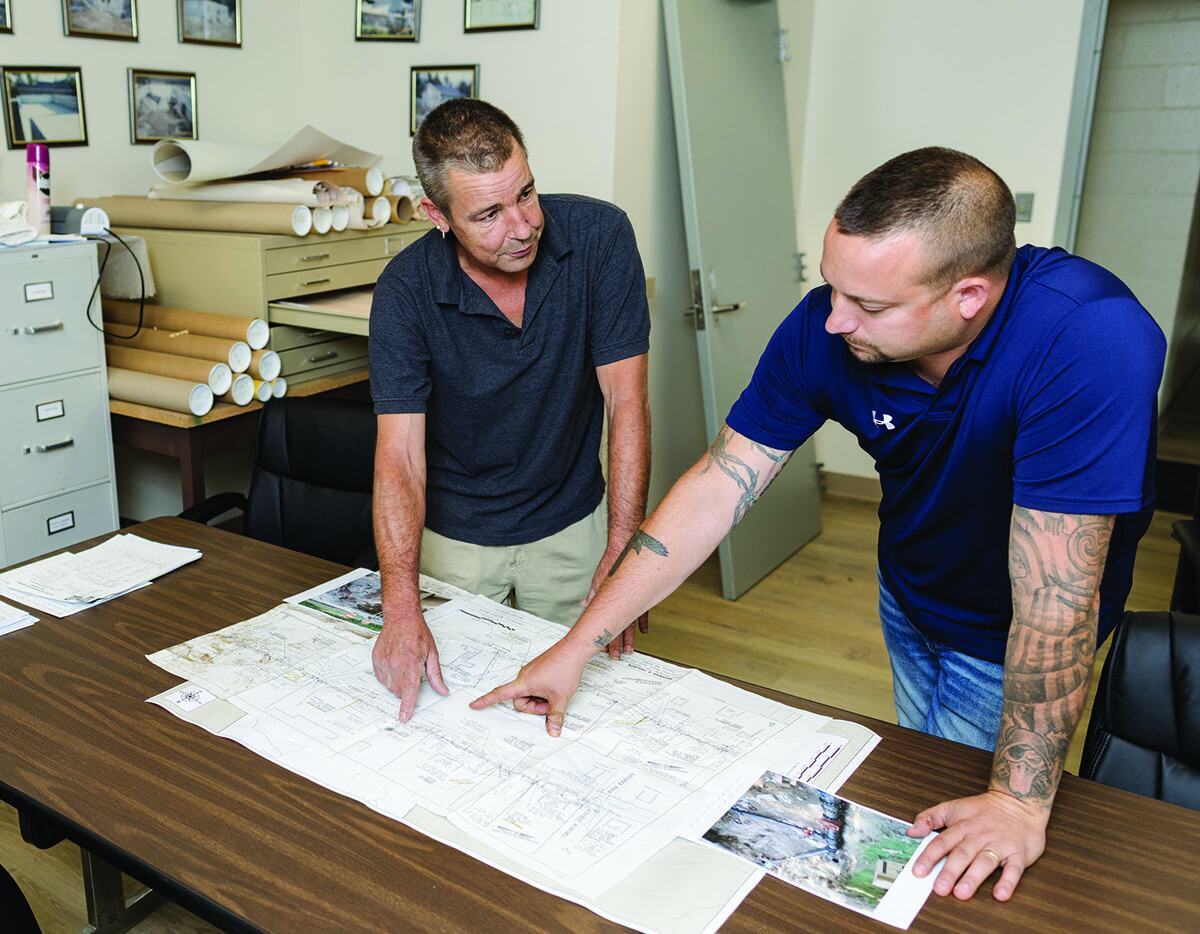
Today he’s supported by Brandon Daniel, assistant superintendent: “We work as a team: all day, every day. We respond to customer complaints. We work on projects extending water mains. When we have water main breaks, our highway department helps out with equipment operators. On any given day we could be doing meter billing, mowing lawn, taking care of our buildings.”
Such is life in a small New England utility. Lastowski grew up in the town of Hadley, near Hatfield, and studied auto mechanics at Smith Vocational High School. After graduating, he worked as a mechanic for Hadley (population 5,300) for 16 years.
“While I was there, they paid for me to get my water licenses,” he recalls. “They relied on me because of my mechanical background for fixing problems. There were eight of us altogether between highway and water departments.
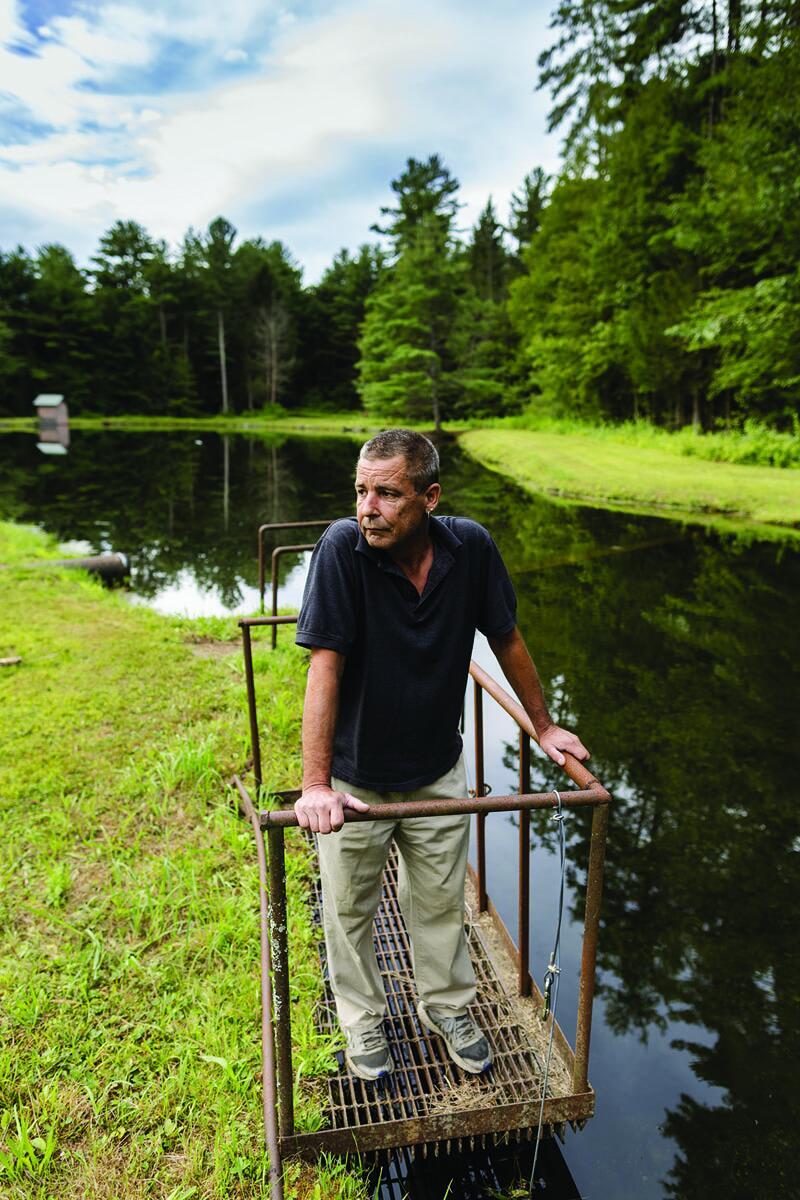
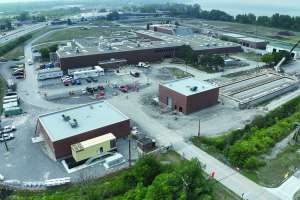
He then moved on to Hatfield. “That was a learning curve because I had never run a surface water treatment plant and wells,” says Lastowski. He can see Running Gutter Brook Reservoir from his office window; it has existed since 1896 and is fed by streams and natural springs.
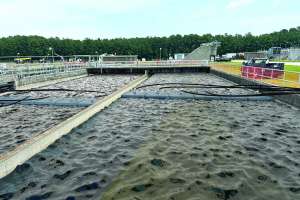
The water system produces about 500,000 gpd in summer and 200,000 gpd in other seasons. The town is blessed with excellent source water: two wells feed directly into the system with no treatment. The treatment plant for the reservoir water consists of slow sand filters.
Other than that, “The only thing we add is chlorine gas for disinfection,” Lastowski says. “Most people who come here look at my numbers and say it’s not possible. The raw water turbidity is about 0.35 NTU. We’re the only surface water treatment plant in Massachusetts that doesn’t add chemicals for corrosion control.”
The wells are used mainly for peak demands and during rain events, when the treatment plant is shut off to avoid handling water that might carry particulate from runoff to the reservoir and plug the two filters, which use media of layered stone and sand. Water storage consists of a 500,000-gallon clearwell and a 500,000-gallon concrete storage tank uphill from the plant.
Distribution requires no booster pumps. The piping is old, but in generally good condition: “We have a lot of old cast iron pipe. I’ve got a plaque from the Cast Iron Pipe Century Club, issued by the Ductile Iron Pipe Research Association, for having water mains over 100 years old.
“Our water quality is so good that we have no scale buildup in any of our water mains,” Lastowski says. Overall, the piping consists of about 40% cast iron and the balance a mix of ductile iron, asbestos cement and plastic.
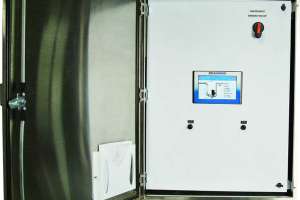
Water operations are controlled with a SCADA system designed and built by Lastowski and John Bacon, an electrician with Elm Electrical of Westfield. “John did all the wiring for this treatment plant when it was originally built in 1996,” Lastowski observes. Given the system’s simplicity, maintenance management is a manual process using an Excel spreadsheet.
Five years ago, with the Hatfield system operating smoothly, Lastowski was hired on part time to help Williamsburg, about 15 minutes away, through a crisis: “They called me up. Their water operator had died of cancer, and they were in a bind for somebody with licensing. They had one operator who knew what he was doing but was not licensed yet. I agreed to help them out.
“I’m listed by the state as the primary distribution operator, but I function like an administrator. I help with treatment. We just had the storage tanks cleaned and cathodic protection repaired. I helped design and bid out a small project transferring over from a water main they wanted to abandon to a new one.
“I got them into compliance with SCADA and alarm systems. I’ve done a lot of work up there. It’s dealing with engineers, working on an emergency response plan and asset management plans.”
Later, he was asked to help the town of Chester, about an hour away: “I had met a new DEP person during one of their surveys here in Hatfield. She really liked my operation and how I was working things.
“They were under a boil water effect. Their surface water plant had the same slow sand filtration process as Hatfield. Their new operators weren’t really sure how things were supposed to work. I met with DEP and the operators, went through their system and made a lot of recommendations.
“They slowly implemented them, and a couple of weeks later they were off their boil water effect. They have continued to strive. Now, I review their monthly reports because they’d had some data problems. We got that straightened out.”
Meanwhile, Lastowski takes pride in the cooperation he helped establish with counterparts in the nearby towns of Hadley, Northampton and Whatley: “We have our own unwritten mutual aid system. We work really well together.
“If I need a part in the middle of the night and another department has it, they’ll bring it over or I’ll go get it. I recently borrowed a special wrench from a neighboring community so I could fix a fire hydrant; I didn’t have the appropriate tools. During COVID, it was taxing because nobody could get supplies. “I could ask, ‘Do you have this? We really could use it for a little while.’ And they’d say, ‘Yup. Here you go.’”
As for the future, Lastowski is seeking funding for design to replace a water main. Old cast iron pipes are the most prone to breaking when ground conditions become unstable. “Some years we’ll have five or six main breaks, mostly on cast iron,” he says. “Other years we won’t have any. Weather plays a big factor. In a real wet year, or if we end up with deep frost, the ground starts moving.”
As he looks to retirement several years off, Lastowski is grateful for the opportunities he has been given and the people he has worked with: “I’ve worked with some incredible engineers and operators. I’m like a sponge. I like to learn. I listen to my elders.”
They include Ed Wroblewski, his predecessor Hatfield, who although retired for 18 years still helps when needed: “I worked with him full time for six months before he retired. He was very knowledgeable about the system, and we got along real well. He gave me information that most people never would have received walking into this place.
“The time we worked together was the beginning of the digital age. We’d take pictures of infrastructure, like mainline valves, and in our spare time we’d mark on them what it was and which direction the flow was going.
“So in the middle of the night, if I have to know where something is, how to shut a water main off, I have that information all printed up.”
It’s just another example of how the Hatfield Water Department is in capable hands.