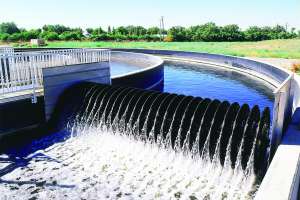
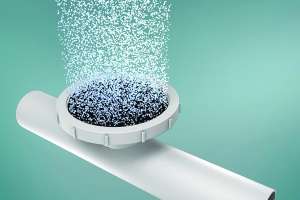
Whether you need to add air to your lagoon, sequencing batch reactor, oxidation ditch or other activated sludge process, you can choose from multiple aeration devices.
Almost all can be added to any process, but some fit better than others for particular processes. For example, a low-speed surface aerator may not be best in a lagoon because of the baffles needed to anchor the unit to the bottom, so as to prevent rotation.
The first and often most difficult task on realizing you don’t have enough oxygen is to quantify the need. There are two basic ways to approach this.
Method 1 is to directly calculate the total oxygen needed and then subtract the amount currently being delivered. This isn’t always easy for a number of reasons. You might not have regular influent BOD and TKN values. You might not know the oxygen delivery of current devices. And the efficiency of existing devices may differ significantly from their new condition.
Method 2 is to estimate the oxygen needed based on process conditions at different times and then use some rules of thumb to estimate current oxygen delivery and determine how much to add.
Determine total oxygen needed
First, calculate your total actual oxygen required. The standard formula (assuming 1.2 mg of O2 per mg of BOD) is:
AOR (lb/day) = flow rate (mgd) x 8.34 x (BOD x 1.2 + ammonia x 4.6),
where BOD and ammonia are measured in mg/L.
If you have warm enough water and long enough sludge age, oxygen for nitrification will be used whether you plan for it or not. Therefore it is usually best to assume it is occurring and include oxygen for it. Also, if you have good denitrification in an anoxic basin, or with simultaneous nitrification-denitrification, you can use a smaller ratio on oxygen required for nitrification. Typically, you can assume at least 30% less oxygen for ammonia removal with good denitrification.
Subtract aeration delivered by existing devices
Once you determine total oxygen demand, you need to subtract current oxygen being delivered. The challenge might be that you don’t know how much oxygen your equipment is now supplying. You can determine that by looking up your original design documents (if you have them) or by estimating based on general rules of thumb for the devices shown in Table 1.
If you have diffused aeration, you may need to derate from the original values if the diffusers have not been cleaned in five years or more. Aeration devices are rated at standard conditions, so the actual oxygen delivered needs to be corrected for actual conditions. This ratio of standard oxygen rate (SOR) to AOR is referred to as field correction factor or FCF.
FCF includes the ratio of wastewater to clean water efficiency (alpha or α), the relative saturation factor for wastewater (beta or β), tank depth for fine-bubble/coarse bubble/jet aeration, operating dissolved oxygen relative to saturation, temperature and elevation.
The two most important factors generally are alpha and the dissolved oxygen operating point. For floor-mounted aeration like fine-bubble diffusers, tank depth has a significant effect. Elevation can have an impact as well in mountainous regions but generally is not much of a factor at 1,000 feet and below.
Typically, beta is assumed to be 0.96 to 0.98 for municipal wastewater. In submerged aeration systems, such as fine-bubble or jet aeration, deeper tanks provide more oxygen transfer; beyond an 18-foot depth efficiency starts declining.
Assuming water temperature at 20 degrees C, beta of 0.98 and 1,000 feet elevation, approximate alpha and FCF are shown in Table 1. This assumes operating at dissolved oxygen of 2.0 mg/L. Tank depth is assumed to be 20 feet for floor-mounted aeration devices.
The range of typical alpha for fine-bubble aeration is due to several factors, but alpha typically is lower at the beginning of the plant and higher near the end. If anoxic basins are used, aeration basin alpha will be higher due to fewer surfactants remaining after the anoxic basin.
Remember to consider the condition of the diffusers if not cleaned in five years or more. Typically, they can lose oxygen transfer efficiency of roughly 10%, but considering additional power required for increased headloss of old diffusers, total power efficiency loss can be about 20%.
Diffused Aeration
If the original design parameters are available for your aeration devices, subtract that from the calculated aeration required. If not, the typical values above can be used.
Estimating oxygen required
If aeration is sufficient during low flows, such as at night, but not during higher flows during the day (not considering dilute storm flows), you may be able to estimate the aeration required. When able to achieve the target dissolved oxygen (such as 2.0 mg/L), add up all the aeration devices operating.
For example, if there are positive-displacement blowers with fine-bubble diffusers, add up the percent speed of all blowers and multiply by size to determine the total energy used. Then divide by the typical AOR. Then multiply by the difference in flows from low flow to the nonstorm maximum flow.
Aspirating aerators and high-speed floating aerators are commonly used in lagoons. They provide aeration through the shaft of a mixer. Because the air is released at a relatively shallow depth, efficiency is relatively low. Mixing is directional for these aerators; they can be useful for basins that are not sufficiently mixed. Their cost is relatively low.
High-speed floating aerators are also relatively inexpensive and improve efficiency. They also provide more uniform mixing around the aerator. Oxygen is transferred to the water as the water passes through the air. Aspirating and floating aerators are common upgrades for lagoons.
Low-speed vertical-shaft aerators transfer oxygen in a manner similar to high-speed floating aerators. The larger-diameter propeller improves efficiency, but the gearbox increases cost, and more substantial mounting is usually required. These devices are common upgrades for sites where some low-speed aerators already exist and another tank is being added, or horsepower is increasing for additional aeration.
Low-speed brush and low-speed disc aerators provide efficiency similar to the vertical-shaft aerators. The cost is similar, but mounting can usually take advantage of tank walls. These devices are common upgrades for new oxidation ditches or as additional devices in an existing ditch. Disc aerators generally provide better mixing than brush aerators.
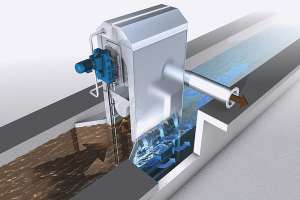
Horizontal aeration discs in a multichannel oxidation ditch are a typical method to provide aeration and mixing. Jet aeration can improve surface aeration efficiency with low maintenance. Although they are less efficient than fine-bubble diffusers, there are no membranes to replace. Jet aeration can operate with mixed liquor being pumped through the large pipe, mixing with air from the smaller pipe and discharging through the jet nozzle.
Diffused aeration can be supplied with coarse- or fine-bubble diffusers. Coarse-bubble is less efficient but can be lower-maintenance with no membranes to replace. In aerobic digesters, coarse-bubble may be a better fit, since mixing is a higher energy requirement than the oxygen transfer. Fine-bubble is the most efficient if the tank is relatively deep (about 15 to 20 feet). At less than 10-foot depth, surface aeration is typically more efficient.
When adding aeration, there are cases where mixing energy has to be considered, such as when adding a new tank or lagoon. Fine-bubble mixing intensity is normally measured in standard cubic feet per minute per square foot of floor space; the minimum for activated sludge is 0.12 scfm/ft2.
Turndown of the additional devices is also a factor. During lower flows, will some aeration from the new devices still be needed? If so, the motors will require variable-frequency drives. VFDs are not typically used with-high-speed floating aerators.
Other ways to improve aeration are more subtle but can have significant effects. For example, since oxygen transfer efficiency is related to operating dissolved oxygen, adding aeration in low-DO areas will have the biggest effect.
Adding an aerator at the end of the process where DO is already near 2 mg/L will have 30% less effect than at the beginning where the DO is zero. If the basins are hydraulically capable of being put in series, doing so can improve efficiency. If 50% or less of the oxygen demand is added to the first basin, the DO will stay near zero, and efficiency will be about 30% higher than if adding oxygen at 2.0 mg/L DO.
If you know the options available, it is not difficult to determine the best technology when your existing equipment cannot provide sufficient aeration. The most difficult part might be sizing the equipment, but knowing some rules of thumb can get you close. Don’t forget that suppliers can provide advice on sizing.
About the author
David Dubey, P.E., (david.dubey@xylem.com) is global product manager for biological processes, with Evoqua Water Technologies (now part of Xylem).