
In 2022 and 2024, the Kishwaukee Water Reclamation District was named a Utility of the Future Today by leading industry organizations for its energy recovery and efficiency.
In 2024, its wastewater treatment facility was named Plant of the Year by the Illinois Association of Water Pollution Control Operators. These are among several honors the district has received for its forward-thinking approach.
The district has saved more than 60% on energy each year by using biogas, reducing mixer runtimes, optimizing UV disinfection and making small but productive adjustments to pumps, aerators and blowers. And, having taken an approach that examines each plant process and questions how things are done, the district team is just getting started.
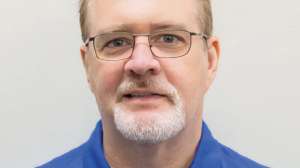
“It began with our 2017-2021 plant upgrade,” says Jason Robbins, operations manager for the district, based in DeKalb. “That was our big driver. We had to meet new limits for phosphorus removal, but at the same time we thought: How can we become more energy-neutral?”
Getting buy-in from staff and the district board of trustees was critical in achieving results. Robbins calls it “an openness to innovate,” facilitated the improvements known as Phase 1B.
The wastewater treatment plant has a design flow of 8.63 mgd; daily flow averaged about 5 mgd. It serves about 47,000 customers in DeKalb and Malta and unincorporated areas of DeKalb County. It also receives flow from Northern Illinois University and Kishwaukee College. The plant is fed by 186 miles of sewer pipe and 11 lift stations.
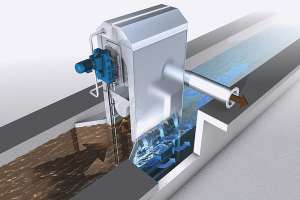
Wastewater enters the headworks, passing through a quarter-inch mechanically raked bar screen (Vulcan Industries) and a grit classifier (Smith & Loveless). The water is then pumped up to circular primary clarifiers. Primary sludge is pumped directly to four anaerobic digesters, along with fats, oil and grease the plant receives from restaurants by way of private haulers.
Primary wastewater overflows into four Bio-P tanks (phosphorus control) where it is mixed with return activated sludge using Philadelphia mixers (SPX FLOW). The overflow from the Bio-P tanks moves through the aeration process. “We can run the tanks in two configurations for flexibility,” says Robbins. “We typically run a five-stage Bardenpho so that we can increase nitrogen removal and minimize the electrical costs associated with our blowers.
“We use fine-bubble aeration and mixing for ammonia and nitrogen control. Once the wastewater passes through the aeration tanks it overflows into one of three oversized final clarifiers with a slower settling rate that allows us to eliminate the need for filtration for solids removal.”
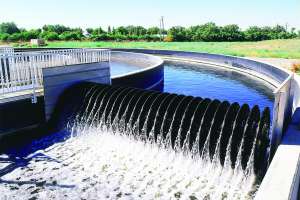
The final effluent UV disinfected (Wedeco) before discharge to the Kishwaukee River. The plant uses chlorination process during excess flow events, which have decreased in frequency by 80% since the facility upgrade.
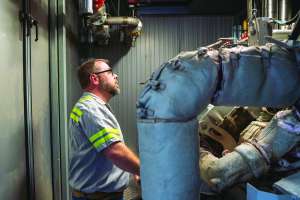
Waste activated sludge is delivered to a gravity belt thickener (Alfa Laval) and then to the anaerobic digesters. Biogas from the digesters is filtered to remove hydrogen sulfide and siloxanes and burned in a pair of 375 kW combined heat and power generators (Nissen) that fulfill 90% of the plant’s electrical demand and all of its thermal needs, including digester heating.
Biosolids are dewatered on centrifuges (Centrisys/CNP) to 19-21% solids cake and hauled to a remote storage facility as Class B material. Synagro hauls the biosolids to farms for land application sites several times a year. Total volume is about 2,100 dry tons.
The plant uses a Rockwell SCADA system and WIN-911 alarm notification software (SmartSights) in the main control room. Staff members rely on it for controls and alarms; six touchscreen displays are located throughout the plant. “All staff members have their own tablets as well to access the SCADA system,” says Robbins.
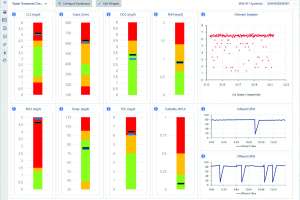
“We have a Rockwell computerized maintenance management system that we have been integrating over the past year. All staff have access to this as well. We also use a Hach Water Information Management System to implement and share data from our plant and lab.”
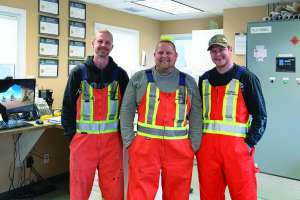
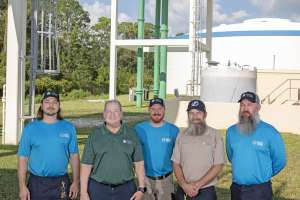
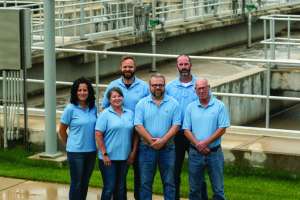
In addition to Robbins, the plant staff includes Ben Meier, operations foreman; Nate Sauer, operations laborer; and Patrick Sipp, Kevin Cherry and Trent Owens, operators. Maintenance operators are Dan Knaak, foreman; and James Garland and Chris Sitka.
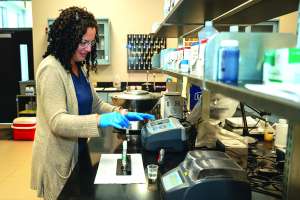
The collections team consists of Jamie Cochrane, foreman; and Grant Olsen and Floyd Griffin, collections. Allison Yates is laboratory supervisor, assisted by lab technician Zack Wade.
The administrative staff includes Mark Eddington, P.E., executive director; Onasis Rivera, P.E., district engineer; Tracy Zenker, office manager; and Nick Newman, GIS/environmental specialist.
The decision to implement Phase 1B and make the treatment system more energy-efficient led the district team to connect with the Commonwealth Edison Strategic Energy Management program in February 2022.
The program helps facility managers identify and implement low-cost energy efficiency projects. At no cost, ComEd performs an energy assessment, monitors energy usage, identifies operational changes that can save energy and provides materials and training to facility employees. The focus is on maintenance and behavioral changes that produce long-term savings.
Biogas from the Kishwaukee plant’s anaerobic digesters has provided the most significant savings. The two CHP generators are capable of producing 15% more power than the plant requires; additional power has been pushed to the utility grid.
“We made the decision to accept restaurant grease and add it to the digesters to increase gas production,” says Robbins. It worked. Since the district began co-digesting hauled grease, biogas production has increased from 50,000 cubic feet per day to 225,000.
The energy savings mindset didn’t stop there. Working with ComEd and listening to staff suggestions and ideas, the district implemented a spate of other measures. Many involved making small adjustments in setpoints, temperature controls and runtimes. “The ideas just snowballed!” Robbins says.
For example, the blower pressure and airflow in the waste activated sludge tank have been reduced, as has the runtime of the primary sludge pumps, the digested sludge storage mixing pumps, and the phosphorus tank mixers. Other projects involved lowering dissolved oxygen setpoints and adjusting the raw wastewater wet well level.
Once staff and management identify a potential energy savings move, phased process adjustments are closely monitored to find the sweet spot. Adjustments to the plant’s wet well level are a good example. Previously, the level was set at 5.5 feet. It was carefully raised to 8 feet over two years, reducing the need to cycle the pumps and saving on power. This saves 65,700 kWh per year, or $5,256.
Even more savings have been realized by reducing the runtime of the secondary digesters. Robbins explains that the digesters were previously running at 75 minutes on, 15 minutes off. After adjustment to 45 minutes on and 30 minutes off, runtime has been reduced by 8.5 hours per day, with a potential annual savings of 232,000 kWh, or $18,500.
Another $11,320 savings is estimated to accrue from more frequent cleaning and setpoint adjustments in the UV disinfection system.
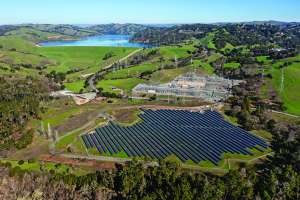
The energy management and efficiency program will move ahead as 2025 begins. As part of a planned plant upgrade between now and 2027, the district is considering solar panels on open areas of the plant property, new programmable logic controllers and construction of a sludge storage tank that can be converted in the future to another anaerobic digester for more biogas production.
A major project will update the plant electrical service system. “At present, we have five different electrical meters,” says Robbins. “We plan to consolidate those into one internal medium-voltage loop. That distribution system will allow us to better utilize all the power we create and add resiliency and flexibility to our delivery of service. It will also make it easier to monitor electrical power usage and determine savings from our energy reduction projects.”
And speaking of electrical power, the district has six public and four private electric vehicle charging stations available 24/7. The EVs that plug in are recharged using electricity generated with biogas.
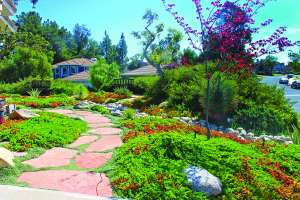
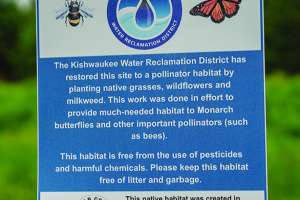
Other initiatives include the conversion of more than eight acres of turf grass to native prairies that include native wildflowers and will be registered as monarch butterfly habitats. The prairie plants do not need to be mowed, and they have deep roots that reduce stormwater runoff.
It’s likely that none of this would have happened without an open-minded approach to innovation and a commitment to sustainability from the district staff and board of trustees.
“We could have said, ‘Let’s just run the plant. Don’t play with it,’” Robbins says.
But the team did the opposite. Robbins says 100% of the ideas for energy efficiency have come from staff: “We have weekly meetings between the administrative and operational staffs. If an idea looks promising, we give it a shot.”
The focus has been on small, incremental changes. “We think change is good,” Robbins says.
“It’s sometimes difficult to get everyone to buy into a new idea, but once you do, you see the impact it can have.”