Dedication comes naturally for the team at the William C. Maytum Water Treatment Plant in New Port Richey.
Serving 35,000 residents in the city 40 miles north of Tampa and 19,000 more in surrounding Pasco County, the production team works tirelessly to produce quality water, rejuvenate the plant and bring it into the modern era.
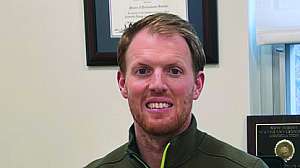
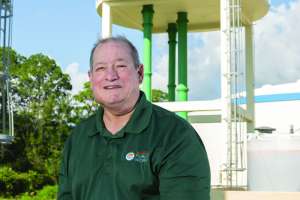
“It’s an old plant,” says Greg Wikholm, water production supervisor. “We’ve redone the interior and exterior and replaced the equipment. We’ve done an incredible amount of work. For as old as it is, the plant looks great. We’re constantly upgrading. It never ends.”
His team’s work earned a 2024 Outstanding Class B Water Plant Award from the AWWA Florida Section. “We applied for the Most Improved Water Treatment Plant award because of all our work,” says Michael Stein, lead operator. “So Outstanding Water Treatment Plant was a pleasant surprise.”
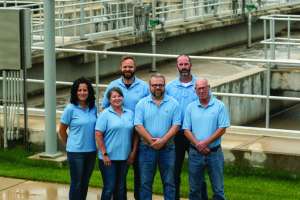
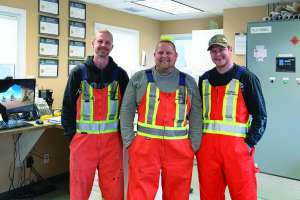
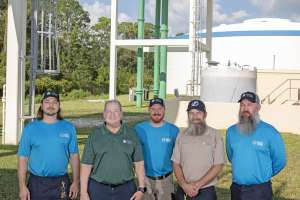
The plant staff consists of five operators. Wikholm holds a Class A drinking water and distribution license. Team members are Michael Stein, lead operator (Class B); operators Daniel Robertson (Class B) and Devin Ammiano (Class C); and Andrew Smith, trainee. That team is supported by a maintenance crew staffed by Luis Garcia, Jeff Foltz and Tom Brown.
While the city utility is a member of the regional Tampa Bay Water, one of the nation’s largest drinking water utilities in the United States, the New Port Richey staff resembles a small-town outfit, taking on broad responsibilities.
“Where a larger utility would have a separate team to take customer complaints or distribute precautionary boil water notices, we handle all of the things outside of production as well,” says Stein, who began as a trainee at the plant soon after graduating high school in 2001.
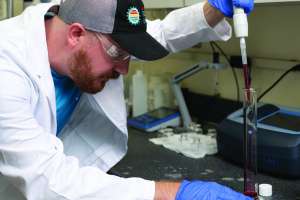
Wikholm adds, “We wear a lot of hats here.” The production team collects samples for laboratory analysis and files water-quality reports with regulators and others. The team files monthly reports with the state Department of Environmental Protection, and the Southwest Florida Water Management District. The U.S. EPA and other federal regulators also have reporting requirements.
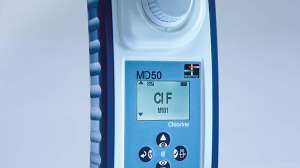
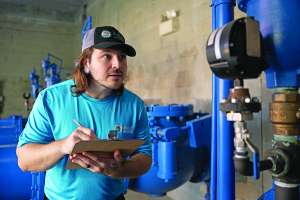
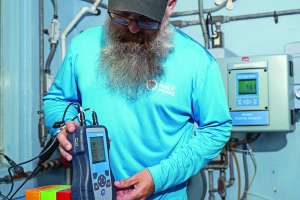
“We sample and test for sulfate, iron, conductivity and TDS,” says Wikholm. “We also have remote sites we monitor every day and on a monthly basis. And since we have a chloramine disinfection system, there are several parameters we have to monitor every day. Some have to be monitored continuously with online analyzers.”
Team members collect samples for the Fifth Unregulated Contaminant Monitoring Rule (UCMR5) and compare results with Tampa Bay Water’s laboratory team, which also monitors member utilities’ water.
The production team collaborates with other New Port Richey public works functions.
“We work hand in hand with the distribution team, communicating on system failures and pressure drops,” says Stein.
“A distribution system we inherited a few years ago had a massive break, requiring us to hand out boil notices and shut down a large portion of the system. Afterward, we worked with the distribution team to create a loop to isolate that section of the system in the future if needed.”
On top of these tasks is the shadow of upcoming regulations that can upend treatment processes and procedures, like the U.S. EPA’s recent passage of maximum contaminant limits for six PFAS chemicals. “We’re very fortunate,” says Wikholm. “We’ve completed the UCMR5 samples, and each one came up as nondetect for PFAS. As of now, there’s no need to change our treatment process to address PFAS.”
The Maytum treatment plant was commissioned shortly after passage of the Safe Drinking Water Act. “The exact date of commission is not clear,” says Wikholm. “But blueprints suggest that the plant was built between 1972 and 1973.
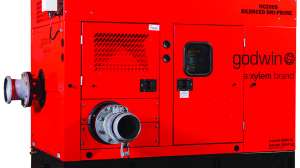
“Our source is primarily groundwater wells. Tampa Bay Water monitors our storage tanks, and they provide the water. The plant is rated for 11.1 mgd and we treat around 5.5 mgd. We also have a well pump (FloWise) on site that can produce 0.5 mgd.”
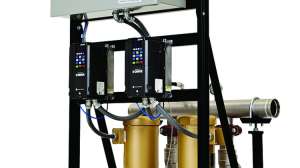
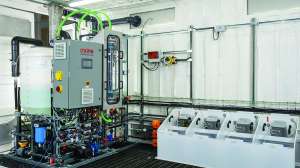
The treatment process is relatively simple. “We aerate with 45-foot-tall cascade aerator towers (CROM Corp.) to remove hydrogen sulfide,” says Stein. “The water then goes into our 1 million-gallon raw water tank [also CROM].” Sodium hypochlorite disinfectant is delivered by ProMinent Fluid Controls pumps.
Ammonium hydroxide is added to the water to create chloramines. After chloramination, the water enters a 2 million-gallon finished water tank. The water that goes into the city’s distribution system is fluoridated, but not the amount treated for Tampa Bay Water. A 500,000-gallon elevated tank in the city serves as a buffer and reservoir (both tanks from CROM).
Surrounding Tampa Bay Water communities also rely on New Port Richey plant for drinking water. “Since we have an overabundance of capacity, Tampa Bay Water sends us an extra 2 mgd to treat, which then goes to Pasco County,” says Wikholm. The plant produced a total of 2 billion gallons in 2023.
Given the plant’s age, the crew has paid close attention to modernizing operations over the years. While ensuring that the water outperforms state and federal standards, the operations crew upgrades its technology and maintains equipment. Team members also handle jobs like painting walls and installing new security cameras.
“With the assistance of the maintenance staff, we’re pretty much self-sustained,” says Wikholm. “We put down bleach, ammonia and fluoride feedlines. We installed a new fluoride pump and tank. Just recently we replaced one of our bleach tanks (Snyder Industries). That’s a big project because they’re 19 feet tall, weigh 2,000 pounds and are in an awkward spot at our facility.”
Stein observes, “A lot of utilities would hire a contractor to do these types of tasks, but we have the skills to do them ourselves. Some of our ChemScan analyzers (In-Situ) had operated for close to 11 years, so we made a big push and replaced them with the latest ChemScan models.”
The team has devoted substantial efforts to modernizing data collection and control.
“We’ve built spreadsheets from everything that used to be in paper form and we’ve totally digitalized the plant,” says Wikholm. “We’ve made it so that we have a ShareFile with all of our plant data for permanent record and to review historical data.”
Stein adds, “We used to rely on Tampa Bay Water for SCADA, so we could only read what their system told us. So we built our own standalone SCADA (Siemens) on a fiber optic network. Now we have control of our own private network. Louis Garcia, one of the maintenance specialists at the New Port Richey water reclamation facility, helped us install multiple PLCs throughout the plant to complete the project.”
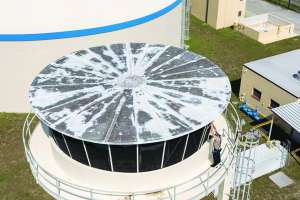
Along with equipment upgrades and modernization, the crew has rejuvenated the plant and other water assets throughout the city to look brand new. “We’ve done a lot of upgrades aesthetically because it was pretty beat up,” Wikholm says. “We painted everything, recoated and painted the elevated tank after a five-year inspection, and replaced the logo.”
The relentless dedication of the plant crew has not gone unnoticed. The facility has been recognized with several awards. Besides the 2024 Outstanding Plant Award, they include:
The work is never-ending, whether it’s maintenance, modernization or assisting other public works teams. It all ensures the plant remains at the forefront of water treatment excellence. “I enjoy coming to work every day,” says Wikholm. “I want to be sure we’re the best plant we can be. And I think we’ve achieved a lot so far.”