Potable reuse of wastewater is growing nationwide. Florida’s operator association is preparing its members for the advanced treatment technologies needed by creating a voluntary training and certification program.
The program consists of an eight-chapter training manual, an 80-hour course to be offered initially online and later in the classroom and a 100-question exam.
The 5,400-member Florida Water and Pollution Control Operators Association was founded in 1941 to provide training and development for professionals working in the state’s potable water, wastewater and stormwater operations.
Potable reuse is the latest in a long line of voluntary certifications offered by the association. Others include water distribution, wastewater collection, utility maintenance, stormwater, customer relations, reclaimed water field inspection and backflow prevention. These certifications mostly cover areas where the state at present does not require licensing.
A growing trend
Indirect and direct potable reuse are increasingly necessary in Florida, notes Patrick Murphy, chief wastewater operator in Plant City and association president. “We’re very close to matching the activities in California,” Murphy says. “There are a lot of pilot programs in process or starting up.”
Casual observers may note that water is abundant in the state, but potable reuse is needed because the resources are under stress, Murphy observes: “The city of Winter Haven, for example, has 100 lakes. It looks like there’s lots of water. But when you have 1,000 people moving into the state every day, they’re going to be using a billion gallons more water per day in 10 years.
“We have to pull the water from surface sources or an aquifer. We cannot over-pump the underground sources because if we do, we’ll collapse the aquifer or enhance saltwater intrusion. If the aquifers are over-pumped, we’ll need to go deeper and deeper and use more advanced treatment technologies. The goal of potable reuse is to have a sustainable supply.”
As of last fall, the state Department of Environmental Protection was working on a new administrative code chapter spelling out rules, regulations and permitting requirements for direct and indirect potable reuse. The association’s voluntary certification is designed to make sure operators are prepared as full-scale potable reuse facilities come online.
During the DEP rule-making process, the association quickly saw that direct potable reuse requires operators thoroughly trained in both water and wastewater treatment technologies, and that no Florida training program existed.
Murphy states, “Our mission for 80 years has been to train operators and get them certified and knowledgeable. We will be working hard to help operators be able to treat wastewater effluent, have it be safe and help convince the public that it’s a safe and reliable drinking water source.”
Taking action
Responding to the DEP rule-making, Murphy established a Direct Potable Reuse Operator Training Committee of:
- John O’Brien (chairman), treatment plant operator with Seacoast Utility Authority
- Fred Greiner, purification manager with Jacksonville Electric Authority
- Scott Ruland, consultant and operator with Woodard and Curran.
The committee commissioned the ProEdit instructional design firm to help complete the materials by the end of 2023.
The group drew from internal and external sources in gathering information for the manual. They reviewed, condensed and organized technical information from a broad range of public domain resources into a uniquely Florida program.
The direct potable use manual, now complete, incorporates technical training in multiple treatment processes; regulatory, safety and maintenance disciplines; and a brief diagnostic test at the end of each section. The materials also include an instructional PowerPoint presentation and the certification exam questions.
When in final form, the manual will be bound to match the other volumes in the association’s training library and will be ready for presentation in early 2024. The material covers indirect potable reuse, which mainly includes the treatment of wastewater for discharge to surface drinking water sources such as rivers and reservoirs, and potable reuse in which highly treated wastewater is fed to a drinking water treatment plant.
“We want our program to go hand in hand with what the state is developing,” says Darin Bishop, the association’s finance, education and membership coordinator. “We want it to sound like the DEP rule.”
Challenging processes
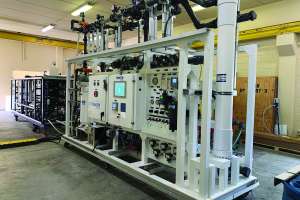
O’Brien notes that direct potable reuse will entail levels of treatment plant complexity for which many water and wastewater operators are not prepared at present. Processes involved will include different levels of membrane filtration, as well as granular and powdered activated carbon treatment, pretreatment with ozone or hydrogen peroxide and others.
“They’re going to deal with a number of processes already used in some of the more advanced drinking water plants, but with a multilayer, multibarrier approach and more degrees of treatment,” O’Brien says. “There will be a burden on the wastewater treatment plant to produce and maintain the necessary effluent quality for that source water.”
The course covers all those treatment processes in a deeper level of detail. “Most operators are not familiar with the complexity of the analyzers that need to be in direct potable reuse systems to measure each parameter,” Greiner says.
“Due to the multibarrier approach, if a particular process doesn’t meet the design criteria, the system is immediately shut down and the water is diverted back to the reclaim system or the headworks of the wastewater treatment plant. When these things happen it’s important for operators to know what to look for, to understand why they’re having those issues, and then to be able to troubleshoot and solve things.”
Operators who would like more information about the potable reuse course and voluntary certification can contact the Florida Water and Pollution Control Operators Association at 561-840-0340 or membership@fwpcoa.org.