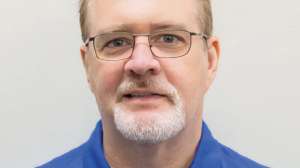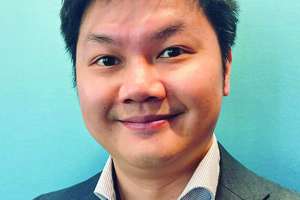
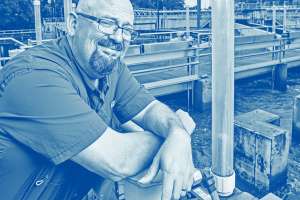
You’d never guess today that Brian Boswell more or less stumbled into wastewater management.
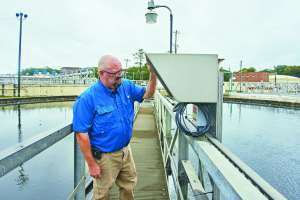
Now as superintendent of wastewater for Columbus (Georgia) Water Works, he oversees two combined sewer overflow water treatment facilities along with the South Columbus Water Resource Facility. For his 18 years of industry excellence, Boswell received a 2022 William D. Hatfield Award from the Georgia Association of Water Professionals.
After 15 years at various jobs in area companies, Boswell realized by the mid-2000s that companies in the area were closing up or moving away. “I knew that I wasn’t on a good career path,” he recalls. So he signed on with a temporary agency and got placed at the water treatment plant at what was then the Fort Benning Army Base (now Fort Moore).
“I was driving the tank and well routes, testing wells and filling water tanks,” he says. “When I wasn’t doing that, I was actually operating, making clean drinking water. The position was what we call a process control specialist now.”
After six months, he transferred to the 90 mgd North Columbus Water Treatment Plant. A year and a half later, in 2007, Boswell went to work full-time at the Uptown Park CSO facility as a process control specialist apprentice.
He found the work pleasantly challenging: “It was a lot more interesting, and a lot harder. It had a retirement plan, great benefits, pretty good pay and it was kind of recession-proof.” Deciding he liked the industry enough to stay, he received his first wastewater license in 2008.
In 2008, Boswell transferred to the 73 mgd South Commons CSO treatment facility. The variety of work appealed to him. “Those jobs are a little bit of everything,” he says. “It’s about environmental compliance, but also a lot of maintenance, a lot of going underground. Real interesting.”
After two and a half years another process control specialist position opened up at the 42 mgd South Columbus Wastewater Resource Facility. Eleven months later he had his Class II Operator license and five months after that his Class I: “It definitely turned some heads. I was recognized for it.”
Over the next couple years Boswell became an expert and took the newly created position of lead operator. He continued rising through the ranks and took his present role as the only team member who had operated all the water works facilities.
Boswell knows his rapid ascent wasn’t only his doing: “Columbus Water Works is full of people who want you to succeed,” he says. “One person who comes to mind is William Kent, manager of environmental services and GAWP District 4 director. If I was trying to work on or to learn something, he went out of his way to help.
“The same is true of Lynn Campbell, now retired, who was a vice president of Water Resource Operations and Managed Maintenance. Billy Cobb, water works executive vice president, was a mentor when I was running one of our strategic planning teams. Quite a few people were mentors at strategic points.”
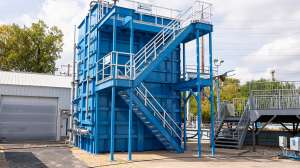
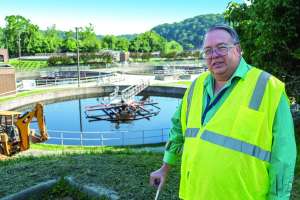
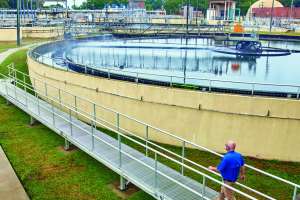
Built in 1964, South Columbus Water Resource Facility is an activated sludge plant that takes influent from a territory that includes a large downtown area with combined sewers. The collection system has 88 lift stations, 1,084 miles of gravity mains, 41 miles of force main. It serves about 250,000 people, including Fort Moore.
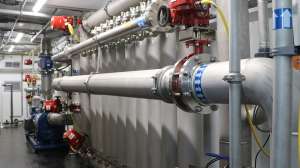
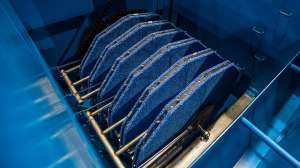
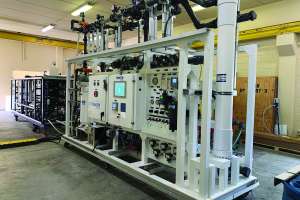
Influent enters through four-channel, 4-foot-wide, 5/16-inch bar screens (Headworks), slated for replacement with 6 mm screens in the near future. A pumping station with five 25 mgd-capacity Fairbanks Nijhuis pumps (Pentair) moves influent into vortex grit separators. The water then passes to six primary clarifiers.
The flow continues to six 1.3 million-gallon aeration basins before final clarification chlorine disinfection, dechlorination with sodium bisulfite and discharge to the Chattahoochee River.
Boswell’s workday kicks off with an 8 a.m. shift briefing with eight to 12 staff members as the first shift comes on and third shift prepares to leave. They review what has transpired on the previous shift and discuss plans for the new day.
“I have a crazy crew,” Boswell says. “They love to play practical jokes on one another. A lot of times we talk about what we did on the weekend, or a football game. I’ve found that when you have a crew that does that, you get a lot out of them. So I just let them be, or sometimes I participate.”
After the meeting he boots up his computer, reviews emails and then works on special projects, reports or budgeting. His favorite part of the job is problem-solving: “I get energy from it, and I bring other people with me on that little journey. With a plant problem, we’ll figure out what happened and what we need to do about it.” He has a crew of 21:
With the combined sewers, variable flows are a fact of life. The South Columbus facility sits in a floodplain. “Flood risk is actually quite major out here,” Boswell says. “All our buildings have submarine doors. They can be sealed when substantial rain events come through.”
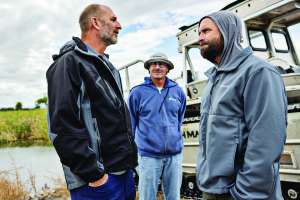
During a flood on Christmas Day 2015, he and his team were on boats inside the plant. Each building has a ladder to access the roof and to get down inside. “So we had all the buildings sealed, going from building to building to do our rounds, pull our samples, the whole nine yards. I would definitely say that’s a challenge.”
Challenges have been many since Boswell became superintendent. “First off, I spent years building up and empowering the team,” he says. “We’ve instituted multiple cross-training programs and helped many people get their licenses. I’ve even helped some very talented people get different jobs if they weren’t enjoying where they were.
“They were working in operations, even working for me. One of them now is running a TV truck. He’s on the crew that televises the underground lines. He’s a great employee; operations just wasn’t for him. So I got the reputation of someone who is good to work for. Now when we have openings, I get people applying from other departments. That’s a little flattering.”
Boswell believes technical and administrative abilities also put him in line for recognition.
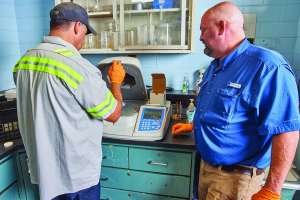
His facilities use the Claros Water Intelligence System (Hach) for instrument, data and process management. He believes in centralized, digital data, “But you have to build all that. I spent years and built all our operational reports into it. Then I trained the staff on how it works, on the math, so they could really understand what it was doing behind the scenes.
“So the operators are in the field, doing their checks, running their numbers, running their samples. They can plug their results into the database, tell it to calculate and it spits out all this information. I took the time to explain why we do all that so they could actually start tracking plant efficiency.
“It has made a huge impact on things like the amount of chemicals we use, even the power sometimes. One day we were able to dewater sludge at 5 cents per thousand gallons, where a couple of days before that it was 12 cents. When you build all that and show your people how it works, they start using it. It helps them diagnose problems. Efficiency skyrockets.”
Operating a nearly 60-year-old physical plant has its share of problems. “I’ve resurrected a good bit of it,” Boswell says. “We’ve invested a lot in the infrastructure, but it is at its peak performance. We average 98% removal across the board. The operators run it to the hilt, but the infrastructure is nearing the end of its useful life.”
Knowing he’ll soon have to replace that infrastructure, Boswell stays current on new technology and practices. He serves on the GAWP wastewater committee and presents at some of its yearly conferences. He also attends some Water Environment Federation events.
He’s active with a combined heat and power group that meets quarterly with leaders from around the country. “It’s through those activities that you stay up to date,” he says “That stuff changes constantly. In 18 years, I’ve networked with a lot of consultants and other superintendents. Everyone in this industry is always learning.”
One thing Boswell has learned is that it helps to have an employer that is open to new ideas. Columbus Water Works has a track record of innovation, but ultimately, it’s about the people who operate the plants.
Boswell knows the value of team building and morale maintenance: “I take time out of my day, when I have the time, to fire up a grill and throw on some burgers. These guys are out there working on this equipment, getting it running. When they smell burgers cooking, they know it’s going to be a good day.”