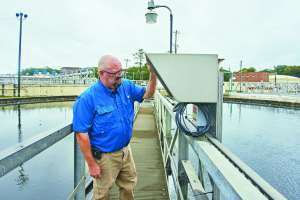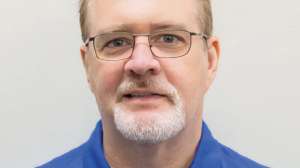

For nearly all his life, Alvin Rucker has been committed to cleaning up the James River and preserving its quality for future generations.
He recalls swimming and fishing in the river as a boy growing up in Amherst County, Virginia, above the polluted areas downstream from a dam and paper mill.
Now, 50 years later, as he retires as superintendent at the Lynchburg Water Resource Recovery Facility, he has overseen treatment improvements that produce clean effluent flowing into the James. “When I took over, we were basically treating for TSS and BOD,” he recalls. “Now we’re removing ammonia, phosphorus and nitrogen. In addition, the city has improved management of combined sewer overflows.”
Rucker attributes the progress to a doubling of the number of treatment processes at the plant, the addition of stormwater holding basins, and automation that includes high-end Ignition SCADA (Inductive Automation), increased use of Allen-Bradley PLCs (Rockwell Automation), and mobile applications. He should also credit his own perseverance in continuing to work despite the loss of both legs below the knee due to diabetes.
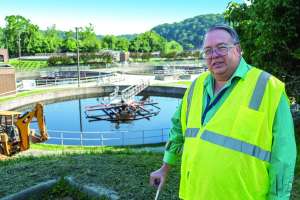
The Lynchburg treatment facility covers 27 acres along the James River and treats 13 mgd on average (peak capacity 80 mgd). It serves Lynchburg along with the counties of Amherst, Bedford, and Campbell, a total population of about 100,000.
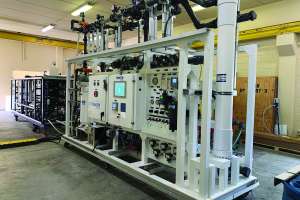
Upgraded several times since it was constructed in the 1970s, the plant includes a headworks with Kusters mechanical screens, rakes, and a PISTA grit removal system (Smith & Loveless). Primary clarifiers are followed by several aeration basins with fine-bubble diffusers (Sanitaire, a Xylem brand).
Rucker likes to talk about the process improvements he has seen: “We’ve moved from a complete mix to a step feed process. That has enabled us to achieve biological removal of ammonia, nitrogen and phosphorus.”
Water then passes to secondary clarifiers, is disinfected with chlorine and dechlorinated with sodium bisulfate, and discharges to the James River. The improvements enabled the treatment team to reduce TSS and BOD from nearly 30 mg/L to below 10 mg/L, and often below 5 mg/L.
Polymer is added to biosolids to promote dewatering on Sharples centrifuges (Alfa Laval). The cake is trucked to a regional landfill or to land application sites. The plant used to haul biosolids seven days a week but now is limited to five days. About 30-35% is land-applied. “Our target is to get that amount to 50%,” Rucker says.
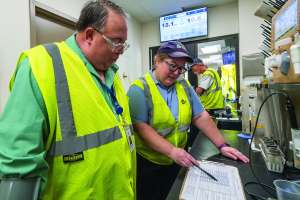
The plant is staffed 24/7 with 40-45 team members, and some contract workers as needed. Rucker’s direct reports include Steve Dunn, assistant superintendent; Thomas Smith, operations supervisor; Sharon Mills, maintenance supervisor; and Jackie Austin, laboratory manager.
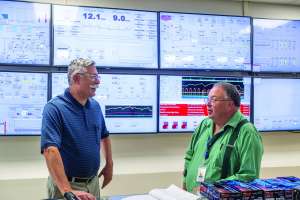
With an advanced SCADA system providing real-time monitoring and control, the staff uses about two dozen PLCs to stay connected with plant processes, CSO data, all pumps, safety measures and more. “The nice thing about our SCADA and mobile apps is we all have access to information,” says Rucker. “We used to have to go to the control room and push a button. Now it’s all on our PCs.”
Improved control is just one of the changes Rucker has seen over his 42-year career. “Processes have changed,” he says, noting that the industry has gone from trickling filters and rotating bio-contactors to processes like the biological nutrient removal technology his plant uses today. “BNR technology wasn’t even on the horizon when I started,” he says.
That was in the early 1980s, when Rucker earned an engineering technology degree from the local community college and joined the treatment plant staff as a trainee. “Originally, I was interested in hospital work, science and math,” he remembers. “But I switched to engineering technology. I applied first at the water plant, but jobs were scarce and I wasn’t hired. So, I applied at the wastewater plant. They were moving from traditional drafting to the CAD system.”
As a trainee, he learned the lab procedures along with operations and maintenance. He was a good enough apprentice to move up to management positions including plant supervisor in 1991. He was named superintendent in 1993. In 2012, the Virginia WEA honored Rucker with its William D. Hatfield Award: “That was a very special moment for me.”
After four decades in the clean water field, Rucker has many accomplishments to be proud of and a career’s worth of wisdom to share. Completing the city’s CSO project is one of his most significant achievements.
“Lynchburg was named a CSO city in 1989,” he says. That designation refers to municipalities with significant CSO issues. Lynchburg took on more than a dozen separate projects to remedy the situation in both the collection system and the treatment facility.
Closing off CSO overflow ports in the collection system and better managing flows enabled the city to direct more of the wastewater to the treatment plant. Maximum wet-weather flow at the plant increased from 22 mgd to 80-100 mgd. Plant capacity was increased through secondary clarifier baffles and Tow-Bro hydraulic sludge removal system (Evoqua Water Technologies [part of Xylem]) in the clarifiers. New 4 million-gallon storage tanks were installed to capture excess stormwater so it can be released later and blended with wastewater for treatment before discharge. The improvements enabled the city to treat most if not all storm flow and create less hazard for the environment.
Multiple plant improvement and expansion projects have occurred on Rucker’s watch. “We’ve had as many as 12 construction projects going on at the same time,” he says. “All of them affected our flow and our various treatment processes. We’ve had to deal with emergency breakdowns as well as issues with power lines, clarifier drives and feeders.”
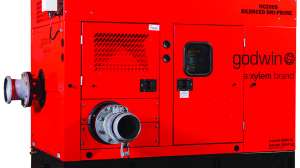
Built-in equipment and power source redundancy, plus temporary reliance on emergency diesel backup engine-generators (Cummins) helped address those issues.
Safety protocols for chemical containment, air monitoring, safety showers and personal protective equipment have advanced significantly. Relationships with the rate-paying public have changed as well.
“When I started, changes in the treatment system were not all that well publicized,” says Rucker. “Now, with our construction projects, we seek public input on all phases. We put out much more information to the public, even though I’m not always sure they’re paying attention to it. We’ve made a large effort to advise the public on what they should and should not put into the sewer system. They play a part in wastewater collection and treatment.”
One of Rucker’s challenges is finding team members. “When I first began, people tended to stay a long time,” he says.” Now we have a hard time finding people. There’s more turnover.”
While salaries are the biggest issue, the long training and development period can also work against wastewater utilities.
“One problem with wastewater is it takes two to three years to learn the plant, even longer to get state licensed,” Rucker says. “We’re looking for people with some education and an interest in mechanical things, or in collecting samples, running tests. Automation plays a big part in our operation now but it requires education in order to operate it.
“If you don’t like inside work, be prepared to do repairs. There’s a massive shortage of people capable of repairing mechanical or electrical equipment. This is an interesting field. It’s not boring or stagnant. There’s always something up. Legacy pollutants, for example. There’s a need for more and more knowledge. We want people to stay with us.”
As Rucker hangs it up, his staff members compliment him on his career. Timothy Mitchell and Geoffrey Poff of the city’s water resources department cite his knowledge of the Lynchburg facility and his dedication to improving the lives of area citizens.
Maintenance supervisor Mills observes, “Alvin invested time in me. Through his encouragement and support I was inspired to pursue my current position. I will always appreciate his confidence in me.”
Smith, operations supervisor, notes, “You could call him any time of day or night and he would always come up with a solution to your problem or situation.”
And Dunn, assistant superintendent, says, “Alvin is an excellent example of lifelong dedication to preserving the environment through hard work and perseverance.”
As his retirement nears, Rucker plans to spend more time with friends and family and travel a bit. “Nothing long distance,” he says. “Stay close to home and see more things in the area.”
Maybe he can head down to the James River and watch local folks, including his daughter and son-in-law, canoe and kayak on the water he helped keep clean.