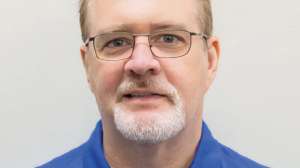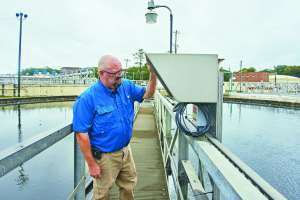

“See it. Learn it. Do it.” That motto best describes the management style of Rich Mickelsen, district manager for the Timpanogos Special Service District in Utah County, Utah.
It’s how he challenges his staff, and it typifies his approach as he has risen from private business, to laboratory analysis, to his current position.
Mickelsen recalls that when he was placed in charge of the Timpanogos Wastewater Treatment Plant five years ago, the staff seemed reluctant to learn new skills or take the initiative to solve problems. “It was almost like they might lose their jobs if they tried something new,” he says.
“It was a challenge. My role was to provide the tools and the education and safety programs we needed. Theirs was to talk with each other, share knowledge and learn how to run the plant.”
Today, he’s extremely happy with the staff: “They’re hard workers.” And the plant runs well, meeting all effluent requirements including stringent limits on phosphorus.
The Timpanogos treatment plant is just one of several responsibilities on Mickelsen’s plate.
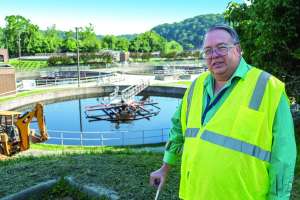
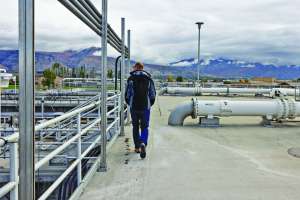
Recently optimized and scheduled for expansion to 40 mgd by 2029, the facility serves 10 cities and 90,000 connections in its area of Utah, just south of the Great Salt Lake. Together, those communities comprise the Timpanogos Special Service District, overseen by a board of directors representing the member cities.
It’s a responsibility that requires accommodating expected growth, while communicating effectively with the board, the municipalities and the rate-paying public. Mickelsen and his staff are also responsible for the collection systems that connect the district communities with the treatment facility.
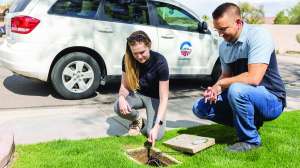
The team regularly schedules inspection for most of the system using POSM software, and line cleaning with Vactor combination trucks, coordinating with the various cities. “Some of the communities have their own cleaning equipment,” Mickelsen adds.
“It’s been quite a challenge because up to now we’ve recorded everything on paper. We’re making the transition to electronic data for better management and increased knowledge on where we’ve cleaned. Each of the cities is unique and they only see their own system.”
A new program from Cityworks is helping to retain institutional knowledge that is often lost as veteran workers retire and leave the team.
Interaction with so many communities requires a special brand of communication, a skill Mickelsen and his team have developed. It was a main reason Mickelsen was selected for the 2022 William D. Hatfield Award from the Water Environment Association of Utah.
The district’s website is a critical part of that effort. An education tab there includes projections for future growth and the resources needed by all district communities to meet future treatment plans. Another tab addresses algae blooms in Utah Lake, a regional water resource that receives the district’s treatment plant effluent.
“We have a video on our master plan, and other videos on research we’re conducting on the water quality in the lake,” says Mickelsen. He spends a great deal of time meeting with the board and representatives from member communities, sharing how the district is responding to growth, explaining rate structures and more.
A few decades ago the Timpanogos area was a small community with a basic 7 mgd oxidation ditch treatment plant. Today more than 300,000 residents have settled there. Mickelsen promotes the infrastructure expansions needed to support this growth and champions the need to maintain equipment and plan for the future.
The area promotes outdoor recreation and family-friendly lifestyles. Projections have the population more than doubling in the next 40 years. “People are moving here because they love the open spaces,” Mickelsen says. “It’s a great place.” He encourages his board “not to throw anything away,” but to keep and invest in maintaining what the district has: “We need to use our assets to their full life expectancy.”
Staff communications and relationships are equally critical, and Mickelsen is proud of the way the 43 full-time team members have adapted to recent changes and are preparing for the future: “I’m thrilled with the progress our staff is making. We have a wide range of ages on staff with a number of new and upcoming people learning the business.
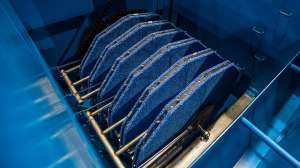
“We’ve moved from coarse aerators in the aerobic digesters, which basically just mixed the contents, to fine-bubble diffusers. Since 2020, on average, we’re meeting our annual phosphorus limit of 1 ppm.
“The aerobic digesters were designed by the engineers. Essentially, the tanks are holding basins until biosolids are dewatered. Those basins were releasing phosphorus because of lack of air. We increased air flow with fine diffusers. The phosphorus-accumulating organisms retain the phosphorus until the biosolids are dewatered. The additional air keeps them from going anaerobic. Our effluent phosphorus dropped from 2.3 mg/L-p to 0.6 mg/L.”
Mickelsen says the shift from paper to digital data management has been difficult for some staff members, as is generally the case everywhere. “Things like asset management and bar codes are picked up faster by the younger operators,” he says.
His job is to obtain the funding and furnish the tools and the training to help the operators do their job of making his facility run right. “My style includes meetings, demos, getting people to talk with each other and share knowledge,” he says.
“You need to know things here — how to maintain the biology, when to waste. The busier you are, the faster the day goes by. And you won’t lose your job by sharing your job knowledge with others. We promote a career path here. We want to keep good people around.”
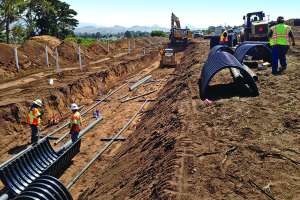
Experience and skill will be important in the upcoming process upgrades. The new plant will incorporate primary clarifiers, anaerobic digestion, thermal biosolids dryers, tertiary filters and other sidestream equipment to ensure consistent phosphorus removal throughout the year, preventing warm-weather releases of that nutrient.
Degrees in chemistry and mathematics, experience in private business, and a career in wastewater laboratories have prepared Mickelsen for his current challenges. He graduated from Weber State University in Ogden in 1991, and first joined a private company in the nutrient supplement market.
His job included laboratory analysis of the supplements, so he was prepared when, in 2000, a lab position opened up at a wastewater treatment utility. He worked in the labs in Brigham City, Ogden and Provo for several years.
“In the laboratory, you see everything that’s going on before anybody else,” he says.
That perspective gave him the broad view necessary to become district manager, a position he accepted five years ago. It also may have also provided him with vision and the eagerness to tackle tough problems.
Trevor Lindley, client manager with Brown and Caldwell, the firm working on the Timpanogos expansion project and one of the people who nominated Mickelsen for the Hatfield Ward, puts it this way:
“Rich is not just checking the boxes. He has a passion and a vision for wastewater treatment.
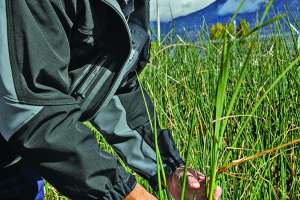
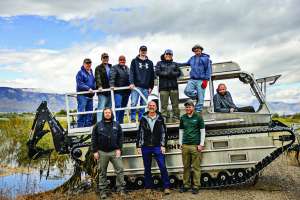
“He’s a strong leader. He wants to do things better, and he pushes against the norms. He paints a vision of doing things better than the way they’re being done. For example, there are some marginal wetlands near the plant. They could be ignored, but he wants to make them better.
“He does hard things.”
And he encourages those around him, from board members to ratepayers to employees to join him in that task.