
Many clean-water and drinking water professionals are retiring. Too few new people are coming in to replace them. It’s the recipe for a worker shortage in an industry that’s essential to protecting health and environment.
In response, Veolia North America is stepping up, opening its in-house online training program to the public to help Americans gain the knowledge and skills they need to begin well-paid, stable, rewarding careers in the water sector.
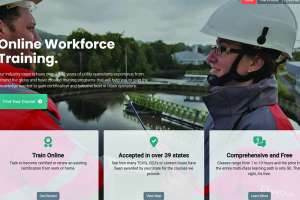
Veolia Academy offers free online courses that teach technical skills and prepare participants to earn the state certifications they need. The company says the industry in the United States needs tens of thousands of new workers.
The academy (academy.veolia.us) was founded in 2021 to prepare Veolia team members to advance their skills and earn promotions; already more than 200 have completed more than 400 courses. The training has been approved by 38 states, and more approvals are in process through the states’ licensing and regulation authorities.
Company President and CEO Fred Van Heems announced the initiative at the U.S. Conference of Mayors Annual Meeting last June in Columbus, Ohio. The academy offers courses in seven Learning Paths covering wastewater collection and treatment, drinking water treatment and distribution, water quality testing and the maintenance of water and wastewater systems.
Veolia team members developed and taught the courses. The academy is partnering with vocational and technical schools to provide the curriculum needed to prepare students to enter the water workforce. Karine Rougé, CEO of municipal water, and Adam Lisberg, senior vice president of communications for municipal water, talked about the academy in an interview with Treatment Plant Operator.
TPO: What is the history of the Veolia Academy?
Rougé: Veolia serves 28 million people in the U.S., which means we have operators from north to south and coast to coast with different competencies and grades of licenses. We were training them, mostly in the classroom. COVID forced us to digitize much of the curriculum. That was the origin of the online Veolia Academy, which initially focused on our own employees.
TPO: How was the decision made to open the academy to the public?
Rougé: As a big player we have a responsibility to the industry. Getting people into the industry and building their skills so we can manage the retirement wave is a huge challenge. And suddenly a lightbulb lit up: We have this amazing resource with hundreds of classes certified in many states. Why should we keep it to ourselves? Helping people get into the industry helps us, helps our customers, and helps meet the challenges our country faces. We decided to make the training 100% free and 100% accessible.
TPO: Why is an offering like this important for attracting people to water careers?
Lisberg: It’s the first step into the industry where people need the most help. It can be a tough ladder to climb. To get to the first rung, to learn that the industry exists, to acquire the basic skills, to earn the certification they need to get their first job, that’s where training and guidance are the most important. Once they’re in, it’s easier to see the progression.
TPO: How many people have taken advantage of the training?
Lisberg: As of Aug. 29, 2023, nearly 2,000 people had taken classes from the academy.
TPO: From your viewpoint, how acute is the shortage of water professionals?
Rougé: Across the U.S., on average it’s very acute, although it differs from state to state and on a local basis. Overall, the average age of a water industry worker is 55-plus, and particularly in the more senior licenses we do have gaps. In New Jersey where we have large operations all over, we don’t really have a shortage. But there are states where it’s a dire situation.
TPO: How does opening the academy align with Veolia’s strategic business objectives?
Rougé: It aligns well as a core part of the way we measure success. We are equally focused on financial, social and environmental performance, so sharing the academy is important for that reason. And second, because of our scale, the more people we have acquiring skills and becoming interested in the industry, the easier it will be for us to continue our growth. I’m convinced that everybody rises together. We will be better off this way than if we were just trying to hire people away from our competition.
TPO: Industry training programs typically focus on groups such as veterans, students in technical schools and operators looking to increase their licensing levels. Is that also the case for your initiative?
Rougé: Yes, and we also want to bring certain types of institutions and organizations on board. For example, we’re having discussions with municipal utilities that prefer not to build a training program by themselves; they can use Veolia Academy as part of their curriculum. We’re also having discussions with unions. Half of our workforce is affiliated with unions. They offer training, and the academy is a resource they want to be able to offer to their members.
TPO: What kinds of unions do you see getting involved?
Rougé: We’re having discussions with the union for pipefitters and plumbing trades, where there are entry-level jobs that you might not even need to have a high school diploma to get. They want to tell their people that now they have a path to earn a license to operate a water or wastewater plant and have a high-paying job.
TPO: Is there counseling to help people structure a curriculum for a certain career or a license in a particular state?
Rougé: There is no individual counseling, but if for example someone wants to earn a license for a given state, there is a full package with all the classes they need to take, depending on the grade of licensing they want to access.
TPO: How would you describe the breadth of classes available?
Rougé: It is very deep and extensive on water and wastewater operations. We are adding maintenance courses, and by the first quarter of this year we expect to have a dedicated program in advanced water treatment to satisfy the license requirements for water reuse in California. We think those courses will be valuable in other states as well.
TPO: Is there any thought of turning the academy into a revenue center?
Rougé: Absolutely not. If we were to turn it into a commercial venture, the whole intent of it would be lost. The challenge of building up skills for the industry is real. And from a community point of view, these jobs are great. They pay well, they are very stable, and they offer career opportunities. People can build a life on these jobs. They can get a mortgage, send their kids to college. If we can help even in a small way to get people into the industry and make a good life out of it, that’s good for everyone.
TPO: How many of the people taking the courses are new to the industry?
Rougé: That is a question we’re exploring. We plan to do an analysis of who is taking the courses and how long they stay, so we can have a better understanding of the need and target our outreach a bit better. Right now more people already in the industry are taking the classes because they have easier access to information about the academy.
TPO: How can the water sector compete with other sectors for quality people?
Lisberg: Many industries need people right now. You can hardly drive down the highway without seeing a billboard for jobs paying $17 an hour. The water sector doesn’t advertise on billboards, but it offers opportunities to people for careers they can stick with and really enjoy. Our industry’s appeal is not as obvious to the outside world as some others, but the payoff is a lot better. So that’s why we’re trying to get the word out there.