It might be difficult to imagine a wastewater treatment process that doesn’t use chemicals or biological agents or membranes or filters.
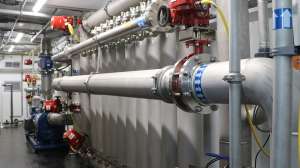
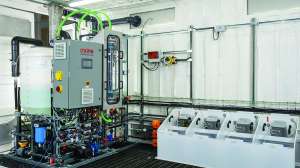
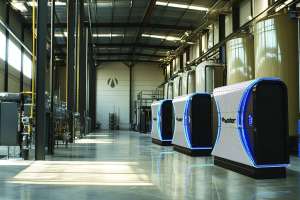
But that’s what a company called VVater is offering. Company leaders say it is redefining water reuse with a fully electric treatment technology. At its core is a technology called the Farady reactor. With ultra-low-energy electric fields, the process disrupts pollutants at the molecular level, destroying pathogens, endocrine disruptors, pharmaceuticals, PFAS and microplastics without generating secondary waste.
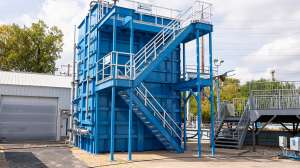
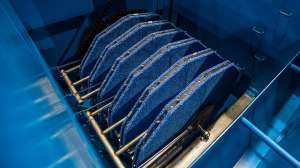
VVater’s process pairs the Farady reactors with advanced dissolved air flotation units.
For its technology, the company received the CES Best of Innovation 2025 and the 2025 World Future Award for Best Water Treatment Solution.
The awards recognize devices, software and services with potential to help transform the global economy and define the future. VVater CEO Kevin Gast talked about his company’s technology in an interview with Treatment Plant Operator.
TPO: What is the background for this technology’s development?
Gast: The technology was incubated in a larger company with significant industry experience. Working closely with plant operators, we recognized significant challenges for water treatment in dealing with chemicals, health and safety, energy usage and maintenance. We looked at how to modernize and simplify the process as a step forward in the market.
TPO: What is the basic principle on which this technology operates?
Gast: We developed an advanced low-tension electroporation process that is housed inside our Farady reactors. The key is low-voltage electroporation. With the appropriate combination of volts, amps, frequency and harmonics, we can literally chop up cells into a thousand little pieces, be they protozoa, parasites, viruses or bacteria. So we can disinfect without generating any sort of disinfection byproducts. We can also remove nitrates and phosphates and, to a degree, manipulate the mineral content in the water.
TPO: Can this process break the bonds in persistent organics such as PFAS?
Gast: We are one of few technologies that can destroy short-chain and long-chain PFAS. We achieve removal down to 6-8 parts per trillion at the commercial level and to less than 4 ppt at laboratory and pilot scale. By sometime in 2026, we believe we will be below 4 ppt on commercial systems.
TPO: How is this technology designed for each specific site?
Gast: We need to know the quality and chemical analysis of the water coming in, how much throughput will be required and the desired quality of the output. For example, do we need to take the water all the way to potable or ultrapure quality? Those variables dictate the nature and cost of the system we install.
TPO: In simple terms, how does the treatment process work?
Gast: We first run the water through our Farady reactor, where we zap it with electricity, instantly killing all the microorganisms and breaking apart other constituents in the water, depending on what the customer needs. We then pipe the water through an ADAF system that uses microbubble and nanobubble technology. We float the solids to the top, precipitate some solids to the bottom and skim the clean water straight down the middle. Then we run it through a polishing unit, which is a high-intensity pressurized cyclonic vessel. Depending on the requirements, we might add a secondary disinfection technology.
TPO: Can this process treat raw municipal wastewater?
Gast: Raw sewage would require a classical primary treatment process upstream, and probably treatment halfway through a secondary process, after which we would deploy our technology. But we are first and foremost an engineering partnering company, so we are fully capable of designing, building, owning and operating entire treatment plants from beginning to end.
TPO: How easy is the technology for plant personnel to learn and operate?
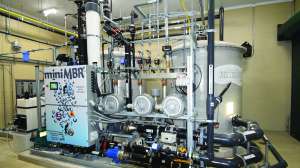
Gast: It’s somewhat like an electric vehicle in that it doesn’t have many moving parts. Our fixed systems operate with hydraulic retention times of under eight minutes, and — for our mobile units under four minutes. The system is designed to be fail-safe. It has automatic performance adjustments — continuous monitoring, adaptive control and remote support. It is extremely operator-friendly, and getting up to speed on the technology is really quick.
TPO: What maintenance does this process require?
Gast: There are no membranes to clean, no filters or UV lamps to replace and no chemical tanks to refill. Maintenance depends on the design. Our mobile units that take discharge water to potable water treat 100,000 gpd. One of our machines that had treated 25 million gallons was brought in for its first official service, and the cost was $480 for the entire package.
TPO: How does this technology’s cost of ownership compare with traditional processes?
Gast: he capital expense compared to a typical reverse osmosis system or conventional treatment process is probably 40% less, but the big savings come in the operating expense, which is 80% lower than anything else on the market. We use about 40% less energy.
TPO: What kinds or sizes of facilities is this technology best suited for?
Gast: The technology is easier to scale up than to scale down. A 5 mgd or 50 mgd facility is easier than a 10,000 gpd facility. The process is best suited for secondary and tertiary treatment, disinfection, direct and indirect potable reuse, pond treatments, nutrient removal and industrial closed-loop systems. Our mobile units are used for disaster relief and military applications. We also have skid-mounted package plants to assist customers building larger facilities over a two- to five-year construction period.
TPO: Has this process been deployed in commercial applications?
Gast: We have installations worldwide and are among the leading entities in direct potable reuse. To date, we’ve treated roughly 4.3 billion gallons.
TPO: Can the technology be applied to both new and existing treatment facilities?
Gast: It’s a modular process, which makes it easy to add on to existing facilities. But at the same time, we want to work with customers directly, starting from the design phase.
TPO: What is the financial arrangement with customers?
Gast: We use a contracting model called water as a service. We take on the entire capital project, and the customer signs a 10-year agreement with us. They make monthly payments to us in the same manner as for leasing a vehicle.