The World Bank’s Water Global Practice says fewer than one in five water workers are women.
In Belleville, Ontario, on Lake Ontario’s Bay of Quinte, a dozen women work in the production and distribution of drinking water. They account for 26% of the total workforce in the city, population 55,000.
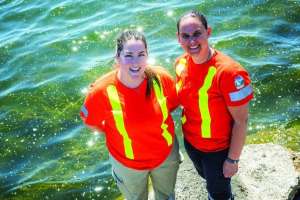
Among them are Joanne Biggs, Class IV, and Amy Lisk, Class III Water Treatment Operator certification. They and colleagues have grown comfortable in what is still a male-dominated sector.
Both women worked up through the ranks. Lisk started as a summer helper while in college, working for a number of municipal water departments. After schooling, she joined the Prince Edward County water department full-time and stayed four years before joining Belleville’s water treatment group in 2023.
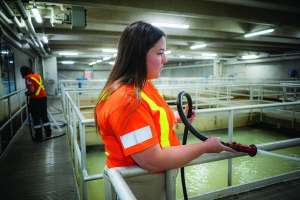
“I work on a rotating shift at the water plant,” Lisk says. “Our facility is staffed 24 hours a day, and we all take turns covering daytime, evening and midnight shifts. In the evenings and midnights, our shift operators run the plant alone.
“I oversee the operation of the plant and complete backwashes and dissolved air flotation system float-offs. I call in co-workers when there are issues at other stations and attend to any problems that arise.
“Sometimes our duties include decanting chemicals, rotating the duty of pumps or day tanks, transferring chemicals from bulk tanks to day tanks, completing lab analysis or taking treatment processes in and out of service for maintenance or cleaning. As time goes on and you learn the plant, you get to train new staff, take part in the Overall Responsible Operator rotation and lead more work tasks.”
Biggs got her start with a consulting company, where she learned about water and wastewater treatment. From there she worked in a smaller municipality’s water and wastewater department. She was hired on at Belleville in 2013 and is now part of the ORO rotation.
From an early age, Biggs knew she wanted to work in an environmental field. “Like many others, I took for granted that we turn on our taps and the water is safe,” she says. “This career gave me an appreciation for the day-to-day provisions and the people behind them that make this happen. Working in this field was just a natural evolution.” She earned her environmental technologist diploma from Sir Sandford Fleming College in Peterborough, Ontario, in 2008.
Lisk took notice of water treatment after graduating from Lakehead University with a bachelor’s degree in environmental science: “The appeal was its encouragement of continual learning, and the way the job offered a unique mix of science, math, chemistry and hands-on mechanical skills.”
As for working in male-dominated industry, “I did worry that being a woman would cause differences in how I was treated. Due to age and gender, I foresaw that at times I wouldn’t be taken as seriously as men who had done the job for longer. I feared that I wouldn’t be seen as a good candidate for promotions, but I didn’t let it dissuade me. I knew I was just as capable and able to learn to be as other young operators.”
Biggs, on the other hand, was encouraged to pursue a career by men in the industry, such as Jeff DeMarsh and Bob McKeown. “Jeff helped me get a placement with a consulting company,” she says.
“Bob is the retired superintendent for Belleville Water. I met him while working in consulting, along with a few other men who were no longer operating but working in related positions. I wasn’t mechanically strong, but I was assured that there was so much more to the job that it wouldn’t be a concern — that you have so much opportunity to learn and develop those skills.
“Indirectly, my dad had an influence on me becoming an operator. When I was new to the industry, he worked transport, making deliveries to some water and wastewater facilities. He’d have conversations with some of the staff while he was there and got an intro to the job.
“I was still new enough that I didn’t know much, and he’d tell me about so-and-so who worked wherever he stopped that day, and if they were hiring. I recall Dad even offering to keep a couple of my résumés with him, and he’d drop one off at the facilities next time he was there if I wanted.”
Belleville gives its water operators the training they need to upgrade or maintain their certifications. “We operate a Class IV facility, so all operators are encouraged to acquire their Class IV Water Treatment certificate,” says Lisk.
“We get credit for on-the-job training and CEUs for accredited training modules. With our shift schedule, coordinating training sessions is a bit difficult, but everyone gets what they need.” They take many courses at the Walkerton Clean Water Centre, a government training facility and are trained in safe practices like working at heights and entering confined spaces.
Biggs observes, “This industry has mandatory training requirements, so ongoing training hasn’t been a problem. I’ve focused some of my training on areas I thought were weaknesses, such as mechanical troubleshooting and equipment repair. Technology and legislation are constantly under review and development, so there’s always something to learn.”
Even with 12 women on the job, the water department is staffed mainly by men. “In my experience, being a woman in water is mostly positive,” says Lisk. “I have many wonderful co-workers who trust my abilities, and supervisors who treat me exactly the same as my male colleagues. There are many excellent women on our team, and it is lovely to be a part of a group with so many clever, hardworking ladies.”
Despite this, “There have been moments where I could tell people would have preferred a male operator. But that happens more with the public or contractors than within the department. All you can do is carry on, do your job and let your work speak for itself.”
Biggs notes that the prevalence of women in the industry is increasing: “It was common when I started out to be one of maybe three women in the room when I went to write an exam to upgrade my license. I love seeing the number of women increase each time I sit for an upgrade exam or take training courses.”
Both women see the water industry as a high-quality occupation with a solid career path. “I enjoy the variety this field offers, even in my daily responsibilities,” says Biggs. “You can be servicing a chemical pump one day, collecting samples another.
“You can be working as part of a team, but there’s also some independent work. It’s something where you’re never done learning. I need to be able to move around, and with this job I can. And I appreciate the job security: People will continue to need water, which means there will always be a need for it to be treated.”
Lisk observes, “This career path has been wonderful. I love to learn and develop, and that is a big focus in the water and wastewater industry. Continual improvement and training are pillars of this industry. I love being encouraged to know more and meet new people.
“I enjoy the day-to-day work very much. It’s the perfect blend of critical thinking, hands-on maintenance, data review and analysis, and problem-solving. You get to wear so many hats; you’re always on the move and up to something.
“This is a rewarding job. I’ve helped schools, hospitals, businesses and homes all be safe and comfortable. Even if people forget that I exist, I know I’ve done my job well; no news about water catastrophes is good news. The care people in the industry share for public safety and operational improvement makes me very proud to be a part of it.”