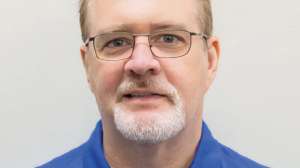
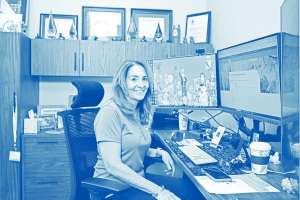
Weighing in trucks at the Pasco County Landfill was not Jeannie Burda’s idea of a stimulating career.
“I used to go home and tell my husband, ‘My brain is dying,’” she recalls. “I needed to be able to learn.” It turned out her career salvation was right next door at the Florida county’s Shady Hills Wastewater Treatment Plant.
Long story short, Burda has worked there for 16 years, the last 11 as lead operator. And between earning a Class A (highest) Wastewater Operator license, directing a 10-member team, dealing with aging equipment and manual processes and helping plan a major upgrade to meet new state effluent limits on nutrients, she has had ample room to learn and grow.
On top of that, last year she became the state’s first Wastewater Certified Professional Operator by completing a new program at the University of Florida’s Training, Research and Education for Environmental Occupations Center.
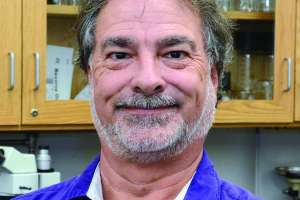
David Torres, a Shady Hills operator, remarks, “Jeannie is an incredible leader, someone who truly advocates for her team and makes a positive impact. She shows wisdom, confidence and a deep understanding of what is best for the team and the process.”
Driven by growth
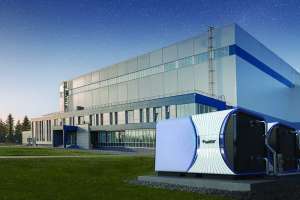
Pasco County, on Florida’s west-central coast north of Tampa, is among the nation’s fastest-growing counties, with a 2025 population of nearly 635,000. At Shady Hills (14 mgd design, 12.85 mgd average), Burda leads the team at the largest of the five treatment plants the county owns. The others, all currently using the modified Ludzack-Ettinger process, are:
- Wesley Center, 9 mgd design, 8.2 mgd average
- Embassy Hills, 1.8 mgd design, 1.7 mgd average, being updated to 2.25 mgd capacity with full biological nutrient removal
- Land O’ Lakes, 3.5 mgd design, 3.2 mgd average, slated for expansion to 5 mgd with BNR
- Southeast, 3 mgd design, 3.1 mgd average, being expanded to 6 mgd with an anaerobic-anoxic-oxic process
Burda grew up in Florida’s Pinellas County and completed the legal professional secretary program at Pinellas Vocational Technical School. She worked as a legal secretary for 10 years, moved with husband, Jim, and their two children to Pasco County in 2001, and took the job at the landfill in 2007.
Every day she saw the Shady Hills facility, then just being built, and was intrigued. She found out about the county’s wastewater trainee program, applied and in 2009 was hired. “I was fascinated with wastewater treatment, but I had no idea what anything was,” Burda says. “I didn’t even know what a coupling was.
“But everything happened to work out perfectly because when I started, this whole plant was under construction. I could see all the pipes, and all the gentlemen here were opening up blueprints.” She learned by relentlessly asking questions: “The men taught me everything. I am so grateful to everybody who helped train me.”
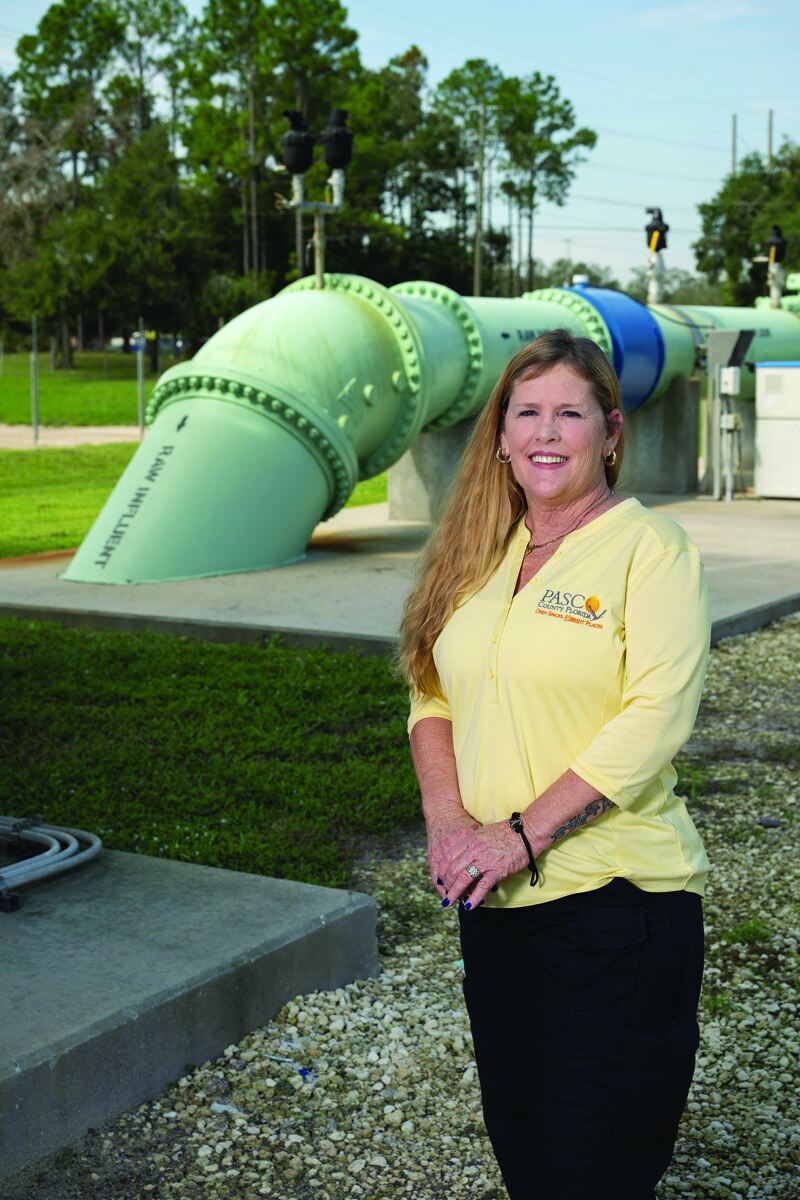
She especially remembers Johnnie Fogg, a lead operator now retired: “I started under him as a trainee, and one day he sent me to change a flow meter. I went out there and had no idea what to do. I called him on the radio and he said, ‘Jeannie, look at the pipes.’
“I put down that radio and started looking at the pipes, and I saw that there were arrows on them that pointed which direction the flow was going and which valves to open. The advice he gave me to follow the pipes has stayed with me throughout my career.” Now she gives that same advice to trainees in her charge.
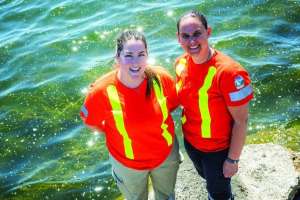
Her Shady Hills team in addition to Torres now includes plant operators James Bravico, Caleb Corson, Jeff Diedrich, Dan Hostetler, Cody Khan, David Murvine, Terry Smith, Glen Altomare and John Northup. “I’ve never had a job before where I could say I was so blessed with my team. The crew I have now: Wow!”
Extensive reuse
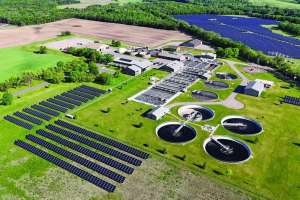
The Shady Hills plant is designed for a modified Ludzack-Ettinger process but operates as an extended aeration facility. The headworks, soon to be upgraded, has two coarse screens (Spaans Babcock) and an Eimco grit chamber (Ovivo).
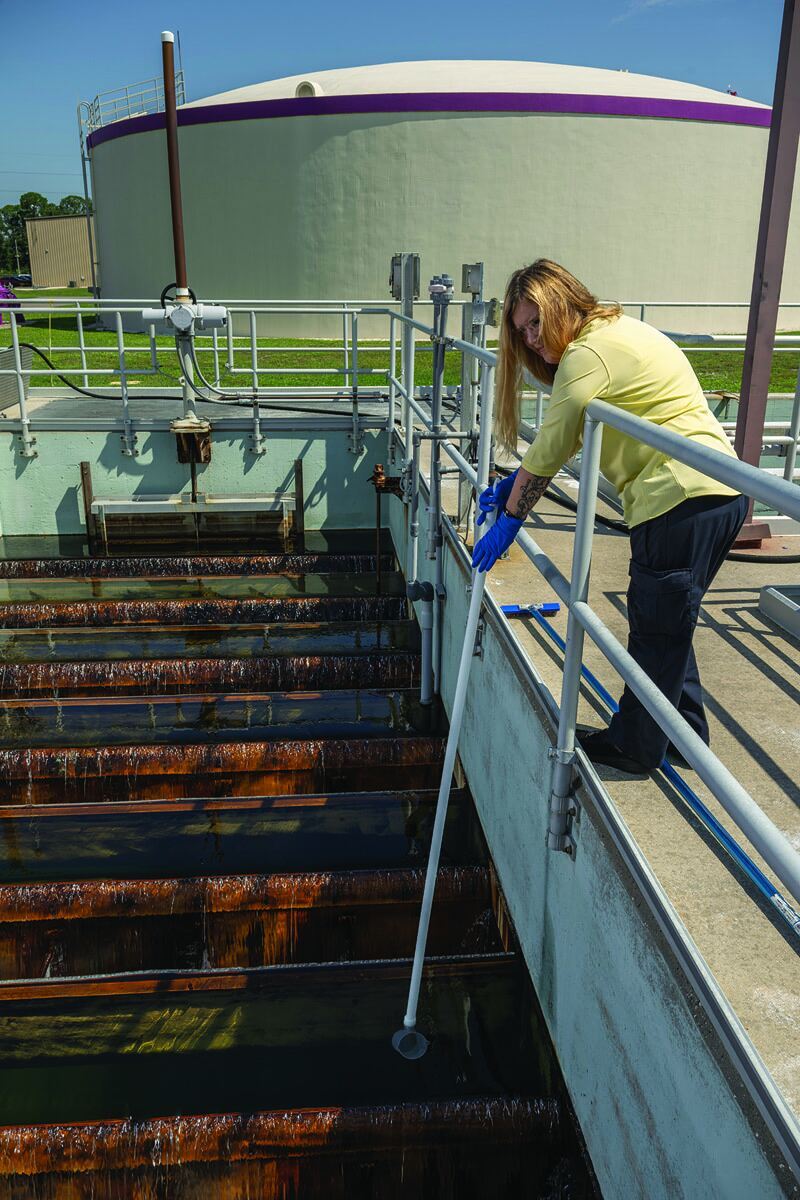
Wastewater proceeds from the headworks to four aeration basins with fine-bubble diffusers (Sanitaire - a Xylem brand) fed by five Hoffman & Lamson blowers (by Gardner Denver). The flow then moves on to six secondary clarifiers, followed by seven deep-bed filters (Roberts Filter Group) and two chlorine contact chambers.
The facility has a pair of 5 million-gallon tanks for public distribution of reuse water and a 1.5 million-gallon tank for reclaim water used on site and for delivery of water to the landfill’s cooling towers. In addition, Seminole Electric will soon receive 3 mgd for its cooling towers.
“With a 14 million-gallon reject pond, we have capacity for 1.2 days of a reject event if that were to happen,” Burda says. “We also have four rapid-reuse infiltration basins for emergencies. We had to use them in 2024 during two hurricanes.”
Waste activated sludge goes directly to a pair of storage tanks and then to five belt filter presses (Alfa Laval). The dewatered biosolids are picked up by Merrell Brothers Biosolids Management Services and processed into Class AA Florida Green fertilizer in a public-private partnership with Pasco County.

Facing challenges
The most critical task at Shady Hills is to meet the requirements of a state Department of Environmental Protection Basin Management Action Plan for the Weeki Wachee River. BMAPs provide a framework for water quality restoration through comprehensive solutions to achieve the pollutant reductions, notably for nitrogen and phosphorus, based on total maximum daily loadings.
The BMAP affecting Shady Hills will limit effluent total nitrogen to 3.0 mg/L. No phosphorus limit is specified, but the maximum phosphorus recorded in sampling each month must be reported. It was the BMAP and the process changes it will require that led Burda to pursue the Wastewater Certified Professional Operator program.
All five Pasco County treatment plants are now under construction, though not in all cases for the Weeki Wachee BMAP. Shady Hills is being redesigned for a five-stage Bardenpho process with intent to meet the BMAP requirements by February of 2028. As of that point, the county will be under a consent order until the requirements are met.
“As part of the county’s mission to serve our community and create a better future, we’re taking big strides to reduce nitrogen,” Burda says. “That’s why we’re upgrading our treatment plants with advanced technology and increased capacity.”
A key challenge for Shady Hills is that for the most part the plant is operated manually. Another is dealing with about 1 million gallons per month of leachate delivered via pipeline from the landfill next door, and additional trucked-in slug loads of leachate.
“It’s a great accomplishment that our team is able to maintain compliance with all the adversity of this toxic leachate coming in,” says Burda. It helps that the trucked leachate is being diverted to the Wesley Chapel facility, which has a process better equipped to treat it.
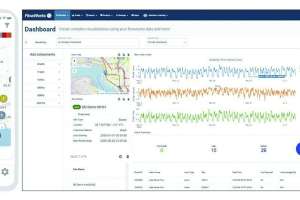
Meanwhile, the county is preparing for a SCADA upgrade for all five plants, featuring AVEVA enterprise software. At present, two 55-inch screens in the administration room enable team members to observe and control operations.
Team building
While supporting the plant upgrades, Burda has worked to improve teamwork and morale. Soon after taking her current role, she observed that the five lead plant operators were not necessarily familiar with each other’s facilities. She instituted walk-arounds for the leads at all the plants, so that, for example, “when I’m on call, if another plant’s operators would call me in the middle of the night, at least I would know what I’d be looking at.”
At Shady Hills a couple of years ago, she started an Operator of the Month program, sending an email each month and asking team members to vote: “They send me their votes, I write up something about the winner, take pictures and post it on the bulletin board.” The winner also receives a token of appreciation, and front-row parking for the month.
On Wednesdays Burda hosts team meals, alternating breakfasts and lunches so that all three operator shifts can attend: “That way, everybody is part of it. It’s not just about work. We make it fun. I’ve had the same crew for eight years now. Everybody truly loves their job.”
Reaching out
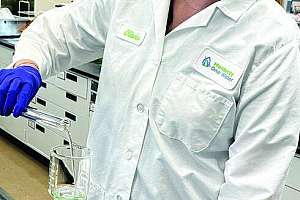
Burda also looks to show county residents what her team does and why it matters. When groups take tours, they notice that the plant is impeccably clean. “Until people come into a facility, they don’t realize what really goes on there,” Burda says. “Once they get here, they are in awe.
“I love being able to put up a sample of what’s coming in. Then I put up a beaker of bottled water and a beaker of our final effluent, and they can’t tell which one is which. That’s our heart right there. That’s what we’re here for.”