Wipes manufacturers are taking steps to help clean-water agencies deal with the problem of wipes and other durable debris in collections systems.
Measures include setting standards for flushable wipes to make sure products with that designation actually break down easily on their way through the pipes, in a manner similar to bathroom tissue.
Consumer education is another priority, under the banner of the Responsible Flushing Alliance. It includes support for proper labeling of packages for flushable and nonflushable products and conducting an annual Flush Smart public awareness campaign.
RFA also has also performed and shared the results of studies on the types and quantities of flushed materials found in wastewater systems. Lara Wyss, RFA president, talked about the industry’s initiatives in an interview with Treatment Plant Operator.
TPO: How would you summarize progress on regulation of wipes in collection systems?
Wyss: Since really 2021, seven states have passed laws requiring proper labeling of wet wipes: California, Washington, Oregon, Illinois, Colorado, New Jersey and Michigan. These laws require nonflushable wipes that are mainly used in the bathroom and that contain plastic to have the Do Not Flush symbol on the package. We also see a lot of collaboration on those laws between the wipes industry and wastewater sector. And at the federal level, there’s a bipartisan WIPPES Act that would make Do Not Flush labeling a national requirement.
TPO: Do you have evidence that the Do Not Flush messaging is reaching consumers?
Wyss: We’ve done a national survey for the last couple years to gauge people’s knowledge of what can and cannot be flushed and to check our progress on educating people about the Do Not Flush symbol. The first survey was in 2021. Over the past four years, the percentage of people familiar with the symbol is up by nine points, to 78%. People who say they’re knowledgeable about nonflushable products are up 11 points, to 48%. And people who have flushed something they knew they shouldn’t are down 10 points, to 48%.
TPO: Is there any similar data related to specific kinds of wipes?
Wyss: All baby wipes are required to have the Do Not Flush symbol. People who thought baby wipes were flushable started out at 19%, and now it’s down to 13%. People who thought surface cleaning wipes were flushable are down from 13% to 8%, and for makeup removal wipes it’s down from 11% to 8%. This indicates that the combination of the legal requirements and our consumer education campaign is making a difference.

TPO: Specifically, how does the industry define flushability in wipes products?
Wyss: Two primary standards are used in the U.S.: the International Water Services Flushability Group standard, and the GD4 standard created by INDA, the wipes industry association. Both have a slosh box test to see how the wipe breaks down in water. They also take the particles, put them in a sieve and then measure and weigh how much passes through. The tests are designed to simulate what happens in a wastewater system. It’s my understanding that most flushable wipes go through the IWSFG standard, which is slightly more stringent.
TPO: How do flushable wipes differ from nonflushable wipes?
Wyss: Flushable wipes are made with short, plant-based fibers. Nonflushable wipes are made with very long fibers that are intertwined to make the product durable and strong. Those types of wipes would need to have the Do Not Flush symbol. Nonflushable wipes represent about 90% of wipes sold in the U.S. Ten percent of wipes products are labeled as flushable, but that is a growing segment, so it is important to explain the difference.
TPO: What have your studies found about the kinds of wipes found in collection systems?
Wyss: We worked with the California Association of Sanitation Agencies and the nonwovens industry group on the largest collection system study conducted to date. Thirty-four percent of the items we collected were wipes that would have been labeled with the Do Not Flush symbol. That tells us that the laws are targeting the right wipes, and that it’s very important for us to continue educating consumers on why they should not flush those. Fifty-three percent of the items were paper towels, and 7% were feminine hygiene products.
TPO: What share of the items collected were flushable wipes?
Wyss: Just under 1% were fragments of flushable wipes. All of the items collected were fully intact except for the fragments of flushable wipes, which were attached to items that shouldn’t be flushed. This shows that the flushability standards are working.
TPO: Why is it necessary to have flushable wipes at all? Why not simply educate the public not to flush any type of wipes?
Wyss: Flushable wipes have a very specific usage. They are meant to be a supplement to or replacement for dry toilet paper, and they are sold in stores next to the toilet paper. Consumers like them. They see them as good hygiene products. We’ve spent our first years generating awareness for the Do Not Flush symbol. Now we’re talking about why you shouldn’t flush those wipes and how flushable wipes are different.
TPO: Why is education about different wipes so challenging?
Wyss: We’ve found that people are flushing baby wipes, cleaning wipes and makeup removal wipes. And unfortunately they’re all white rectangles. From a consumer perspective, they need to trust the label, and if it has the Do Not Flush symbol, it goes in the trash, never the toilet. And if it is labeled as flushable, then it has gone through the flushability standards. But we also like to say: When in doubt, throw it out.
TPO: Are there both flushable and nonflushable symbols that go on the packaging?
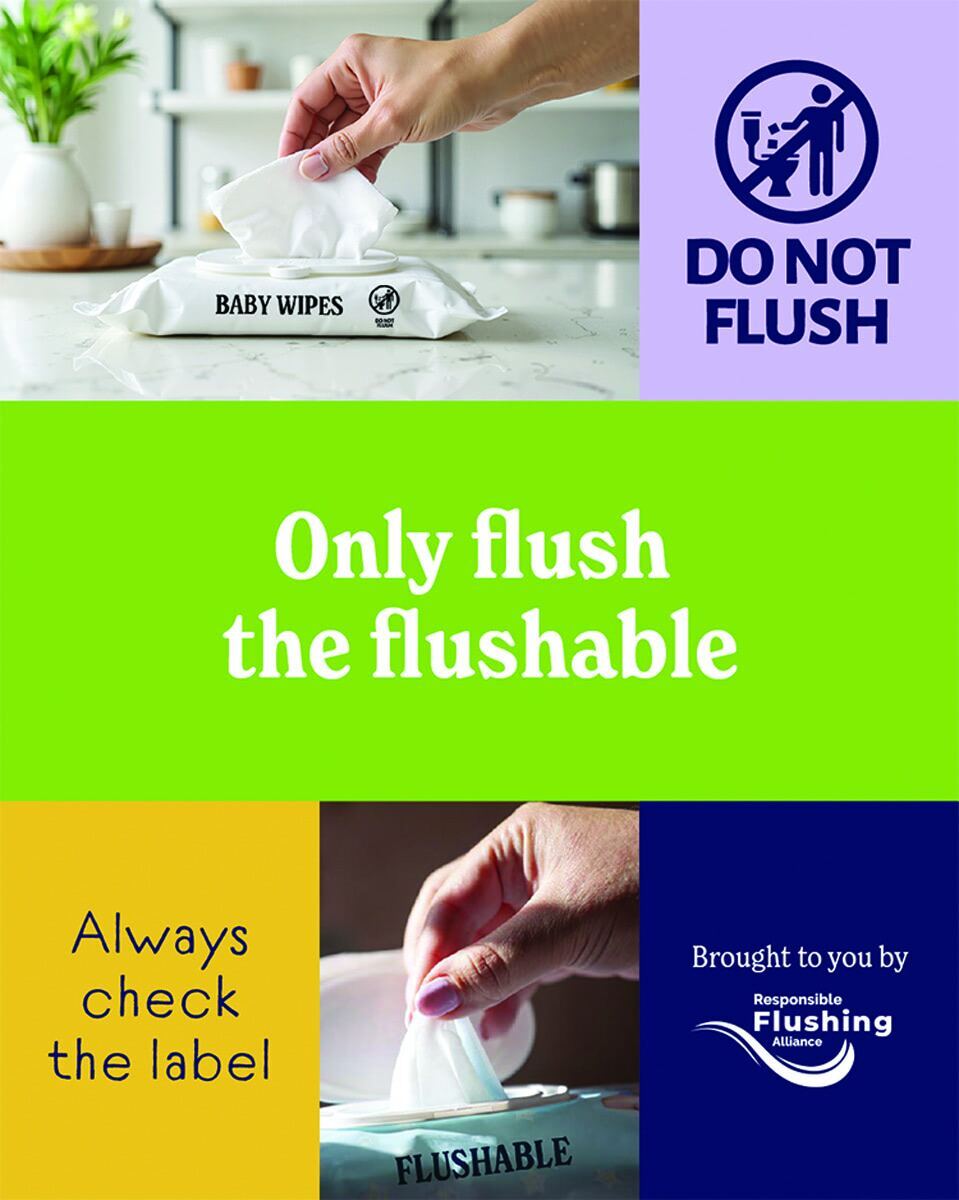
Wyss: At present there is not a flushable symbol. I believe the International Standards Organization is talking about having some type of flushable and nonflushable symbols. But right now, if it’s a flushable wipe, it will just have the word flushable on the package.
TPO: How would you characterize progress in the industry to ensure that wipes labeled as flushable actually do disintegrate as they are supposed to?
Wyss: The flushability standards have grown more rigorous over the years, and I feel very confident that if a wipe product is labeled flushable, then it truly is. And if it were not, it could be breaking the law. The proper labeling laws for nonflushable wipes require the Do Not Flush symbol. The words have to be of a certain size proportional to the package, and they have to be on the front.
TPO: What do RFA educational campaigns look like?
Wyss: We’ve been around for five years, and 2022 was our first Flush Smart Day. It was on July 1 to coincide with when the California labeling law went into effect. Then in 2023 we introduced a character called the Clog Monster, who is the embodiment of all the things we’re not supposed to flush. In 2024, we created a talking and singing toilet named Mel. He was the sidekick to Detective Vincent Drains, and they were solving toilet crimes. We’re always looking for humorous ways to break through the clutter.
TPO: What has been the focus of this year’s campaign?
Wyss: This year we’re doing Potty Training for Grown-ups, and we extended it into back-to-school season. We partnered with influencers who came up with some hilarious songs about looking for the Do Not Flush symbol and knowing which wipes are and are not flushable. I presented the campaign at the World of Wipes industry conference, and everybody was clapping and really loving it. And every year when I present to wastewater groups, they really love it, too. These efforts are supported by a steady stream of content on our blog and social media channels, and we keep that conversation going year round. We also provide educational materials in both Spanish and English, available and free and downloadable from our website.
TPO: What are you doing to support and enhance utilities’ own education campaigns?
Wyss: I speak at different national and state wastewater conferences. I’ve heard good comments about our educational sheets, which wastewater agencies can print out and hand out, such as to kids when they come through on plant tours. We also share social media content that agencies can cut and paste. We have a monthly newsletter that always includes something from social media that they can share. And we have a coloring book that features Apollo the clog-fighting dog that agencies can download from our website.
TPO: How have clean-water agencies responded to your campaigns?
Wyss: The response has been overwhelmingly positive. I’ve presented our collection study results in person at conferences and over Zoom. They’re very interested in seeing the data, and very appreciative of our campaigns.
TPO: What will be RFA’s emphasis over the next two to three years?
Wyss: We’ll keep building on our Flush Smart campaign. For next year, we’ll continue supporting the idea of trusting the label. And we hope the federal WIPPES Act is passed by the end of this year, since that will make product labeling a national requirement. It will make it really important for people to know they can trust the label: If it says do not flush, then do not flush it.
TPO: How can readers learn more about RFA and its initiatives?
Wyss: They are welcome to visit our website at flushsmart.org. And if they reach out to me at lara@flushsmart.org, I’ll be happy to chat with them.