The Hendersonville Water and Sewer Department doesn’t always do things the easy way. Maybe that’s why it won the city’s Sustainability Hero Award in 2025.
Hendersonville, North Carolina, has numerous sewer pipes next to streambeds that are vulnerable to erosion in flood events. The typical way to fix sewers exposed by erosion is to dump stone or riprap around the damaged area. While that is relatively inexpensive, simply armoring the area often fails to address the underlying cause of erosion.
“We’ve done some projects where we actually use bioengineering,” says Adam Steurer, P.E., utilities director. “We’re doing bank stabilization using logs or boulders to create pools and flowing riffles, and we’re planting native species along some streams where there has been erosion and deterioration.
“It improves the quality of the stream and also protects our infrastructure. We’ve done quite a few projects where we brought in a contractor, engineered plans and stabilized the stream. The streams always look really good after. It’s a cool program.”
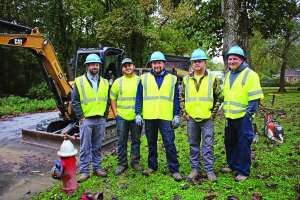
Now several members of the Water and Sewer Department have been trained in stream restoration, and they take on some smaller projects. “Some of our crews have done this work, and it always turns out really good,” Steurer says. “I’m proud of our department’s initiative to perform proper stream restoration practices and not simply dump riprap on eroded areas.”
Three department members — Bo Stepp, Damian Bingham and Chase Dowdy — were mentioned for their stream restorations by the city’s Environmental Sustainability Board when it presented the award. Also mentioned was Stephen Bell, laboratory supervisor, who initiated a recycling program at the water treatment facility.

Solids management
The stream restorations are just one component of the city’s sustainability practices. The department is upgrading its biosolids management in a way that Steurer believes will significantly reduce costs.
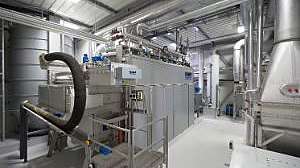
At present, the solids are dewatered with belt presses (Sernagiotto Technologies) to about 16% solids before being landfilled. A thermal dryer (Gryphon Environmental) will be added to yield a 90% solids Class A product that can be used as fertilizer.
“The dryer cooks off extra water and heats the material to a temperature that kills any remaining pathogens,” says Steurer. “So we turn wet and kind of soupy material that has to be landfilled into a dry product that can be beneficially used for agricultural applications.”
When the dryer goes online in fall 2026, Steurer expects to sell the biosolids, but the sales revenue is a small fraction of the project’s value. Avoiding the hauling costs and landfill tipping fees will save about $500,000 a year.
A 200 kW photovoltaic system on the roof of the new biosolids drying facility will offset 70-100% of its electrical demand. Steurer calls it the department’s “shining star” sustainability project.
As for the water side, the Hendersonville Wastewater Treatment Plant (4.8 mgd design, 3 mgd average) serves about 25,000 residents, mainly in the city limits. Most people outside the city are on septic systems. The 12 mgd water treatment plant, serving 80,000 in the city and surrounding area, is being expanded to 15 mgd.
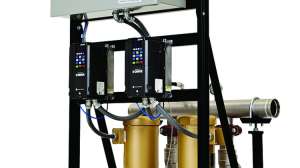
Meanwhile, the department has been replacing obsolete pumps and motors with more efficient versions with variable-frequency drives. The UV disinfection system at the wastewater treatment facility has been ungraded to a new unit (Trojan Technologies). These measures have saved electricity and, in some cases, yielded significant utility rebates.

Branding the water
For the past few years, Hendersonville has been promoting its water with the slogan, “Mountains on Tap,” used on reusable water bottles and bumper stickers and in social media.
“We wanted to brand our tap water, kind of like a marketing campaign,” Steurer says. “We have some good water sources being located where we are. A lot of our water comes out of Pisgah National Forest, and we do treat it, but it’s very high quality.”
The city promotes tap water to emphasize its cost advantage over bottled water and discourage use of plastic bottles. Steurer notes that many water system customers come from areas in Central or South America where tap water may not be safe to drink. Without education and outreach, those perceptions may remain in the community.
While so far no data shows whether the marketing campaign is converting residents to tap water, Steurer believes it is making people more aware of city water’s high quality.
“We’ve promoted and improved our education and outreach within the last two or three years,” he says. “We participate at public events. We promote campaigns such as Drinking Water Week, Imagine a Day Without Water and Fix-A-Leak Week. We have bumper stickers, and we’ve put our logo in public buildings that are on our water system, just so folks think a little more about where their water comes from.”
Hurricane recovery
Another reason for the sustainability award was the department’s quick recovery after Hurricane Helene, which caused widespread flooding and power outages in fall 2024. About 95% of water customers had service restored within five or six days, although it was two weeks before all were back online.
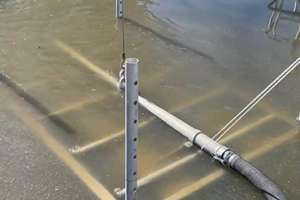
“There were a lot of places where waterlines cross streams, and they just blew out,” says Steurer. “Or if they ran along a road, the road washed away and took the pipe with it. For the first day or two it was difficult just getting around our system to locate these issues. Roads were closed or trees were down, and you couldn’t really get anywhere.”
Backup power has to be used at most of the pump stations and the water treatment plant because so many power lines were down: “The first couple of days were pretty hectic, but we were able to isolate the leaks in a pretty efficient manner, and then start making repairs and reinstating service.”
The city relied on help from contractors as the staff couldn’t handle the extreme workload. Assistance also came from other utilities across the state by way of NCWaterWARN, a mutual aid organization through NC Rural Water Association.
The stream restorations also paid some dividends during the flooding: “After the hurricane, a lot of those locations held up very well and are still in really good shape compared to areas that didn’t have that work.”