A key to reducing I&I is to know where clear water is entering the collection system.
Strategic flow metering can identify and quantify I&I sources and in turn help clean-water utilities set priorities for investment in piping and manhole rehabilitation.
Now Flow-Tronic offers a smart flowmeter designed for open channels, which include partially filled pipes, as in gravity sewers. The BELUGA A/V meter uses ultrasonic sound waves to measure the speed of flow and a pressure sensor to measure depth. From these measurements, the meter calculates the flow in real time.
The manufacturer says the unit’s compact size and ease of installation enable accurate monitoring even in remote, hard-to-access and buried open channels without large equipment. A replaceable pressure sensor extends meter life; there is no need to replace the entire unit if the sensor wears out.
All calculations are completed inside the sensor so that flow measurement is output and ready to use in real time. The built-in processor means no external hardware is required. Vincent Favre, North American sales manager with Flow-Tronic, talked about the technology in an interview with Treatment Plant Operator.
TPO: What is the background of Flow-Tronic in the water and wastewater industry?
Favre: Our products are manufactured in Belgium and sold in the United States through representatives and through a partnership with Badger Meter, which buys our sensors for their products. We manufacture a variety of sensors that measure the velocity of water in full or partially filled pipes. We focus our engineering on making very accurate and reliable velocity sensors for drinking water, wastewater and stormwater systems.
TPO: What differentiates the BELUGA A/V from other sensors in the marketplace?
Favre: It is a submersible area/velocity sensor in which the level sensor is replaceable. In previous devices, a failure of the pressure sensor meant replacing the entire device. In our unit, if the level sensor goes bad, you remove it, put a new one in and you’re good to go for many years. In addition the BELUGA A/V, like all our products, uses an open protocol. The information can be uploaded to a SCADA system, a remote data logger or mobile devices. And we sized the meter to fit in very small pipes.
TPO: In basic terms, how does this technology work?
Favre: The sensor sits on the bottom of the pipe, facing the flow. For the velocity measurement, it sends an ultrasonic signal into the flow. That signal is bounced back by particles in the water, and the speed is calculated using the Doppler effect, the same principle as the devices police officers use when checking the speed of cars. For the water level, the device measures the pressure of the water above a membrane.
TPO: Does the sensor also need to know the area inside the pipe?
Favre: Yes. We include software so that customers can enter the size of the pipe, allow for the presence of sediment at the bottom of the pipe, and more. Users can program all sorts of conditions that enable the device to calculate the right area and calculate the flow.
TPO: Where in a collection system would this device typically be deployed?
Favre: It can be installed at any access to the sewer pipes, particularly through manholes.
TPO: Does the device have applications beyond monitoring I&I?
Favre: I&I is a big application for us, but the device can be used for flow monitoring in any open channel. It can monitor the flow of treated wastewater to a river. We also do a lot of CSO and SSO monitoring, as well as discharge monitoring on the industrial side. The one thing we don’t do with this technology is measure flow in very large pipes. We have other technologies much better suited to that purpose.
TPO: How does the flow information from the sensor get to the user?
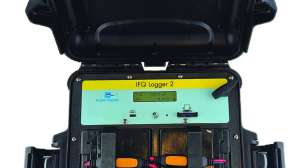
Favre: A cable runs along a stainless steel band connected to a communication device just underneath the manhole cover. It sends the data to the cloud using a SIM card. In the case of Badger Meter, they have a remote-enabled battery-powered data logger that transmits the information.
TPO: How easy is the technology for users to learn and operate?
Favre: What comes out of the sensor for analysis can we very simple or more complex, depending on the user’s needs. The main information they receive is the calculated flow. We also output the velocity and the level, because some users are engineering companies that prefer to do their own calculations. The device also reports the signal strength as a value from zero to 100, and the water temperature, which is becoming more important because stream discharges that are too warm can have an impact on the watershed and on fish and other life in the water.
TPO: What maintenance does the device require?
Favre: The primary maintenance is cleaning. Once in a while the user needs to go into the manhole and clear away sediment deposits or rags or paper that stick to the sensor.
TPO: Does the user receive some kind of notification if the sensor is blocked?
Favre: Yes. The sensor will simply stop working. If it is covered by a rag, for example, the velocity reading will drop to zero.
TPO: What kinds of customers is this product best suited for?
Favre: Our main customers at this stage are private companies that do I&I analysis and CSO monitoring. But recently we see a number of utilities in small towns buying one or two units because they have issues with I&I and want to monitor it.