Concerns about PFAS in drinking water keep rising. And so does the number of technologies designed to remove these “forever chemicals.”
There are at least two key challenges in PFAS treatment. First, removing PFAS can mean big money and significant water rate hikes for customers. Second, common treatment methods like ion exchange and activated carbon transfer the PFAS to media that then has to be managed.
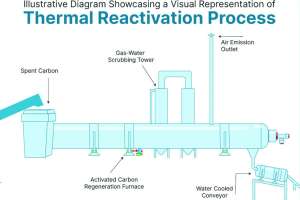
In response, a Birchtech division, WE2C Environmental, has developed an optimized technology aimed at communities that will use or already use granular activated carbon for PFAS treatment. The company says its thermal reactivation process for GAC can in some cases deliver rejuvenated material with more capacity to adsorb pollutants than virgin material.
This will reduce the frequency of GAC reactivation, improve treatment efficiency, and make PFAS treatment more affordable. The company’s aim is to offer thermal reactivation as a service from strategic locations around the country. Dr. David Mazyck, division director of WE2C Environmental, talked about the technology in an interview with Treatment Plant Operator.
TPO: What is the motivation for bringing this technology to the water utility market?
Mazyck: There is much discussion about forever chemicals and PFAS regulation that will affect all water utilities in a few more years. Our focus is on any water utility that uses GAC for water-quality purposes. GAC has been used in water treatment for decades, but we expect its use to increase to meet the PFAS regulations.
TPO: What is the current status of thermal reactivation for GAC?
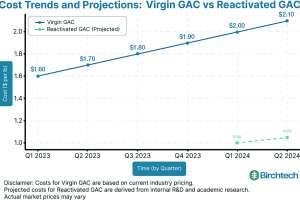
Mazyck: GAC has a finite capacity to adsorb contaminants. Thermal reactivation is available throughout the U.S., but relatively sparingly. It is there for those that are doing it on site, and there are some geographical locations where it is done. Our focus is to offer thermal reactivation as a more sustainable solution that can reduce cost by about 50%, making compliance with PFAS regulations more affordable.
TPO: Where would the reactivation process be performed?
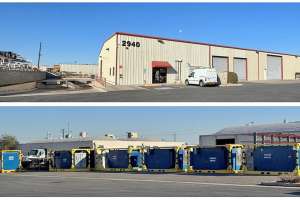
Mazyck: The utilities would ship the spent carbon to our facilities where we would thermally reactivate it and return it. You can think in terms of having reactivation centers in locations supporting areas where the volume of spent carbon is sufficiently high.
TPO: How can you take in spent GAC and give it more capacity than virgin material?
Mazyck: Thermal reactivation has not been a focal point over the past several decades, and therefore the process is generally not optimized. It does a decent job, and that has been good enough. We will supply a more fine-tuned approach whereby at the very least the rejuvenated carbon can perform the same as virgin GAC. And, based on our know-how and method, we will be able in many cases to uplift its performance.
TPO: In basic terms, how does the optimized reactivation process work?
Mazyck: Thermal reactivation is essentially a chemical reaction. My Ph.D. dissertation focused on thermal reactivation, and for the past 25 years I’ve studied this reaction and how to control it. It’s one thing to control a chemical reaction; it’s another thing to design equipment to do so. That’s where the experience and expertise of our organization comes in.
TPO: What progress have you made in setting up thermal reactivation sites?
Mazyck: Right now, we are identifying the preferred spots. We have time on our side because the PFAS regulations give water utilities until 2027 to start monitoring for PFAS and until 2029 to achieve compliance. So we want utilities to start now with piloting the use of GAC. In the meantime, we would work with them to understand how often they will need to reactivate in the context of a partnership. We would then discuss with them where to locate the reactivation sites and how to space them out to meet demand, with sustainability and feasibility at the forefront.
TPO: What will be the basic pricing structure for this program?
Mazyck: It will be priced on a per-pound basis. To use a simplified example, suppose that a utility simply replaces spent carbon with new carbon at about $2 per pound. Now imagine thermal reactivation being about half that cost. That allows them to meet the PFAS regulations legislation at a much lower operation and maintenance cost.
TPO: And you would be giving them a product better than virgin carbon?
Mazyck: That is our goal. In reality, there will be cases where the quality is about the same as virgin, and cases where it will be better. Every water in the country is different, so there will be some variables out of our control. But at present, utilities using reactivated carbon may see a 25% to 50% decrease in performance relative to virgin material.
TPO: Does your theoretical cost comparison include the cost of shipping material to and from the reactivation sites?
Mazyck: The short answer is yes. We look at the shipping cost as neutral because whether they’re taking reactivated carbon from our facilities or receiving virgin carbon, the material has to be shipped to the utility location.
TPO: And if their spent carbon is not being reactivated, it still would need to be shipped somewhere for final disposition?
Mazyck: Yes. One option is to landfill it, and that has costs. Landfills have tipping fees, and already there are discussions on whether spent carbon that contains PFAS could be classified as a hazardous waste. That would increase the tipping fees.
TPO: Is there a sweet spot for your process in terms of utility size?
Mazyck: There is an opportunity for all utilities to benefit. Looking at life cycle cost, it’s easy to conclude that we can benefit any utility that will use GAC in the future. That includes small utilities. We have a strong desire to work with rural water utilities, which often are neglected and struggle as a result. We have boots on the ground in these rural communities, and we attend Rural Water Association conferences. We’ve worked with them for decades helping solve their problems, and we are just as committed to them as to the large flagship utilities.
TPO: What has been done to prove out this technology?
Mazyck: We have two world-class design centers. So we can take a utility’s spent carbon, reactivate it, and then show them in head-to-head trials, using their own water, how our process compares to virgin or other sources of thermally reactivated carbon.