Karen Lewis needed a change. She wasn’t unhappy with her job in Florida’s pest control industry, but was looking for a position with better benefits like health insurance and paid holidays.
When a friend told her about an opening in the grounds department at Hernando County Utilities, she jumped at the chance. It was the start of a prosperous career in the water sector; she’s now a lead operator on the drinking water side of Pasco County Utilities.
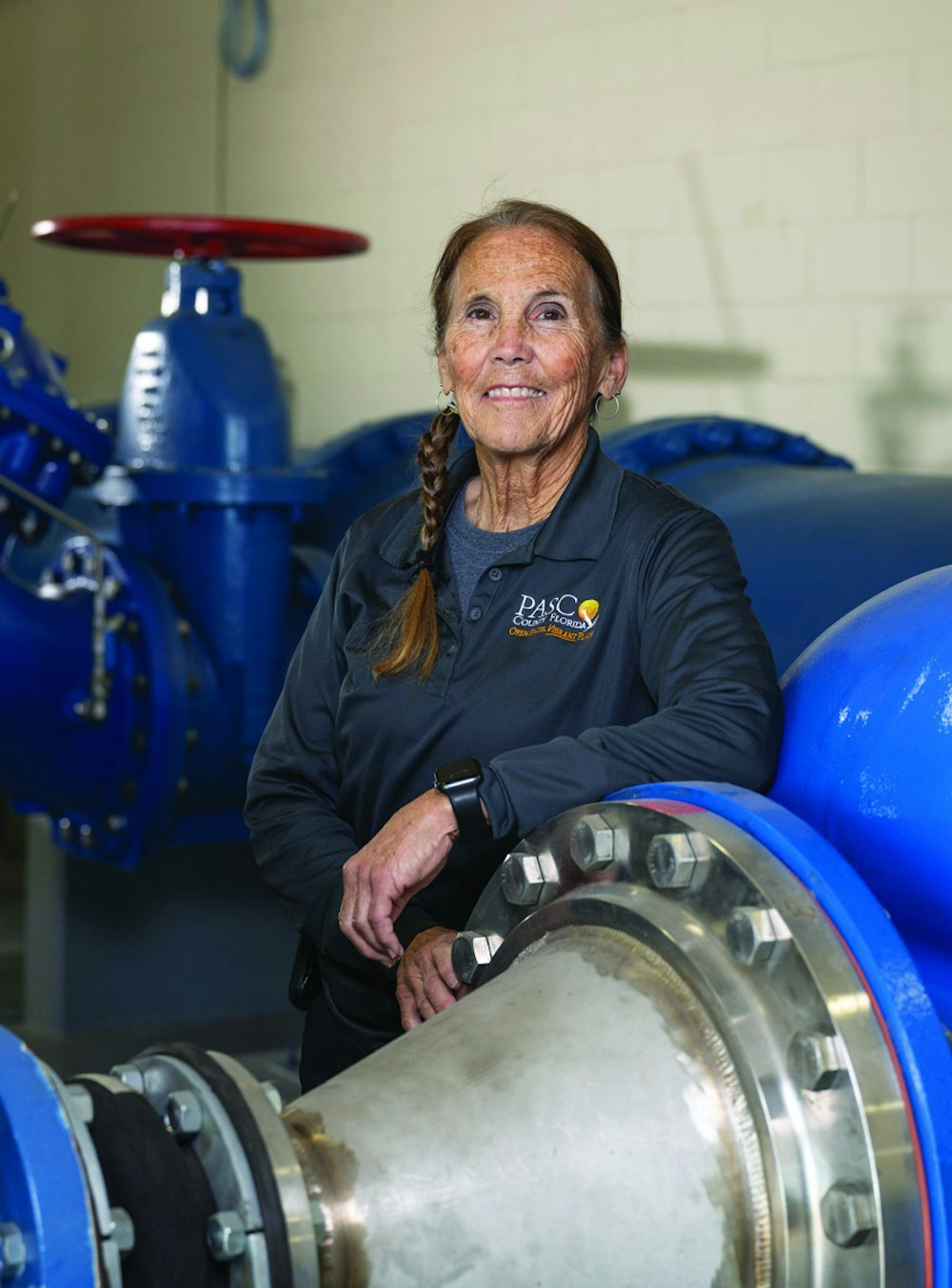
After 26 years in the industry, she was recognized as the 2024 Marvin N. Kaden Outstanding Water Treatment Plant Operator by the Florida Section AWWA. She was nominated by Jim Kaplan, water operations supervisor, who noted her contribution to the organization.
“Karen is in charge of writing plant standard operating procedures that help new employees learn the proper way to perform tasks from plant checks to full operations. She has been improving the asset management program for water operations, and she created a matrix system that captures assets and tracks them to the end of service life.”
Lewis is glad for the career choice she made. “It’s an open field where there are very few limits to what you can do,” she says. “Every day is different. It’s not something where you go in and you’re on the phone doing the same thing every day. It’s always a challenge. I like getting up in the morning and going to work.”

Steady progress
Lewis was born in West Virginia, but her family moved to Florida when she was very young and she has lived in the state ever since. She earned an associate degree in accounting from St. Petersburg College, but didn’t enjoy that field and so moved over into retail business, and then pest control.
After joining Hernando County, she worked for five years on a crew that kept busy with mowing, weed-eating, bush-hogging and other tasks. “I had a supervisor who kept asking me, ‘Why don’t you come over and work in water operations?’” she recalls.
“I kept telling him no because in grounds maintenance, I didn’t have to go on call, I didn’t have to work weekends, and I always got the holidays off. Then in 2004, they had an opening as a trainee, and I decided to take it for the professional opportunities.”
A year later she earned her Class C Water Treatment license; she now holds a Class A license (highest). In 2012 she joined Pasco County Utilities as an operator working at the water plants and taking water samples. She was promoted to lead operator in 2014.

Versatile contributor
Pasco County Utilities serves a population of about 630,000 and nearly 1,500 businesses in an 868-square-mile territory in west-central Florida near Tampa. The county receives about 94% of its potable water from Tampa Bay Water, a regional wholesaler.
Tampa Bay Water uses large transmission mains to deliver fully treated water to four major connection points in Pasco County. About half of that water is further treated with chlorine and ammonia before distribution. The other half is delivered directly to customers.
The source is typically a blend of ground, surface and desalinated water. The county operates 19 wells (about 6% of the water system) that stand alone to supply rural communities or supplement the regional system. The utility distributes an average of 40 mgd.
Lewis and fellow lead operators Mike Avila and Mike Ward share responsibility for the water plants. Her two counterparts take charge of the utility’s east and west zones while Lewis fills in at the various sites when needed, handles asset management and at times helps out in the Parks department doing water operation checks.
“All of our operators report to one of the three of us,” says Lewis. “We have our specific areas, but if they have a question and they need to talk to somebody, they can call on any one of us.” In leading people, Lewis prefers a relaxed attitude.
“The guys feel comfortable with my approach,” she says. “I wouldn’t ask them to do anything I wouldn’t do myself. They know that instead of just pointing my finger and saying, ‘Do this,’ I’ll jump in right beside them. They like that. It makes them feel like I’m part of the group.”
When visiting a site, Lewis performs routine tasks like reading meters, taking chlorine levels, checking pH and temperature, and generally making rounds to check on equipment. Often, she finds herself supervising or observing a project: “The last time I filled in at one of our plants on the east side, we had a project putting in new meters and mixers. It was quite an undertaking, and it was educational to watch the crews come in and do their work.”
Making water
The Pasco County sites use similar treatment processes, with differences for local conditions. Three large site plants tap the supply from Tampa Bay Water, trim disinfection, boost the pressure and send it into the distribution system. A fourth regional plant adds chloramines to well water before release into the network.
At the smaller sites, treatment consists of dosing with free chlorine and, in some cases, ammonia. An exception is a facility that serves an area with older homes. There the water is also injected with a blend of polyphosphate and orthophosphate for lead and copper abatement; it coats the pipe interiors to keep metals in the service lines from leaching into the drinking water.
The water from two other wells has a high iron level and has to be treated with sand filters made by Miami Filters.
As asset management takes on a growing role in water infrastructure, Pasco County is investing in technology. For years, the team has tracked equipment inventory and service life using an Excel spreadsheet while handling maintenance and work orders with enterprise asset management software.
Recently, the utility adopted the Rio cloud-based data management software (Aquatic Informatics), designed to centralize daily workflows and integrate lab, process, field and other data sources to improve visibility and decision-making in managing assets and operations. “Instead of reactive, we’re going to be proactive,” Lewis says.
Serving the industry
While her lead operator role keeps her plenty busy, Lewis gives her time freely to the Florida Section of the AWWA. The utility pays for employees’ memberships and supports their involvement in association events.
“Networking through FSAWWA allows us to get involved in projects and discuss issues that other utilities may be experiencing,” Lewis says. “The conferences enable us to talk to vendors about the products they offer. The training classes keep us up to date and give us the knowledge to stay on top of compliance issues and new regulations.”
She is the most excited about taking part with a team in state and national AWWA Top Ops challenges. “It’s nerve-racking and time-consuming, but I love the thrill of the competition,” she says. At present the Pasco County team includes Lewis; Vincent Domanico, operator at the Little Road Water Treatment Plant; and Jason Happle, operator at the Southeast Water Treatment Plant.
“We’ve won the state competition a couple of times, and we’ve been to the ACE conferences representing Pasco County,” Lewis says. “I have probably one more chance to win at the state level and go to nationals.”

Counting rewards
Now about a year away from retirement, Lewis sees only positives from the career change she made two and a half decades ago. One point of pride is that around the time she hired on with Pasco County her son, Dakota Barrett, joined Hernando County in water operations.
“Now he and I talk shop all the time,” Lewis says. “People look at us like, ‘Don’t you have anything else to talk about?’ We had a pump problem in Pasco County the other day, and he and I discussed how to resolve it. It gives us something to talk about when we go home.”
Lewis also takes pride in succeeding as a woman in what is still a male-dominated industry. She recalls that Kaplan, her supervisor, at first seemed to have some doubts: “I think I shocked him by being able to do that without any problems. The guys are my favorite part of the job. It’s people with different personalities and walks of life coming together and being a team. I enjoy being part of that.
“It’s hard for a woman to come into a man’s world and thrive. I’ve had women in cars pull up beside me in my county truck and give me the thumbs up, like, ‘Hey, you did it!’ It makes me feel good. This has been an interesting career move for me. I have never looked back.”