High salinity in wastewater effluent can be an obstacle to reclamation and potable reuse.
Salinity removal typically relies on advanced treatment with reverse osmosis, but that means dealing with a brine waste stream. It’s especially challenging for communities where ocean discharge is inaccessible, or deep-well injection is restricted, or the loss of water to the brine solution is unacceptable. Meanwhile, carbon-based advanced treatment does not produce brine waste, but cannot address elevated influent salinity.
Now Carollo Engineers is bench-scale and pilot testing Ion-Exchange-Based Advanced Treatment (XBAT), an alternative technology that enables utilities to address not only salinity but also organics and TOC, a constituent that must be controlled to prevent formation of disinfection byproducts or reduced oxygen demand in receiving waters.
XBAT technology also can remove anions such as nitrate, phosphate and bromide, solving a range of pervasive and previously intractable water-quality challenges, according to Carollo.
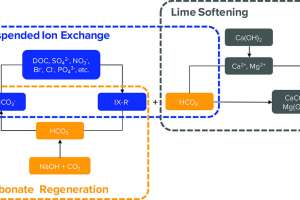
The technology integrates suspended ion exchange with lime or pellet softening to achieve high performance in reducing salinity and TOC without RO and its waste stream issues.
At the same time, softening achieves greater than 90% calcium and magnesium removal, according to the company. Dr. Eva Steinle-Darling, senior vice president and reuse technical practice director, talked about the technology in an interview with Treatment Plant Operator.
TPO: What is the motivation for bringing this technology to market?
Steinle-Darling: Salinity is an Achilles’ heel for potable reuse. Reverse osmosis is great for treating salinity, but it comes with the downside of a 15-20% brine concentrate that has to be managed. Deep-well injection is another option. A desert community may be able to evaporate the waste, but that’s a pretty heavy lift. Then we have technologies for potable reuse that employ ozone and carbon-based media, but they don’t address salinity. The XBAT technology is another way to address the salinity challenge. It is completely different from RO and removes up to 50% of the salinity in the water.
TPO: How widespread is the salinity issue in potable reuse?
Steinle-Darling: Salinity is geographically variable. Parts of the country, such as along the Eastern seaboard other than Florida, have low salinity. People who drink low-salinity water will be less tolerant of any increase in salinity. On the other hand, in Texas or Arizona, there are communities where salinity is very high, and people are used to it. The fundamental fact is that all human use of water adds salt. What we eat, what we cook, the cleaners we use, all of that adds salt.
TPO: Does the XBAT technology apply only where salinity is a problem?
Steinle-Darling: The technology can remove any anionic species, including the components of salinity. It will remove nitrate, nitrite and phosphate — what the wastewater world calls nutrients. It also removes bromide, which can form bromate in some applications that use ozone treatment. The original application of suspended ion exchange was to remove TOC from drinking water. TOC also has a negative charge and can be removed by this process.
TPO: How would you describe suspended ion exchange versus traditional ion exchange?
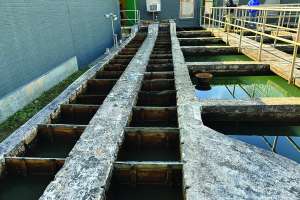
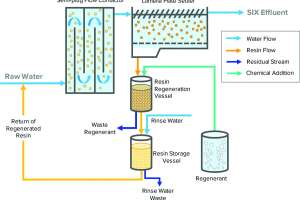
Steinle-Darling: Suspended ion exchange is a fluidized version of ion exchange in a fixed bed. It’s like a conventional flocculation/sedimentation setup, but instead of adding coagulant, we add resin beads to a contactor and then settle the beads out. It’s a continuous process instead of a process where a fixed bed gets exhausted over time and has to be regenerated. We continually regenerate the resin beads and feed them back in at the front end.
TPO: How are the beads that settle out of the process regenerated?
Steinle-Darling: We regenerate the beads with bicarbonate. We actually create a bicarbonate solution, and that is what enables us to do ion exchange without adding salinity to the water. A traditional ion exchange process would use a chloride solution to regenerate the resin, and some of the chloride would end up in the water. We use bicarbonate to exchange all the anions, that then come out in the regeneration stream. The bicarbonate stays in the water and is precipitated out in the softening step.
TPO: Please describe step by step how the XBAT process works.
Steinle-Darling: The suspended ion exchange contactor is followed by a basin with plate settlers that allow the resin beads to be collected for regeneration and returned to the front end of the process. The second step can be any kind of softening to precipitate the hardness. Lime softening can be used. We prefer pellet softening because of the compact footprint and because of the potential for a recoverable resource in the pellets.
TPO: What happens to the regeneration stream?
Steinle-Darling: There is no free lunch; the process does produce a waste stream, but it is less than 1% of the total flow. It is not a brine or a highly concentrated chloride solution. It has high alkalinity, and we think it has potential as a recyclable flow in some wastewater applications. For example, biological nitrogen removal often requires the addition of alkalinity, and our regeneration stream could be one way to serve that purpose.
TPO: What is involved with this process in terms of training and operator attention?
Steinle-Darling: The complete XBAT process doesn’t have a full-scale installation yet, but the individual process elements absolutely do. They are not rocket science. They are conventional drinking water treatment processes that operators can be trained to run, and they don’t have to be babysat once they are dialed in.
TPO: Is there a “sweet spot” for this technology?
Steinle-Darling: Full-scale applications where this process would make sense are probably 1 mgd or larger. From a water-quality perspective, we’re dealing with waters that have marginal salinity. This isn’t a desalination technology. It is designed for waters that need polishing for salinity — the 250 to 300 mg/L of TDS that human use adds.
TPO: What has been done to prove out this process?
Steinle-Darling: We are in the pilot phase. We have done bench-scale treatability testing with regeneration for at least a half-dozen waters, mostly in wastewater applications for reuse. We plan to do more of those. We’ve constructed a pilot-scale bicarbonate regeneration system and pellet softening unit and completed a pilot test in Tampa, Florida, where they had an existing suspended ion exchange pilot. We’ve also commissioned another suspended ion exchange pilot to bring all three technologies together for an upcoming second pilot test.
TPO: What results have been achieved to date in testing?
Steinle-Darling: Most of our data so far is from the bench-scale regenerations. With several of the wastewaters we have worked on, we have achieved about 50% salinity reduction and 50% TOC reduction. Depending on the water, we are seeing reductions of 60% for chloride and bromide, 70% for nitrate, and over 90% for sulfate.