Technology is advancing fast in the water treatment industries. But where can innovators put their new concepts to the test before they’re deployed at full scale?
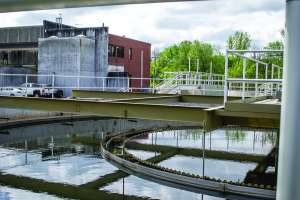
The Milwaukee Metropolitan Sewerage District has one answer in a permanent research center to be built at its South Shore Water Reclamation Facility. The district has a history as an innovator, going all the way back to 1926 with the introduction of Milorganite granular fertilizer, made from dried biosolids and sold in bags in retail stores.
Today the district is known for its sophisticated wastewater collection and treatment systems and for a variety of green infrastructure projects that have improved stormwater management, flood control and community aesthetics.
The research facility, to become operational in 2026, is a collaborative effort with The Water Council, a Milwaukee-based global hub devoted to solving global water challenges by driving freshwater innovation and advancing water stewardship.
The project grew out of the district’s plans to upgrade primary treatment at the South Shore facility to achieve 50% BOD removal before the secondary process. The research facility will be used at first to test a new primary filtration process but then will be made available for innovators to test new treatment technologies at a variety of scales.
The Water Council is seeking a grant from the National Science Foundation’s Regional Innovation Engines program for a Water + Energy Forward initiative in which clean-water utilities, businesses, industry organizations and universities would collaborate to develop and commercialize water and energy technologies for manufacturers and utilities.
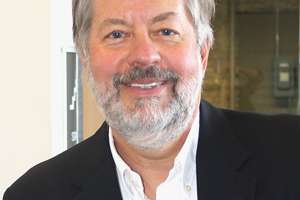
The research facility would help support that initiative. Kevin Shafer, MMSD executive director, and Dean Amhaus, The Water Council president and CEO, talked about the research site in an interview with Treatment Plant Operator.
TPO: Why is it necessary to improve primary treatment at South Shore?
Shafer: The South Shore plant went online in 1966, and so we’re at a stage where we need to upgrade the infrastructure, including the primaries. We’re now in construction of an upgrade on the secondary process, and we are in preliminary design for the primary clarification upgrade.
TPO: Why is it important to achieve 50% BOD removal at the primary stage?
Shafer: We’re looking to remove as much BOD as we can in the primary stage to enhance our secondary treatment operations. We’ve seen technologies that can meet the 50% level, and we want to see if they will work in our facility.
TPO: How does primary filtration differ from traditional primary settling?
Shafer: We plan to replace the primary settling tanks with underground chambers fed by gravity.
Inside will be little plastic spheres with fibers on them that latch on to the primary solids. The water will enter from the bottom and suspend the media so that it comes in contact with the pollutants. The system will be backwashed periodically. If the pilot proves out one of the technologies we’re looking at, we’ll be able to reduce our energy and chemical costs and our greenhouse gas emissions.
TPO: How did the decision to build a primary filtration pilot morph into the creation of a permanent research facility?
Shafer: To operate the pilot with the weather conditions we have here, we needed a temporary building. In looking at the cost of that, our chief research officer observed that for just a little bit more we could build a permanent structure that could also help foster water research. We have The Water Council as a great partner, and with all the water industries in our area, we thought that would be a win for all of us.
TPO: How would you describe the facility? And what is the schedule for its completion?
Shafer: It’s a building of about 5,000 square feet. The design will be undertaken in 2025, and we’re looking at 2026 for construction. We will treat a sidestream off the South Shore plant flow without impacting our day-to-day operations. The pilot should take about two years so as to include a good cross section of the seasonal flows that come to us. After that we will be able to do more research, and others will be able to use the facility if they want to.
TPO: How does The Water Council envision using the research facility?
Amhaus: Within the region we have a huge strength around water technology. We have water companies that have been headquartered here for a long time, as well as energy technology companies like Johnson Controls, Rockwell, Generac and Kohler. We can bring those two key industries sectors together in what is known as the water-energy nexus.
Climate is having an impact all over the country and the world. As we got more involved we found that small and medium-sized businesses and wastewater utilities are particularly vulnerable. So how do we make them sustainable or resilient to climate change? By developing these technologies and then working with MMSD to pilot them in a real-world situation, in an actual functioning facility connected to a wastewater treatment plant.
TPO: How would you envision the scale and the number of research projects the facility could accommodate?
Shafer: It could be bench-scale projects as well as full-scale demonstrations. Any number of projects could be there at the same time. It really depends on the technologies being looked at. It could span the entire spectrum of wastewater treatment. Our first priority will be wastewater, but later on some drinking water or other processes could be investigated. Who knows what’s out there in research and development? It’s really unlimited.
Amhaus: We’ve seen places where there is a traditional rectangular building but with concrete pads right next to it that could accommodate plug-ins. The idea is that a company developing a technology could literally pull it up in a container, park it like a camper and hook it up to the lines and the power. That way the facility could simultaneously test multiple technologies that are outside the physical building.
TPO: What kinds of organizations could bring projects forward for consideration?
Amhaus: The party initiating the project would not have to be a wastewater treatment plant or utility. It could be an established manufacturer. It could be a two-person startup with something that has moved beyond the bench scale and needs to be tried in more of a real-world setting. It could be a university researcher.
TPO: How might you envision the collaborative process working?
Amhaus: It could bring together private-sector solution providers, the universities and, most important, the users of the technology. So, for example, a medium-sized wastewater utility would be at the table saying, here’s my problem, here’s what we would like to be able to accomplish.
TPO: What is unique about this approach to research and innovation in the water sector?
Amhaus: One unique aspect is that entrepreneurs or established businesses will know that they have partners ready and willing to try their new technologies. There is a confidence level that if you have something that’s good, you’ll be in front of an audience that is able to say yes. You have university researchers who are ready to partner. You may have bigger businesses that are interested and, because of our work with the Regional Innovation Engines, financial support to help cover the cost. You’ll also be tapped into a network that includes companies like Microsoft, Badger Meter and Xylem, which are in the network of our consortium.
TPO: How would you summarize the benefits of this facility to MMSD and the region?
Shafer: It benefits the district because we’ll be able to see first hand the impacts of primary filtration on our process. We’ll be able to see if we can reach 50% BOD removal, and we’ll be able to measure reductions in energy, impacts to climate, and more. It will benefit the region by enabling us to prove new technologies that treat wastewater to higher standards and reduce costs.
Amhaus: There is super excitement about this, and the most important element is the collaboration and the partnerships. It’s far beyond a collaboration between MMSD and The Water Council — there are all these other layers of partners. It’s like an engine: you need lots of parts to make it run. That’s what we’re bringing together.