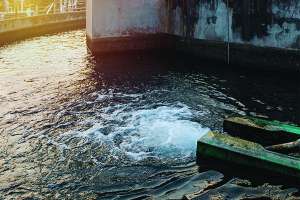
In September 2020, the Oneida Sewage Treatment Plant experienced an upset leading to a discharge that turned the water black in the receiving stream.
The aging plant was placed under a consent order from the New York State Department of Environmental Conservation, and the event underscored the urgency of corrective action. Fortunately, a major plant upgrade was already in the design stage.
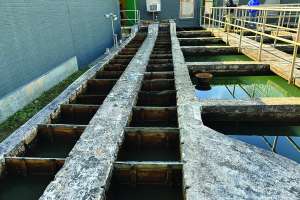
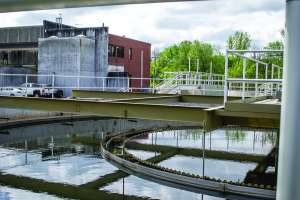
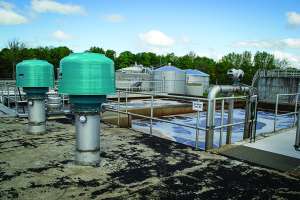
Today, that $50 million project is complete. The improvements touched essentially every part of the facility. The aeration system was expanded and new secondary clarifiers built to improve treatment efficiency and boost capacity for economic growth, notably in the city’s dairy industry.
The project also included specialized processes to accept and treat high-strength dairy waste, a new anaerobic digester complex and a more efficient solids process that reduced the amount of biosolids sent to landfill and mitigated fugitive methane emissions. Multiple improvements in biogas generation and energy efficiency reduced the plant’s carbon footprint.
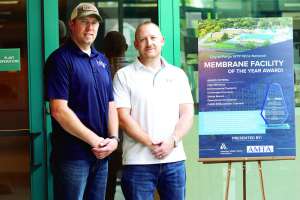
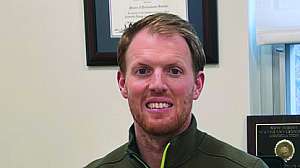
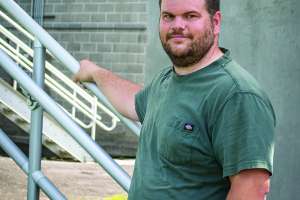
The plant team, led by Jesse Doty, chief operator, helped see the upgrade through to completion. The project received a Platinum Award from the American Council of Engineering Companies of New York, and Project of the Year awards from the American Public Works Associations of New York State and Central New York.
Doty describes the old plant as “straight out of the textbook” from 1982, when it was built. “There had been a few upgrades here and there,” he recalls. “There were several permit violations due to aging infrastructure. It was getting hard to get parts for everything because it was old. The plant was just not keeping up with the times.”
Doty came to the plant in May 2017 as a trainee, having worked four years as a plumbing apprentice and equipped with a two-year associate degree in automotive technology from Morrisville State College. By March 2022, he had earned his Grade 4A (highest) wastewater operator certification and was promoted to chief operator.
Planning for the plant upgrade began in 2018 with the Barton & Loguidice engineering firm. Doty took part in some of the early design discussions. Groundbreaking was held in March 2021 with Energy Systems Group as the general contractor.
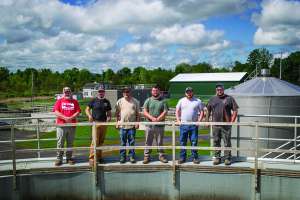
During more than two years of construction, it was all hands on deck for Doty and his team, which now includes Christopher Carney, senior operator; Mike Cosens and Richard Goodwin, operators; James Cullens and Anthony Griffin, operator trainees; and John Plows, maintenance specialist. Also involved in the project were Mark Rehbein, operator, now with the city’s water department; and Leonard Young, maintenance specialist, who has since retired.
“I have a great team,” says Doty. “Everybody pitched in and did things that weren’t necessarily their job, but needed to be done so we could move on to the next step. Almost nobody took time off during the construction. It seemed like everybody was here every day.”
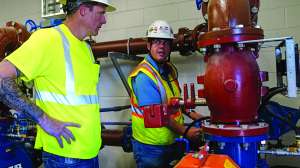
Team members worked overtime getting tanks emptied and cleaned and changing valves in coordination with the construction contractor. Weekly meetings helped orchestrate progress. “I stepped up as chief operator and made most of the adjustments,” says Doty. “If there was anything out of the ordinary from an operations standpoint, I took time away from my desk and headed that up so our operators could focus on maintaining high effluent quality without any extra stress.”
The introduction of each new system included a training session in which the engineers or the vendor described the system’s purpose and showed how to run it efficiently. One key element of the new process is a primary thickener (Lakeside Equipment) that replaced a dissolved air flotation system. “We had an adjustment learning how to operate that,” Doty says.
Lakeside also supplied a new automatic grit classifier. “We went from almost fully mechanical, meaning we had to turn everything on and off every day, to a system that runs automatically,” Doty says. “Our primary pumping was the same way. That also runs automatically, so many minutes every hour. We went from manual pump operation to monitoring automatic pumping.”
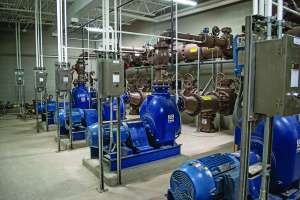
The treatment process begins with an electronic bar screen (Vulcan Industries). Gorman-Rupp pumps send the flow to the grit classifier; the grit and bar screenings are deposited in a dump trailer for hauling to landfill.
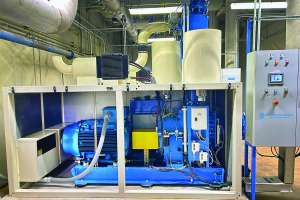
Four WEMCO pumps (Trillium Flow Technologies) deliver the flow to the primary clarifiers. The primary effluent flows to four aeration tanks, two fed by Turblex blowers and two by Continental Blower Industrie blowers. “There we inject ferrous chloride for phosphorus removal,” says Doty. Aeration is optimized on a feedback loop with dissolved oxygen sensors (Hach) in each basin.
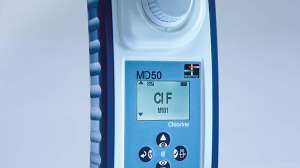
From aeration the flow enters three secondary clarifiers (Lakeside). After disinfection with chlorine gas (May 1 to Oct. 31) and dechlorination with sodium metabisulfite, effluent is discharged to Oneida Creek, which flows into Oneida Lake.
On the solids side, four Gorman-Rupp pumps convey return activated sludge to the aeration tanks, while two SEEPEX pumps send waste activated sludge to a contact adsorption, stabilization and thickening (CAST) system to be mixed with high-BOD dairy plant waste (see sidebar).
Primary sludge, and with thickened waste activated sludge from the CAST process, are pumped to a blend tank, and the mixture is processed by two Rotomix grinder pumps (Vaughan) and then delivered by three Seepex pumps to new anaerobic digesters. Overflow from the digesters passes to three digestate storage tanks that served as digesters in the old process.
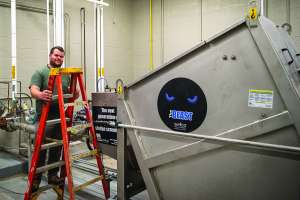
Two Seepex pumps then deliver the biosolids to a pair of 2-meter belt filter presses (BDP Industries) that yield 20-26% solids. Dewatered material is conveyed to a dump truck for hauling to landfill. Digester methane fuels a 5 million Btu/h Hurst boiler for heating the digesters to 96-98 degrees F.
Plant processes are monitored and controlled by a SCADA system (AquaLogics Systems). A StrideLinx portal functions as a SCADA viewer, accessible from anywhere. “If the WIN-911 notification system calls me in the middle of the night, I can pull it up on my phone,” says Doty.
“It’s the same screen we have here at work, so I can see what’s going on. I can make adjustments off of it. If there’s a simple problem that can be fixed electronically, I can do it right from my phone, so I don’t have to come into the plant to fix it.”
All in all, there’s a night-and-day difference between the old Oneida plant and the new. “It’s easier to operate,” says Doty. “It’s adequately sized. One of the biggest improvements in making quality water is that we now have three 500,000-gallon secondary clarifiers, where before we had four 220,000-gallon clarifiers.
“The biggest result is when I see our effluent numbers come back from the lab. Our CBOD and TSS are at the minimum ever since we had the new clarifiers.” The new plant now helps serve as an engine to help support economic growth in the city of Oneida.