Want tap water that tastes really great? Then go to Fargo.
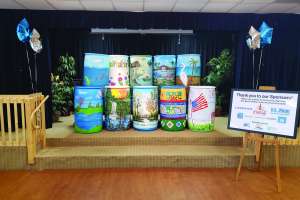
For two years in a row, 2022 and 2023, the output from the Fargo Water Treatment Plant was named the Best Tasting in the state at the North Dakota Water & Pollution Control Conference. To date, Fargo is the only city to win the award two years in a row. And the plant achieved the same feat in 2002 and 2003.
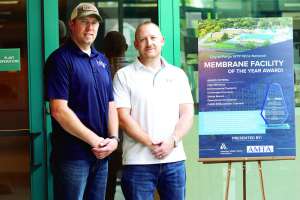
That’s not all: the plant received the Membrane Facility of the Year award at the 2024 Membrane Technology Conference. This national award recognizes water and wastewater facilities that use membrane technology in highly efficient and environmentally friendly ways.
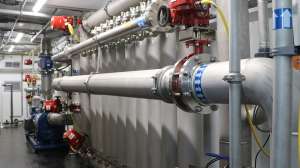
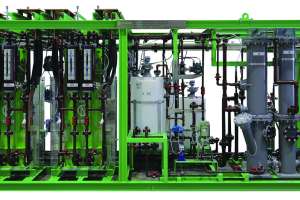
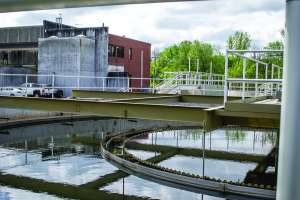
Membrane filtration technology is at the heart of all of these wins. Commissioned in 2018, the Fargo plant has the capacity to produce 15 mgd, using water drawn from the Red and Sheyenne rivers. To ensure pristine quality, the plant uses ultrafiltration and reverse osmosis membranes. Its systems support continuous water quality monitoring and have been built to use chemicals sparingly to keep operating costs low.
Fargo’s water plant was built to address increasing demand and water chemistry challenges. “We have a 30 mgd conventional lime softening plant that was built in 1997,” says Jessey Pederson, membrane system specialist. “As the city grew, we needed additional capacity.
“Our river sources have been changing over the years. The Sheyenne River started to exceed the secondary maximum contaminant levels for sulfates, which our lime softening plant couldn’t remove. So we looked into membranes in 2010-11, followed by a two-year pilot study, two years of design and four years of construction.”
The filtration process begins with pumping of raw river water into five strainers (S.P. Kinney). Sulfuric acid is then added to lower the pH, and the water is dosed with along with Aqua Hawk 607 aluminum chlorohydrate (Hawkins) as a coagulant to reduce turbidity and TOC.
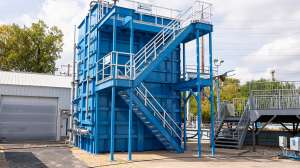
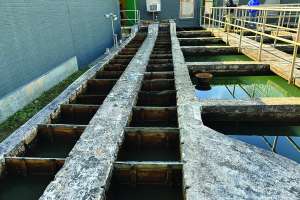
From there, the water is split into two water trains, each of which pass through a three-stage flocculation particle separation process. The water then travels through plate settlers to remove smaller particles, and the sludge is sent to the plant’s dewatering facility.
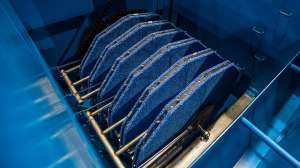
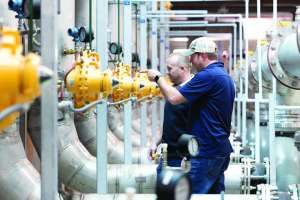
Next, the water enters ZeeWeed 1000 Immersed UF Membranes (Veolia). “We have eight trains; there are three cassettes in each train, and all the cassettes are populated with a total of 2,304 UF modules,” Pederson says.
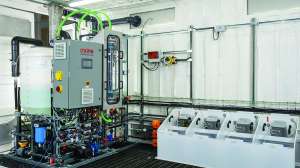
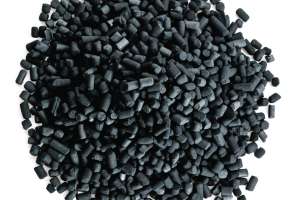
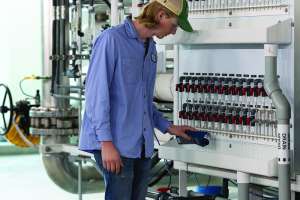
“After UF it goes to our filtrate basin, and that’s where we can split the flow. Typically, two-thirds of the flow goes through our seven two-stage RO membrane skids composed of Toray elements.” The remaining third goes through a taste and odor bypass, which uses ozone sidestream injection followed by granular activated carbon filters.
“We use the bypass because water that goes through our RO membranes comes out too pure,” says Dan Portlock, water utility engineer. “We have to add minerals back into the water, which is why it’s blended.”
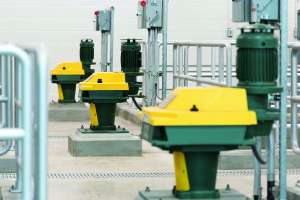
After RO, the water goes through degasifier silos (DeLoach Industries) to remove carbon dioxide. It then flows to a chlorine contact basin, along with the water treated for taste and odor. “We add chlorine and ammonia at this point for disinfection,” Pederson says. “Then we add sodium hydroxide as a pH adjustment and blend the effluent of both plants together to meet our water quality targets.”
The plant team’s biggest challenge is the continuously changing water quality in the rivers. “Our two river sources undergo seasonal changes,” says Pederson. “We have some upstream discharges that can make things difficult.
“We can have high organics and high turbidity due to snowmelt, rain events and upstream discharges. Sometimes we can see turbidity reaching 800 NTU or more. Our turbidity averages 30-50 NTU routinely throughout the year, but when the river freezes over, it is typically under 10 NTU.”
In summer the Red and Sheyenne rivers can get as warm as 80 degrees, boosting biological activity in the water. TOC is normally about 8 to 9 mg/L in summer, which Portlock says is much higher than at other locations in the United States.
“Moreover, the TOC can swing up to the high 20s, which can last for more than a month,” he adds. “We have huge swings in temperature and incoming water quality, plus the hardness can get pretty high. We’ve seen over a thousand parts per million of hardness at certain times of the year.”
Then there’s flooding, a recurring hazard given Fargo’s flat terrain and proximity to the Red River. “In the years with big floods, the whole community comes together to fill sandbags,” says Pederson.
“We use eight-legged, 20-foot-high, sandbag-filling spiders that are set up at locations like the Fargodome indoor stadium. We call each year’s location Sandbag Central where we fill hundreds of thousands if not millions of sandbags. Volunteers of all ages get together to make sandbags and put them out in preparation for the flood.”
“Our main pump station, where we get water from the Red River, used to be vulnerable at very high flood elevations,” Portlock notes. “During a major flood some years ago, there was a chance that water could get into the pump station and electrical panels. So we built a flood wall through the middle of the station, raised the pumps and moved the electrical to the dry side so they would be protected. You don’t see many pump stations with interior flood walls.”
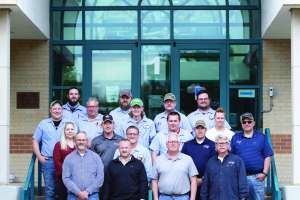
The secret of Fargo’s water quality success is a team of 36 people that includes operations, maintenance, lab and electrical/controls.
“The entire team works really well together,” says Portlock. “It’s the little stuff we all do every day in support of each other that adds up to being recognized by these awards. Every group has their role and does a great job to produce consistent water for the community. It’s also really humbling that we’ve won several awards for our treatment facility, because our membrane plant has been in operation for only six years.”
Pederson adds, “It’s something to be proud of. We have a great staff. Together, we try hard every day to put out the best water that we can for the city of Fargo.”