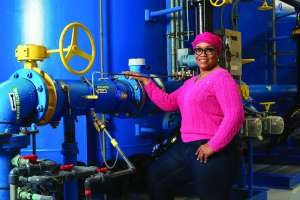


Sophia Oberton came to the town of Delmar water treatment plant with no experience in the water professions.
On becoming water superintendent, she quickly set about improving the facility, deploying SCADA and other technologies to make it more effective and efficient. The secret? In a word, education. She took numerous training classes offered by the Delaware and Maryland Rural Water Associations. She also learned from mentors within and outside her organization.
In particular, she mentions Sara Bynum-King, former town manager, who retired two years ago: “She was always positive in saying, ‘Be a sponge. Learn what you can and push our plant forward.’” After 13 years with the town, nine of them with the public works department and the water treatment plant, Oberton earned a 2023 award for Distinguished Service in Water Treatment from the Chesapeake Sections AWWA.
The town of Delmar (population 5,800) is split between Delaware and Maryland. “It’s known as a little town too big for one state,” Oberton says. “We have a town council on the Delaware side, a commission on the Maryland side, two mayors and one town manager.” The water treatment plant is in Delaware, the wastewater treatment plant in Maryland. Oberton holds Level 4 Water Operator certifications for both states.
Born in Harrisburg, Pennsylvania, Oberton was raised by her grandparents and graduated from high school in Salisbury, Maryland. She earned a bachelor’s degree in health care administration from Sojourner-Douglass College and an MBA from the University of Phoenix.
Before coming to Delmar, she worked for more than 20 years in the food service industry, rising to general manager of a restaurant. A single mother, she moved to the public sector out of a desire for work-life balance.
She started as a clerk, first in the town office and then in the public works department. She soon became safety coordinator and then added the role of special projects coordinator: “I was seeing things that had to get done but needed to be pushed along in a faster way.” She stepped in as water superintendent in 2021 after the public works director retired.
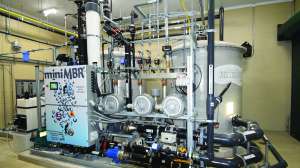
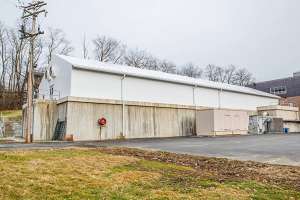
The town draws its water from two wells in the Columbia Aquifer. Raw water passes through an aeration tower (Layne) to remove dissolved gases, iron and manganese. It undergoes sand filtration (Lane Enterprises) followed by chlorine disinfection and fluoridation. pH is adjusted to 7.0-7.1 to prevent corrosion of distribution piping. Treatment plant capacity is 550,000 gpd.
The wastewater treatment plant (for which Oberton is not responsible) includes biological and enhanced nutrient removal systems to meet total maximum daily load limits for nitrogen and phosphorus discharges to the Chesapeake Bay. Its design capacity is 850,000 gpd.
As water plant superintendent, Oberton immediately set about upgrading critical water infrastructure with emphasis on deploying cutting-edge technologies and fostering a culture of conservation through sustainable practices.
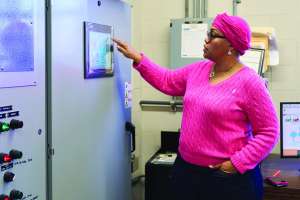
In 2021 she implemented a SCADA system (Shorite Controls) that has helped improve plant performance and reduce the flow to the wastewater treatment plant. “With this technology, we have been able to save millions of gallons of water per month,” says Oberton. “For example, we’ve gone from backwashing 47,000 gpd to 23,000 gallons per week, while keeping our water quality top-notch.”
She also improved operating efficiency by retrofitting high-efficiency pumps and seeing that public works maintenance people are trained to service them, curtailing reliance on contractors. This year the town will implement a second phase of the SCADA system. “We will have all of our infrastructure connected to SCADA so that we can intimately see the details of flows and pressures throughout the system,” Oberton says. Plans also include adding 360-degree security cameras on top of both water towers.
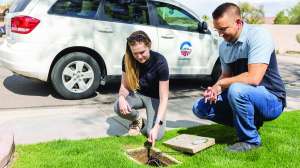
Meanwhile, Oberton retains her role as special projects coordinator and has spearheaded efforts that include hydrant flushing, pressure gauge testing, cross-connection control, managing compliance with the U.S. EPA Lead-Copper Rule and town beautification.
Mentors have been essential to Oberton’s professional growth. Besides Bynum, she mentions Joe Everett, a recently retired Maryland Rural Water Association circuit rider: “He taught me a lot about different classes, meeting the right people, and making sure my questions were answered or putting me in the right place with the different people.”
She’s similarly grateful to Rick Duncan of the Delaware Rural Water Association. She credits Josh Taylor and John McGee of the town’s engineering firm, Davis, Bowen & Friedel, for reliably answering her questions and offering support.
Training classes provided by the state Rural Water Associations propelled Oberton to her water operator certifications and helped her achieve ASSE International cross-connection control certification.
“The trainings that DRWA and MRWA offer are valuable and impactful,” she says. “They help operators and superintendents like myself run more effective and efficient plants. Going to training helps us continue to expand our knowledge. I research the classes I need to take so that I can bring the information back and push our plant forward.”
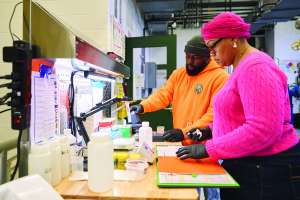
Improving water operations means working with part-time plant team member Devene Spence and with staff in public works and other town departments. “Clear communication is everything,” says Oberton. “That is where leadership starts.
“Effective communication means talking to people and not at them. It means including them in decisions so that they feel like their position is valuable. Sometimes as leaders we make decisions and expect others just to fall in line. We need to take their suggestions on how things could be done better, versus having them fall on deaf ears. We have to be open to what our team members are saying, because without them, where would we be?
“One of the biggest fears people have in teaching their knowledge to their staff is that their staff will then take over their position. I am a firm believer in cross-training on everything. If I know it, then my staff needs to know it. Because what happens if one day I’m not here? The plant still has to run, and the organization still has to function. Your team can’t do that if they don’t have the knowledge or the education.”
Oberton strongly supports apprenticeships in the water sector, such as those offered by the DRWA: “I think every state and municipality should incorporate an apprenticeship program.”
Delaware’s is a two-year program that includes classroom instruction along with hands-on experience. The town of Delmar takes on apprentices even though it doesn’t have multiple operator positions available: “If we can start them at our plants and help them flourish and go to other plants, then that is beneficial to our industry.”
Oberton teaches at Delmar High School as part of the pre-apprenticeship program. “It teaches the kids about the types of jobs available for this field,” she says. “In my first year of teaching I asked the kids for their takeaways. One of the biggest was that they didn’t know about all the types of opportunities available to them. I teach at the high school in hopes that maybe one or two students say, ‘I want to go into this field.’”