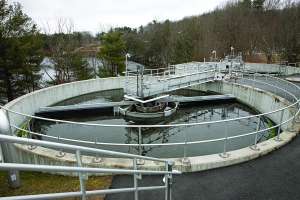
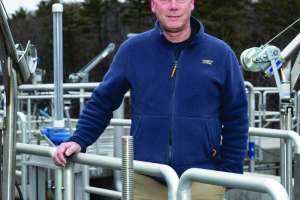
A new total nitrogen permit limit was coming for the town of Newmarket. That meant upgrading an outmoded clean-water plant to the tune of $14.1 million.
The results have been impressive. The plant’s 4-stage Bardenpho process yields effluent that consistently beats a recently imposed total nitrogen permit limit. Sean Greig, environmental services director for the town, attributes that to a careful design process that included intensive regular meetings with the town’s consulting engineers.
He also credits his team members for their dedication and their willingness to strive for optimum plant performance. “We have one of the best teams in the state,” says Greig, winner of a 2023 William D. Hatfield Award from the New Hampshire Water Environment Association.
“Our team members are cross-trained on everything. They know I like to test the limits and see what happens. We’re not afraid to push the envelope. We’re not afraid to make changes.
“With the old trickling filter facility we were discharging about 62,000 pounds of total nitrogen per year. When I did the math on the new design I thought we would get down to 9,000 or 10,000 pounds. With our staff’s optimization, we have actually been discharging 3,000 to 5,000 pounds per year. So we are absolutely crushing what our predictions were.”
Greig has been with Newmarket (population, 8,000) for 29 years. He grew up in Dover, New Hampshire, and earned a bachelor’s degree in business from Norwich University. Starting out in a tough job market, he became a manager for an athletic footwear store chain but found that unsatisfying.
“Instead of going out and looking for a job, I looked for what I wanted to do,” he recalls. “I picked out different professions, and instead of going in and asking for a job, I asked them what they did and what their typical day was like, to see if that interested me.”
That process included a visit with the manager of the Dover Wastewater Treatment Plant. Intrigued with what he heard, Greig enrolled at what is now Southern Maine Community College and earned a pollution abatement certificate. In 1995 he was hired as a maintenance mechanic at the Newmarket plant; from there he moved up the ranks to his current role, in which he is responsible for the drinking water and wastewater systems.
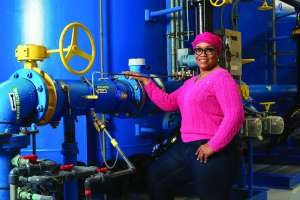
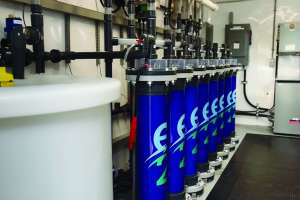
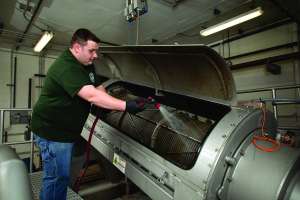
He has planned and supervised upgrades to the drinking water system that eliminated water shortages, adding two bedrock wells and building a treatment plant for two bedrock wells to adjust pH and remove arsenic using greensand filters (Hungerford & Terry); the state Department of Environmental Services had lowered the arsenic limit to 5 parts per billion.
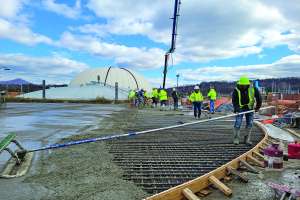
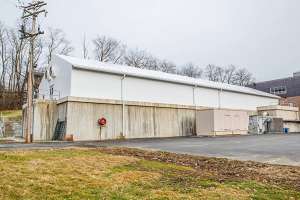
Greig’s most significant project is the comprehensive wastewater treatment facility upgrade completed in 2017. The plant was built in 1969 with primary treatment. A 1985 upgrade added secondary treatment with trickling filters; solids dewatering and influent pump station upgrades took place in 1990 and 1999.
Around 2000 the U.S. EPA began considering effluent nitrogen limits on treatment plants discharging to the environmentally sensitive Great Bay estuary. “We knew the trickling filter plant was not working the way it should because of age,” says Greig. “We also knew that trickling filters were not the appropriate technology to meet future permit limits.”
So town leaders worked out an agreement with the EPA to upgrade the facility and secured joint funding from the Clean Water State Revolving Loan fund and U.S. Department of Agriculture Rural Development. Working with the Wright-Pierce engineering firm, the town reviewed multiple upgrade options before selecting the 4-stage Bardenpho secondary process, designed to remove nitrogen with alternating anoxic and aerobic basins.
Before the upgrade, plant effluent contained about 30 mg/L total nitrogen. The current EPA-imposed limit for total nitrogen is a rolling seasonal average 30 pounds per day, equivalent to about 4 mg/L at the plant’s 0.85 mgd design flow. “Based on current operations and influent conditions, we are meeting that limit quite easily,” Greig says. The EPA agreement also encourages the town to help address nonpoint sources of nitrogen.
The plant’s performance ties back to the design process, which included what Greig calls war room sessions in which he reviewed project details with Wright-Pierce engineers Tim Vadney, Michael Curry and Dave Romilly.
“We’d sit in the room for hours going over the design, layouts, how everything would look, how things would work,” Greig says. “We all had ideas. One day my idea would get shot down. Another day someone else’s idea would get shot down. Or we’d come to a consensus on an idea, but on another day somebody would come up with modification to make it even better.
“Our town staff really worked hard making sure we had good wastewater data to construct the new secondary treatment process. If you don’t have good data for the modeling, it’s not going to work. The more you put in, the more you’ll get out. It was a really good collaborative effort.”
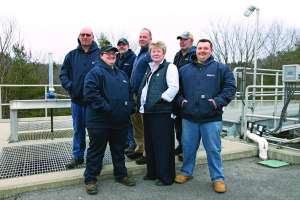
Greig’s team includes Todd Gianotti, maintenance supervisor; Sam Heffron, operations supervisor; Kate Preston and James Barlow, wastewater operators; Ben Trottier, water chief operator; and Sue Landale, administrative assistant.
Besides the new secondary treatment process, the plant upgrade included:
“One thing we did when the town council decided to go ahead with the project was try to remove as much I&I as we could,” Greig says. “I knew that I&I would have a major effect on the process, and it was also going to increase costs.”
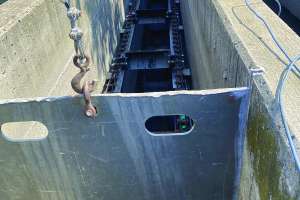
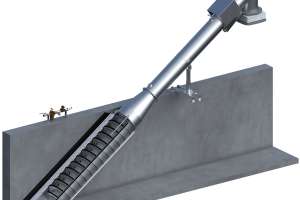
Raw influent passes through the perforated plate screen and is pumped up to the plant, where grit is removed. At present, the flow bypasses the primary clarifiers and goes directly to secondary treatment basins equipped with fine-bubble diffusers (Sanitaire, a Xylem brand) and KSB mixers).
“We bypass the primaries because we found that primary settling had a negative impact on total nitrogen removal by removing too much of the food needed to optimize the 4-stage Bardenpho process,” says Greig. After secondary clarification, the flow goes through chlorine contact and dechlorination before discharge to the Lamprey River.
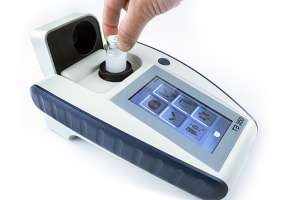
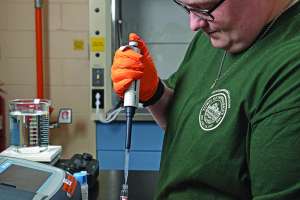
The process is monitored by the online IQ SensorNet system (YSI, a Xylem brand). The plant-wide SCADA system was supported by VTScada.
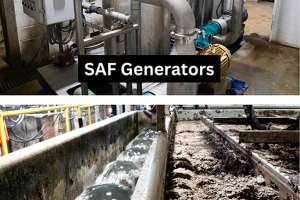
When the plant team began to bypass the primary clarifiers to improve nitrogen reduction, one issue that arose was impact on solids dewatering. The straight waste activated sludge going to the screw press was extremely thin at 0.3 to 0.7% solids, hydraulically limiting the dewatering capacity.
The increased WAS production strained storage capacity, and the dewatered cake was limited to about 19% solids. “I looked around at how we could get our solids thicker,” Greig reports. “We tried decanting in the sludge holding tanks, but that really didn’t work.”
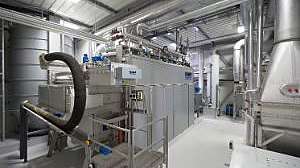
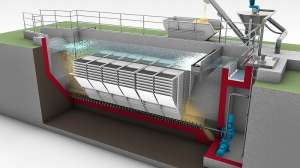
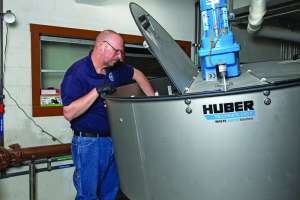
Then, while at WEFTEC, he discovered the S-DISC disc thickener (also HUBER). This compact unit fit existing building space; in two pilot tests it proved easy to operate. During testing the team used a sludge storage tank as a mixing tank and blended thickened WAS at 4.5% solids with WAS at 0.5% solids to create a feed at 1.5% solids to the screw press. The dewatered cake solids increased to 22-23% solids, saving significantly on hauling costs to the landfill.
“We knew we needed to get our solids thicker,” says Greig. “At some point the landfill will not be the final option. We may have to ship the material to a dryer or some other process, and we have to achieve certain dryness to reduce our cost to haul it to wherever it has to go.”
The solids project is just one example of how Greig and his team have approached operating the new plant. They didn’t simply turn it on and run it as designed. “I asked chief of operations Sam Heffron to push this plant one way, and then push it another way, and let it respond,” Greig says.
“The bottom line is I wanted to see not only what the plant could do but what would happen when we did certain things to it. So when things would get upset we could see what was going on and say, ‘Oh, we just need to make this adjustment.’ No matter how much we pushed the plant, it came right back. We couldn’t screw it up.
“Everything we’ve done here is for the long term. That’s an important point that everyone should understand. So many times, things are done for the short term, and that basically puts you in a box. Everything we do is to put us in the best position for the future.”
That includes fostering a capable and cross-trained team: “I ask them when they’re coming up, ‘Do you want to do the same thing day in and day out?’ I empower them to do different things, not to get stuck. If you’re the chief operator, do some maintenance. Do some of this, do some of that. Expand.
“I trust our people to do their jobs. Everybody wants to do the right thing. When you support them, you’re going to have a much happier group.” It pays off in team longevity. Maintenance supervisor Todd Gianotti, for example, has been at the plant since 2001, operations supervisor Heffron since 2003, and water operator Ben Trottier since 2008. Recently retired system technician Joel Drelick worked at the facility from 2003-23.
Greig is also grateful to the town officials for their consistent support: “They are really forward-looking, making sure things are done right for the environment and for clean drinking water. I haven’t had a ‘no’ in I don’t know how many years.”
Meanwhile, Greig gives back through industry organizations. He’s a member and past president of the New Hampshire Water Pollution Control Association, and a member and former New Hampshire state director for the New England Water Environment Association.
From 2001-10 he competed with the state team, called the New Hampshire Sewer Snakes in the national Operations Challenge. The team won Division 2 a few times and placed as high as third in Division 1. As for his work for Newmarket, he’s not slowing down: “The engineers tell me, ‘Sean, look at all the work you’ve done. You can sit back and relax.’ And I say, there’s still so much to do.”