It’s rare for lightning to strike two people at the same time, but that’s what happened when a wastewater supervisor and a plant superintendent were simultaneously flipping through the same trade magazine.
“I ran into my boss’s office so fast,” recalls Lisa Perry, wastewater supervisor and industrial pretreatment coordinator for the city of Rock Island, Illinois. “I was excited because I had just read about a unique material used in a wastewater treatment plant application, and it struck me as a possible solution to an issue we were dealing with.”
The plant was experiencing an issue with grit, sand and rocks entering the treatment plant through a combined sewer system. During dry-weather flow the plant processes an average of 6 to 7 mgd.
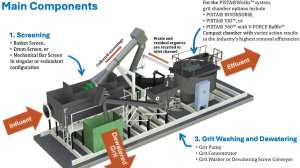
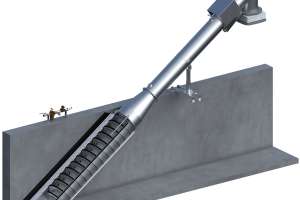
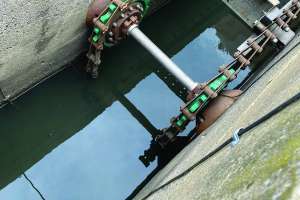
After screening the wastewater enters grit chambers, where the settled and dewatered grit is scooped up by a chain-and-bucket system that deposits the material into a collection system to be hauled to landfill. “We’d been having issues with excessive grit getting into places downstream and causing problems with other equipment,” says Perry.
Kirk Staller, Great Lakes Region engineering sales representative for Graphalloy, observes, “Lisa called me and explained that grit was getting through their system and damaging their digester. Lisa has been taking care of that plant for 35 years, having worked her way up through the ranks, and she is dedicated to the plant operating safely and efficiently.
“She is proactive about solutions, and she told me how she read about the Graphalloy solution we provided to a different treatment plant. She asked if we could come to Rock Island to tour the plant and meet with her and the maintenance team.”
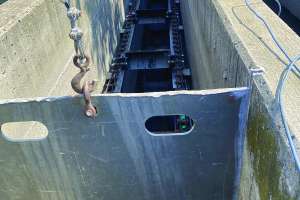
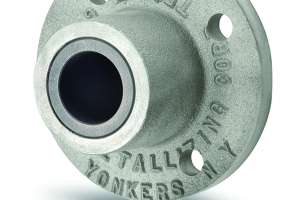
Staller visited the plant in June 2022 and brought material samples, including a pillow block and a flange block bearing, to share with Perry and her colleagues. Perry walked them through the plant and explained that each grit channel had a bucket and chain mechanism with wall-mounted lead bearings that had not been functioning well.
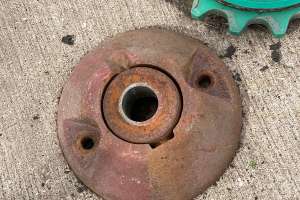
“The lead wall bearings kept seizing up, and lubrication adjustments made with higher-quality lubricants still did not solve the issue,” Perry explains. “In fact, the greasing just led to catching even more grit. So when I read that Graphalloy bearings don’t seize and don’t require lubrication, I wanted to see that special material up close and get my maintenance guys on it.”
Once the Graphalloy engineer was on-site, Perry and her crew showed Staller the grit channels. At that point, a collaboration started between the plant maintenance team and the Graphalloy engineering department. Together, they discussed how to resolve the issue.
“In order to put new bushings in, the maintenance team would have to machine out the lead ones, which was not feasible,” says Staller. “So instead of removing the lead bearings, Lisa’s team re-engineered how their bucket and chain system worked.”
Perry explains, “My maintenance team had the idea to take a self-lubricating Graphalloy flange block bearing and drill a hole in the flange block so that water could be used to rinse the wall-mounted pieces and get the grit out.
“We liked that we would no longer have to grease the flange block bearings, which run submerged and would have a constant flush to clear contaminants. We worked back and forth with Graphalloy on what we wanted to try and got their blessing to make the custom alteration to their standard flange block bearing so it would fit what the treatment plant needed.
“The company shipped out 10 nongalling flange block bearings, and my team drilled holes in them to create a solution specifically engineered for our retrofit. My team did a great job installing the new parts over the existing infrastructure in the one grit channel.
“That first channel was converted in January 2023 and worked well for five months, so we ordered 10 more flange block bearings and modified and installed them into the second channel the following June. For over a year now the bearings have worked flawlessly.”
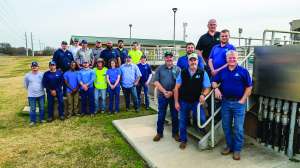
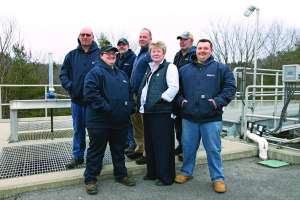
Staller and Greg Danilek, engineering sales manager at Graphalloy, visited the Rock Island plant in July 2023 to check on the updated system, which serves a population of 37,000 and growing. “We’re happy to see both channels working well after Lisa’s maintenance team got the parts installed and running,” says Staller.
Perry observes, “We’re pleased with the performance of the parts, and we know they will have a long life span. Just to have the functioning system is invaluable. Now I can concentrate on the digester rehab project knowing that it won’t be in vain.
“Resolving this issue eliminates all the downstream problems we’d been having. Spending money on the Graphalloy material enables us to prevent problems with downstream equipment so we can reallocate maintenance dollars to other important projects.
“In 2024, we’re going to look at using Graphalloy in some other equipment that has hard-to-access bearings. Since we know the material runs reliably, it would be great for our maintenance team if we could service those hard-to-reach bearings less often.”
Eric Ford (eric.ford@graphalloy.com) is vice president of sales and marketing with Graphite Metallizing Corp.