A growing population and the arrival of new industry meant challenges for the Yorkville-Bristol Sanitary District wastewater treatment plant.
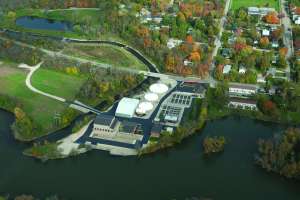
The district, based in Yorkville, Illinois, serves a population of 22,000 and discharges to the Fox River. The treatment plant (3.62 mgd design, 2.0 mgd average) was using a single-stage nitrifying activated sludge process.
ity would likely exceed its rated organic capacity. At the same time, the district had to comply with a new total phosphorus effluent limit of 1 mg/L. The plant needed an upgrade to deal with both conditions.
To meet its dual objectives, the district in 2017 completed an $8 million renovation that included a ZeeLung membrane aerated biofilm reactor from Veolia Water Technologies and Solutions, along with enhanced biological phosphorus removal.
SPACE LIMITATIONS
The upgrade had to be completed within a confined site, notes Cyrus McMains, P.E., the district’s executive director. “We have a creek on the west side of the property, residences right across the fence to the east, and a river to the south,” he says.
A plant expansion with conventional treatment upgrade would have required building a separate plant on the opposite side of the creek, a costly proposition. Instead, the district looked for a treatment retrofit that would minimize capital expenses and civil modifications, while accelerating the schedule by avoiding the time needed to permit and build a new plant.
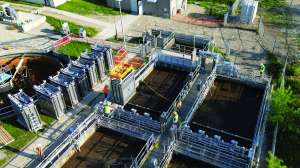
Before the upgrade, the plant had 10 aeration tanks operating in series. Under that scheme chemical dosing would have been the only phosphorus removal option. “We preferred biological removal instead of adding extra chemicals,” says Chris Frederick, plant superintendent.
“But we had a regulatory driver, as well. If we chose straight chemical phosphorus removal, we would have had to hit a lower total phosphorus limit of 0.5 mg/L by 2025. With biological removal we were able to push that limit off until 2030.”
The key challenge was to expand secondary treatment capacity within the existing tanks while converting some aerobic tankage to anaerobic and anoxic for nutrient removal. That was the role of the ZeeLung technology.
ADDING OXYGEN
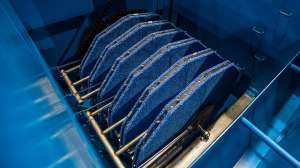
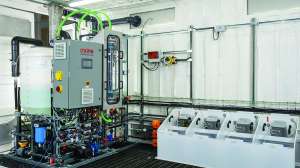
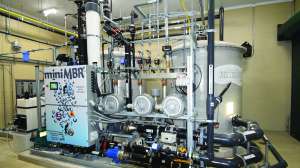
The ZeeLung MABR is designed to maximize the treatment capacity while reducing energy consumption. The process uses gas-transfer media to deliver oxygen to a biofilm attached to the media surface. Oxygen is delivered by diffusion through the media rather than with bubbles, reducing the energy needed by up to four times compared to conventional aeration, according to the manufacturer.
Immersing the membrane cassettes into mixed liquor increases the inventory of biomass in the system, intensifying biological treatment and enabling greater organic load to be treated in existing tankage. The attached-growth biofilm is resilient to load variations and upset conditions.
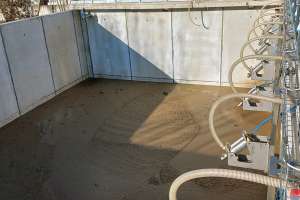
In the upgrade at Yorkville-Bristol, the first aeration tank was modified to an anaerobic zone to promote the growth of phosphorus-accumulating organisms. The second tank was converted to an anoxic zone populated with the ZeeLung membrane cassettes, which support a nitrifying biofilm that enables simultaneous nitrification and denitrification.
In the new process, influent first passes through a headworks with 6 mm bar screens (Parkson Corp.), followed by 1-by-10 mm rotary wedge wire drum screens (also Parkson). The screens function as primary clarifiers. After secondary treatment the flow proceeds to the final clarifiers and UV disinfection (WEDECO) before discharge to the river.
MAKING THE CHANGE
The ZeeLung MABR was deployed while keeping the plant in operation and in compliance. “I described it to my board of directors as performing open heart surgery on the plant,” says McMains. “The aeration system is the heart of the plant. We had to take some of it offline so that we could upgrade. We did say some prayers for no rain.”
Seven of the 10 aeration tanks remained in service during the upgrade. At times plant team members used portable pumps to move wastewater between tanks when gravity flow was interrupted.
“When we did the MABR upgrade, we cannibalized 20% of the aerobic fraction,” says Frederick. “ZeeLung brought back that cannibalized aerobic solids retention time and allowed us to do the same amount of aerobic work in 80% of the tank volume. At completion we had about a 45% biological improvement on the organic treatment side.”
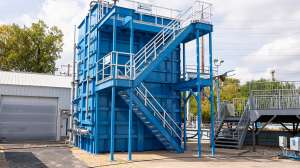
The 18-month upgrade also included various modifications to the existing tanks, changes to the system of blowers and compressors for air delivery, a new building for the aeration equipment, electrical wiring upgrades and installation of ducting and conduits for future MABR capacity additions.
UP TO SPEED
Veolia provided startup training on the ZeeLung system for the plant team. “Everything was video recorded so it can be referenced,” McMains says. “We have that video in our library so that as new staff members come online they understand the background of the technology.”
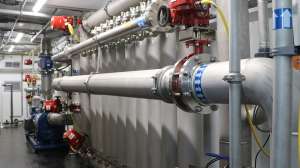
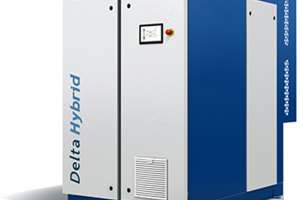
The process is fully automated. Operators clean the dissolved oxygen, ORP, nitrate and ammonia probes weekly and calibrate them to handheld meters. The two Aerzen blowers that deliver process air receive annual maintenance, and the air compressors and valves are serviced regularly. “Everything is heat-traced to keep it from freezing in winter,” Frederick notes.
In the end, the plant upgrade capital cost was 75% lower than if new conventional capacity had been added on the opposite side of the creek. “We saved in operational expenses as well,” McMains adds. “To operate a parallel plant west of the creek to increase capacity and handle phosphorus removal, we would have had to add staff and quite a bit more maintenance.”
Meanwhile, energy costs have remained stable even though the plant’s organic treatment load has increased substantially, McMains observes.
UPPING THE ANTE
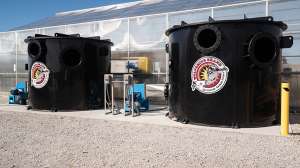
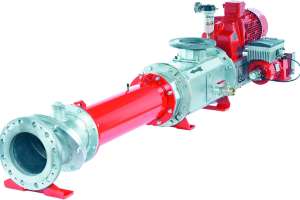
About 18 months ago the ZeeLung process was enhanced by addition of zeeDENSE hydrocyclone technology (also Veolia). The system uses gravimetric selection pressure to retain dense biomass and selectively waste less dense biomass, including filamentous bacteria.
Waste activated sludge or mixed liquor is processed through the zeeDENSE system. The dense biomass is returned to the bioreactor while the less dense biomass is wasted from the process. The result is improved settling of the mixed liquor, which enables up to 50% intensification of secondary clarification, according to Jeff Peeters, Veolia senior product manager.
“We like to say we keep the hard-working middle-aged bacteria and get rid of the too young or too old,” McMains says. “It takes up a very small footprint and a small amount of power, and it’s highly automated as well.”