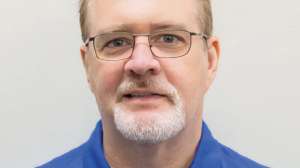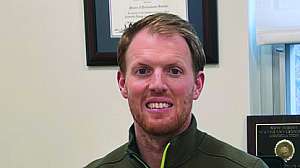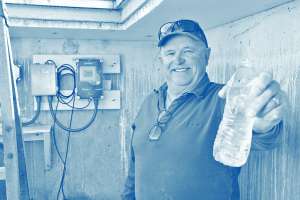
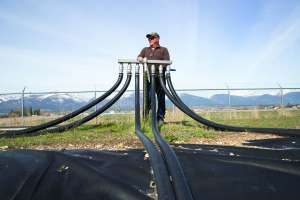
Steve Mosbrucker is always chuckling.
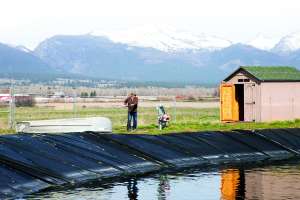
He chuckles as he remembers starting out working at a wastewater treatment plant for $250 a month. He chuckles as he describes the pontoon boat he and a buddy built to service the lagoon aerators. He chuckles describing his sewer district board’s gradual recognition that managing the wastewater operation was important, and that there was lots to do.
But his lighthearted approach doesn’t diminish his accomplishments as general manager of the Corvallis (Montana) Wastewater Treatment Plant.
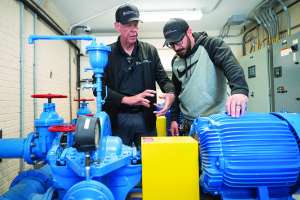
He is responsible for the daily operation and maintenance of the Corvallis lagoon treatment system, the two lift stations in the village’s sewer system, compliance, public outreach and relationships with the village sewer board. He also operates the lagoon system at the community of Victor, 15 miles away.
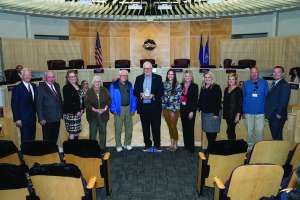
For his work, he was recognized as the 2023 Wastewater Operator of the Year from the Montana Rural Water Association. “I have watched Steve take corrective actions over the years,” says Bill Bahr, who nominated him for the award, and recently retired from the MRWA. “He is truly dedicated to helping his two communities.”
Mosbrucker got into the clean-water profession years ago and in an entirely different setting.
He remembers living in a trailer park with his two kids next to the Corvallis treatment facility and working at the local sawmill. “The board members came over one day and asked if I could tend the plant part time, for $250 a month,” he recalls.
He worked there for 30 days and then asked for $450 a month: “I asked for more or I was out of there.” Eventually the sawmill went out of business, and Mosbrucker took over the wastewater operation full time, with a second assignment since 2004 at the Victor plant. The two plants have similar lagoon systems.
The Montana Department of Environmental Quality helped him get started studying for his license exam in 1995, and he acknowledges the help and encouragement he got from Bahr and Montana Rural Water. “He’s a good man,” Mosbrucker says. “We’ve become friends. He’s seen the plant from when we started to what we’ve done here with our achievements.”
Over the years, Mosbrucker has demonstrated to his board the value of the plant and the need for investment. He earned his Class 1 Wastewater Treatment license in 1998 (he also holds water and water well licenses) and little by little worked with the board to make improvements, including a major expansion taking place this year.
“I just kept plugging away,” he says. “The pay got built up to a decent level. I learned everything. And we added capacity and got the plant caught up a little bit. The award was kind of humbling. I never expected to get an award for just doing my job.”
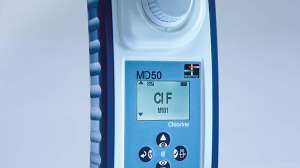
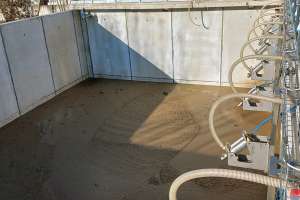
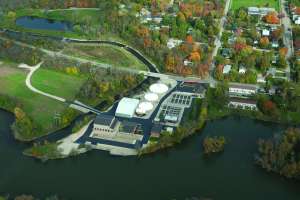
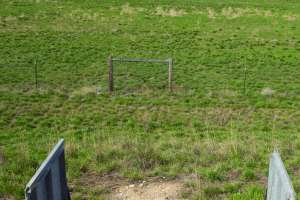
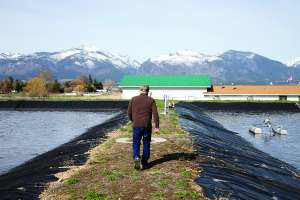
Built in 1979, the plant handles 71,000 gpd. It consists of two aerated lagoons; a third lagoon added in 2001 is used for storage while the other lagoons are shut down for cleaning. Chlorine tablets are used for disinfection. Treated effluent is returned to the groundwater through two constructed wetlands containing eight infiltration ponds.
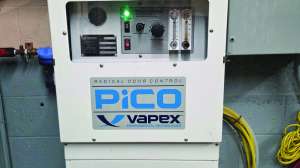
The plant serves about 500 residential connections (1,350 people), plus 60 commercial connections and the Corvallis school district. Mosbrucker and the district’s engineering partner, Morrison-Maierle, have documented areas in need of improvement, namely clogging of the aeration basins and other equipment with trash and rags, noise from the large blowers, odors, and issues with meeting disinfection requirements.
The improvement project, estimated at $3.2 million, will address these issues. A majority of the funding will come through American Rescue Plan Act and Secure Rural Schools grants.
The plant will add headworks with screening to remove rags and trash ahead of the treatment process. The plan is to consolidate all blowers into a single blower building and to install quieter centrifugal blowers (Inovair). The chlorination system will be replaced with two new UV disinfection units (Trojan Technologies).
The two original lagoon aeration systems will be upgraded, too. New Ares aerators (Triplepoint Environmental), the same as the ones in lagoon No. 3, will replace the old units. Corvallis will also get a new shop and office area. In addition, one of the two lift stations in the collection system will be moved. “It’s currently in the school parking lot,” says Mosbrucker. “Traffic can get pretty heavy when school is in sessions.”
While physical improvements are important to continued success, Mosbrucker’s unselfish attitude and willingness to make things work are critical. The constructed wetlands have already undergone a facelift at his direction: “We’ve added a new fence and cleaned up the area. You’ll see geese and fox. It’s more appealing for the public to experience.”
Erik Hoover, the county’s emergency services manager and a member of the Covallis sewer board, says Mosbrucker has a personal stake in the system and wants to see it succeed.
An emergency about a year ago bears that out. “Steve and his family were camping about three and a half hours from here,” Hoover says. “We had a problem with a lift station in the middle of the night. It was winter. We called Steve and he tried to help us through the situation, but finally he came back from his campsite and helped us get the lift station back up and running. He wants to see the system working and succeed, his service has demonstrated that.”
Bahr recalls another example that demonstrates why Mosbrucker is the kind of guy anyone would want on their team. “Steve was directing the clean sludge out of a lagoon that had been causing odors,” Bahr recalls. “He ordered a worker to put out his cigarette or leave the site. Steve is big on safety and process ethics. I don’t know how many would have said that. Or would get down in there and do the work.”
Bahr also credits Mosbrucker for knowing when to ask for help: “Some folks get in a jam but don’t call for help. Not Steve. He’s always on the up and up. If there’s a problem, he’ll call. He was a paper boy here as a kid. He’s always looking out for that little town. It’s the kind of work he wants to do.”
Mosbrucker works on an on-call basis, which he says is 365 days a year, 24 hours a day. When he finds time to relax, he loves to hunt and fish. His favorite place is the Gate to the Mountains along the Missouri River route Lewis and Clark traversed as they explored the West: “It’s where my father used to take me. It’s a place very close to my heart.” He and his wife have two children and six grandchildren, and the family often joins him on his mountain trips.”
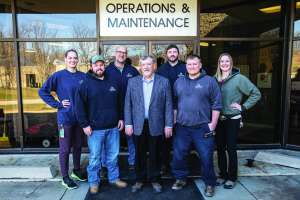
Nick Berger has been Mosbrucker’s assistant for 12 years, taking time from his regular job to fill in at the plant as needed. He enjoys the work and the relationship. “Steve is energetic. He tries new things. He thinks ahead. He gives me the freedom to do my job,” says Berger.
He most appreciates Mosbrucker’s know-how. “He’s incredibly knowledgeable. We had a dicey situation at a lift station once, but with Steve, we were able to make a quick fix. He knows the ins and outs. He even knows which lateral goes to what source.”
And does he chuckle when facing these challenges? Berger puts it this way: “He’s always in a good mood.”