Pumps in treatment plants are easy to take for granted amid all the high-technology equipment involved in the processes.
Pumping of viscous materials like sludges and biosolids can be challenging: Key attributes include consistency, reliability energy efficiency and long service life.
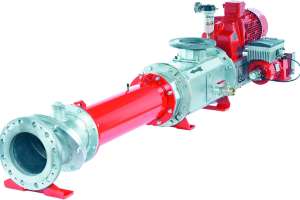
Progressive cavity pumps are a common choice for pumping a wide range of treatment plant waste slurries. Vogelsang has offered its CC Series progressive cavity pumps since 2014. Now the company has introduced the HiCone progressive cavity pump series in capacities from 30 to 1,400 gpm.
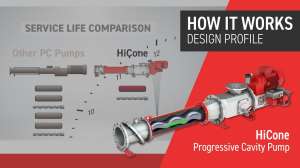
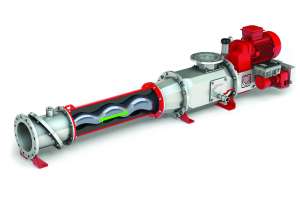
These pumps employ a conical rotor-stator geometry in which a simple external adjustment can advance the rotor into the stator as the pump undergoes normal wear. This increases the contact surface and re-establishes an as-new new rotor-stator sealing line, restoring the original compression and output.
The pumps are available in manual and automatic versions, and an autonomous version is due for introduction in the near future. Aaron Renick, vice president of sales, talked about the technology in an interview with Treatment Plant Operator.
TPO: What are the typical applications for this progressive cavity pump series?
Renick: The pumps are used to move biosolids and all the kinds of sludges in water and wastewater treatment plants except for the very viscous cake that comes off a belt press or centrifuge. We have a successful history in the biogas and agriculture markets in Europe and Canada, and more recently in the United States.
TPO: Why did your company develop the HiCone product line?
Renick: We had been known primarily known for our rotary lobe pumps. We saw value in progressive cavity pumps, and we set out to address the weak points we perceived in those pumps. They took up a lot of real estate in a plant because of the need for space to disassemble them for repair. The longevity of wear parts was not optimal, and they used a lot of energy.
TPO: Did your company have previous experience with progressive cavity pumps?
Renick: We’ve offered the CC Series progressive cavity pump since 2014. It is easy to maintain because of our hollow rotor design and the users’ ability to remove the rotor and stator while the pump is in place without disrupting any of the pipe work. So we looked for ways to mitigate the other issues I mentioned.
TPO: What is different about the HiCone series?
Renick: Progressive cavity pumps have a rotor inside a stator. The pump relies on the compression of an elastomer by insertion of the rotor. That’s what prevents liquid from back-flowing through the pump. The design relies on the correct fit between the rotor and stator. What makes our conical design unique is that users can retract the rotor out of the stator or adjust it forward into the stator. So they can adjust the compression fit between the rotor and stator.
TPO: What is the benefit of that capability?
Renick: In the traditional design, when the pump is new, once you insert the rotor into the stator, you have a fixed fit. It takes a lot of torque at startup to turn the rotor because there is 1/2 mm or more of compression between the sliding surfaces. But with the cone shape and the ability to incrementally retract the rotor, you no longer have that compression, and so less torque is required to turn the rotor at startup. So for example, a standard progressive cavity pump may require 30 hp at startup. But we can start a HiCone pump while the rotor is retracted and then over a 15- to 30-second interval gradually advance the rotor into the stator. So instead of 30 hp, only 20 or 15 hp may be required. That in turn reduces the required size of the motor, the variable-frequency drive, and the wiring to connect the motor to the drive.
TPO: How does this retraction and advancement of the rotor take place?
Renick: In the automatic version of the pump, we use a motor and gearbox to make the incremental adjustments. It’s programmed so that when the pump stops, the rotor is automatically backed out of the stator, so that the lower starting energy is required.
TPO: What advantage does conical shape have over long-term operation?
Renick: As you operate the pump, you’re typically moving material containing hard grit particles that erode the elastomer and eventually the steel on the rotor. Users can then advance the rotor farther into the stator and renew the fit so that the pump has the same compression as when it was new. So users keep the same pumping capacity and extend service life.
TPO: How is that rotor adjustment accomplished?
Renick: On the manual version, the user just has to remove a protective cover and advance or retract the rotor by turning one nut. It requires only a standard wrench out of a toolbox. There’s a visual indication so that they know they haven’t advanced the rotor too far or not far enough.
TPO: What additional capabilities will the autonomous version of these pumps have?
Renick: The autonomous version will allow users to take various inputs and outputs and to make adjustments to the pump when necessary. They’ll know the temperature. They’ll know if the pump gets into a dry-run condition. The pump will then eliminate the resulting friction by retracting the rotor out of the stator while it is in operation.
TPO: What other design features contribute to pump longevity?
Renick: We use a block ring mechanical seal. It’s a cartridge seal that keeps fibrous material and grit away from the seal faces. It has a buffer chamber on the nonproduct side of the seal that is pressurized. The advantage is that it keeps material off the seal faces and keeps the mechanical seal lubricated, so that in case of a dry-run condition the seal is not damaged. In addition, the drive train is very robust. The universal joint is a cardan-style joint that is grease lubricated. It is extremely strong and should last the lifetime of the pump.