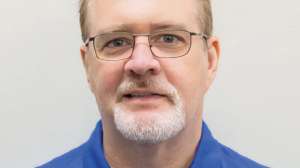
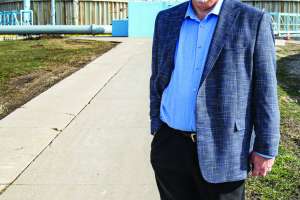
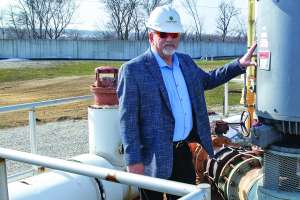
Even with nearly 40 years of experience under his belt, Roy Hesemann says with some levity: “Don’t ever think you’ll be doing what you think you’ll be doing.”
Over his office desk he displays words from the philosopher Voltaire: “Each player must accept the cards life deals him or her; but once they are in hand, he or she alone must decide how to play the cards in order to win the game.”
That philosophy has seen him through life and career issues and helps him motivate his team. “You may walk into the office in the morning and think that you have your day planned out,” says Hesemann, utilities director in Cedar Rapids, Iowa.
“And then the phone rings and all of a sudden your day is 100% different. So you work through it and make sure at the end of the day everything is better than it was at the start.”
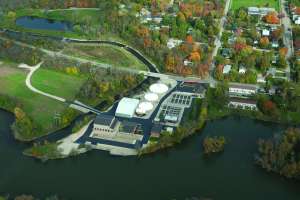
He has seen his share of calamities. He had been with the city for nearly a decade when a flood in 2008 tried to wash the Cedar Rapids Water Pollution Control Facility into the Gulf of Mexico. The Cedar River had flooded the city twice before, but the 2008 flood crested at more than 11 feet higher than the previous record and 19 feet above flood level.
Hesemann was asked to go to the plant to oversee its reconstruction and to be the new plant manager. From 2009-14 he worked diligently with the Federal Emergency Management Agency to get the plant fully operational again.
Then in August 2020, the city was hit with a violent derecho storm that brought 140 mph continuous straight-line winds for 45 minutes, damaging almost every house and tree. The derecho took out all communication, fallen trees made travel in the streets almost impossible and the entire power grid received unprecedented damage. But the water and wastewater treatment plants remained operational on emergency generators throughout the recovery.
Hesemann observes, “Always be prepared, have the right plans and do a little bit of flying by the seat of your pants because you never know what is going to come next.”
Hesemann is past chair of the AWWA Iowa Section and a former chair of the Region 1 AWWA Annual training program in Manchester, Iowa. He is active in several watershed organizations in Iowa and nationally and is an adjunct instructor at Des Moines Area Community College.
In addition, he has taken the FEMA National Incident Management System Training Program, as well as training in counterterrorism and security for the water industry, emergency response to threats of intentional contamination, and advanced incident command systems.
His excellence has not gone unrecognized: He received a 2023 William D. Hatfield Award from the Iowa Water Environment Association and a 2021 George Warren Fuller Award for distinguished service from the Iowa Section AWWA.
Hesemann credits his parents for instilling a strong work ethic. He grew up on a small farm in east-central Missouri that has been in family hands for over 150 years. Besides working the farm, his dad worked in a steel mill so the kids could go to college — three of the four did so.
Hesemann spent summers, winters and spring breaks looking after as many as 250 cattle on the 250-acre grain farm. He jokes with a touch of nostalgia that while his friends were on the beaches having a great time, he was “shoveling manure out of the barn.”
Hesemann started building his management skills during high school in FFA and as student council president. Between his freshman and sophomore years, a teacher took him and a couple of other students on a tour of the John Deere tractor factory in Waterloo, Iowa.
There he saw tractors being built and painted on the assembly floor and was like a kid in Santa’s toy workshop. Thus inspired, he attended the University of Missouri-Columbia and earned a bachelor’s degree in agricultural engineering. But at graduation in the mid-1980s, the farm economy crashed and no one was buying farm tractors and equipment. So he changed his plans and worked for an international well-drilling company for the first 14 years of his career.
His advice to others: “Stay grounded in what you are doing. Look to the future. Always keep your end goal in mind. Don’t ever be afraid of change. Don’t be afraid to step up and take on challenges. Let life take you wherever it is willing to take you.”
Hesemann went to work for Cedar Rapids (population 138,000) 24 years ago and worked his way up through positions including project engineer, water plant manager and water pollution control plant manager before taking on his current role as utilities director.
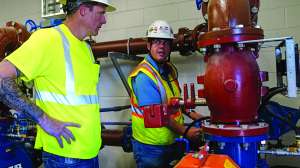
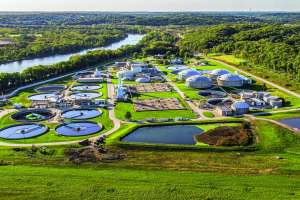
He is responsible for the city’s two water treatment plants with a combined 60 mgd capacity. About 70% of that output goes to eight large processing industries that produce everything from ethanol to food for human consumption. The water pollution control plant treats an average of 40 mgd (maximum capacity 86 mgd) with a high organic loading from those same large industries; it handles the equivalent of the domestic treatment load from a population of 1.8 million.
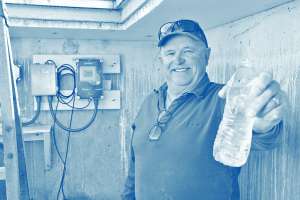
Cedar Rapids has been recognized by the AWWA Iowa Section for the best-tasting water in the state four times in the past 13 years. The water pollution control plant has earned multiple Silver and Gold Peak Performance Awards from the National Association of Clean Water Agencies for permit compliance.
The water treatment plant draws from 51 wells with 80 mgd total capacity. They include 45 vertical wells and six horizontal collector wells in the sand and gravel deposits (alluvial aquifer) along the Cedar River.
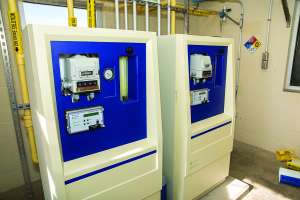
At the treatment plants, the water first undergoes aeration by cascading down a series of trays, adding oxygen and removing undesirable gases such as radon. Slaked lime is then added to soften the water. The lime residuals are removed and applied to farmland. Carbon dioxide is added to lower the pH, and chlorine is dosed for disinfection.
The water then passes through a sand and gravel filter bed. Fluoride is added, and phosphate is introduced to chemically stabilize the water and lessen the risk of lead leaching from water service lines and home fixtures. This is followed by UV disinfection. The finished water is pumped directly into storage tanks and subsequently into the distribution system.
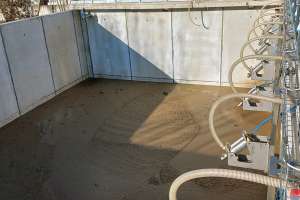
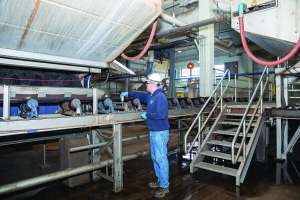
The water pollution control plant uses a secondary treatment process that includes trickling filters, aeration basins and ammonia removal. Effluent disinfected with chlorine is discharged to the Cedar River, and dewatered biosolids are incinerated or land-applied.
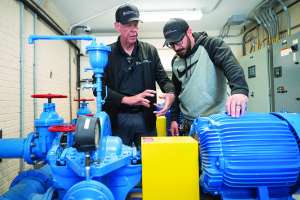
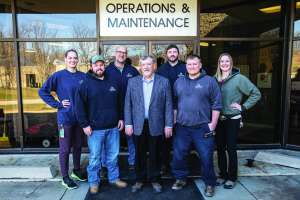
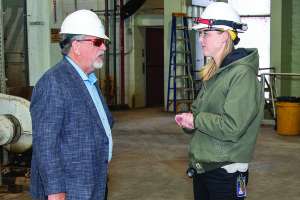
Hesemann leads the robust team that keeps all the facilities and systems operating smoothly. He credits his success to the people at all levels of the utilities department and in particular to his direct reports.
Kevin Kirchner, utilities business manager, oversees the customer service group, which includes meter readers, meter servicing, billing and collections, the customer service call center, backflow prevention and general business requirements.
Dave Wallace, utilities engineering manager, directs the water and wastewater plant capital improvement program, construction oversight, and water distribution including main break repair and valve and hydrant maintenance.
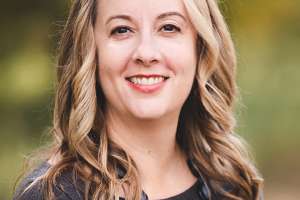
Lauren O’Neil is wastewater treatment plant manager and also oversees operations at 11 lift stations. Christine Knapp is water plant manager. Justin Schroeder, utilities environmental manager, oversees the city’s certified water and wastewater lab, air and wastewater discharge permitting and reporting, industrial pretreatment, wastewater collection monitoring and a regional watershed conservation partnership.
In working with established team members and new hires, Hesemann’s approach is straightforward: “Always make sure they are putting their best foot forward, making sure that they are learning. Life is a journey of learning, and the more they learn, the more adaptive and flexible they will be in their future. Having those skills helps them make their own way in life.
“If you have blinders on and say, ‘This is the only thing I am going to do,’ then your marketability is very small. But if you learn a lot of trades and are good at many things, that will take you a long distance in being able to support yourself and your family.”
Hesemann believes in a family approach to leading a team. “When working with staff it should really be like a family affair, rather than a generic work environment,” he says. “Make sure you are being kind, fair and consistent and be sure everyone is being family oriented and working toward that end.”
Hesemann has been married for 18 years and says his wife, Karen, has “always been extremely supportive,” paying attention when he tells about things that have happened during the day. “It’s nice to have a listening ear at home,” he says. “She always encourages me to do things I want to do. She’s always here for me. Taking care of the dogs whenever I am gone is a good thing, too.”