Water infrastructure can last a long time when well maintained. But sooner or later, it wears out and needs replacing.
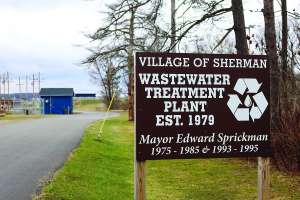
The Village of Sherman in far western New York (population 720) this year finished extensive upgrades to its wastewater treatment and drinking water facilities, investing a total of $9.5 million. And that’s in addition to a new 9.58 MW solar energy array built on the wastewater treatment plant property.
The $7 million wastewater plant upgrade replaced an extended aeration activated sludge system with a sequencing batch reactor and a screw press for biosolids dewatering. “It’s less labor intensive,” says Jay Irwin, lead operator, who is also responsible for the drinking water side.
“It enables us to run an automated system without constantly worrying about operations. Before, everything was done manually. We had to waste manually, dewater manually, shovel the drying beds manually.” Now the entire process is automated, with remote monitoring and operation capability and an extensive alarming and notification system.
Melanie Wright, P.E, an environmental engineer with the New York Department of Environmental Conservation, Division of Water, observes, “Jay and the village of Sherman have done an excellent job of maintaining compliance with their permit despite an aging plant and difficulty retaining certified assistant operators.
“The treatment plant has become a point of pride for the community. They even held a 40th birthday party for the plant when trying to drum up community support for the upgrade, which has been in the works for several years. The village was able to leverage grant funding to make the project affordable. Overall, Jay has impressed me with his resourcefulness and skill, despite the village’s small size and limited budget.”
Sherman, in far western New York near Lake Erie, is a farming community with only household wastewater except for influent from a few restaurants and commercial establishments.
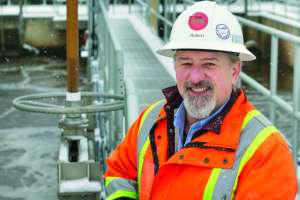
Irwin started with Sherman in 2007 when the treatment plant’s previous chief operator Paul Fisher, a friend, told him the village was looking for an assistant. Fisher retired five years later, and Irwin became chief operator at age 26. “I absolutely love it,” he says. “I enjoy going to work. Every day there is something new, something different.” He runs the plant with part-time helper Craig Weinheimer.
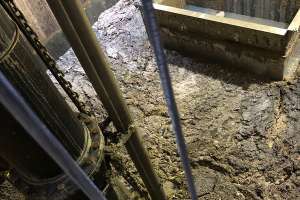
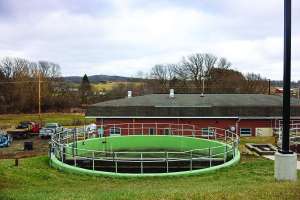
Before the upgrade, the extended aeration process consisted of an aeration basin in a circular tank with a post-aeration section, a contact stabilization zone, and a single clarifier stilling well in the middle of the tank. “It was over 40 years old, and things were starting to deteriorate beyond where we could bring them around,” Irwin says.
The upgrade took about four years, covering design (Barton & Loguidice engineers), grant writing and procurement, and construction, of which final details were completed in late 2023. Grants and low-interest loans from state and federal programs covered the bulk of the $7 million cost. The COVID pandemic hit in the middle of the project, causing delays in equipment delivery and driving up prices. “It was the worst timing possible,” says Irwin.
The upgraded Sherman plant has a design flow of 140,000 gpd and an average flow of 30,000 gpd. The village collection system feeds into a single pump station with an OverWatch system (Industrial Flow Solutions) that lifts the flow to the process.
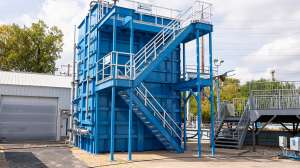
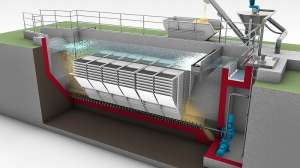
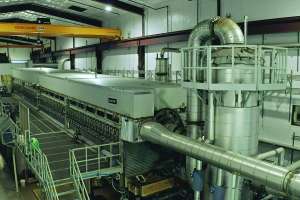
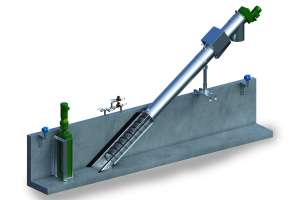
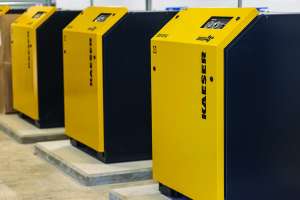
The headworks building includes a FlexRake screen (Duperon) followed by 15-foot grit chamber. The flow then enters the SBR (Sanitaire, a Xylem brand) with continuous flow in two treatment trains. Aeration is regulated by automated dissolved oxygen control. “We have a certain setpoint so that the air is shut off when that setpoint is reached,” says Irwin. “The system also wastes automatically based on preset limits.”
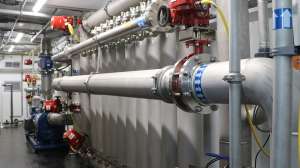
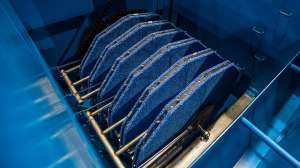
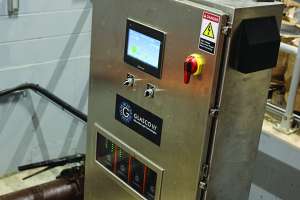
The secondary effluent then goes through a pair of Hydrotech Discfilter units (Veolia) and next into a sample pit from which grab samples are taken for monthly BOD and TSS testing. The flow is disinfected in a noncontact UV system (Glasco) before post-aeration and discharge to French Creek.
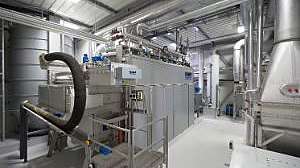
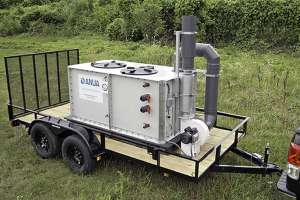
Waste activated sludge is sent to two digesters created by repurposing one of the old circular process tanks and splitting it into two sections. From there the material is dewatered to 20% solids on a 12-inch-wide, 8- foot-long mobile screw press (BDP Industries).
“We had the press installed in a 26-foot enclosed trailer instead of a very expensive building,” Irwin says. “That saved us a lot of money for design and construction.” The dewatered material is hauled to a landfill 30 miles away by a contractor (Casella). Irwin hopes to generate revenue from the press by allowing other communities to rent it. He expects Sherman to operate it only for the equivalent of about two months per year.
Daily plant operation is much simpler now. For one thing, the drying beds no longer exist. “The biosolids took 30 to 60 days to dry, and we had to shovel the beds by hand,” Irwin says. “There were two 20-foot-square beds to shovel.” The drying bed facility will be converted to a storage area for trucks and equipment.
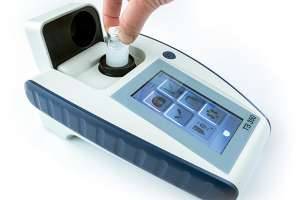
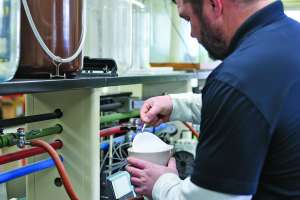
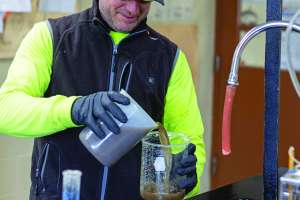
Process control samples are taken daily for TSS, pH, settleability and temperature. “We do a maintenance Monday where we do all our greasing and any normal weekly maintenance,” says Irwin. “The decant on the digesters is still manual, but we don’t have to pull pumps and hoses. We just lower a decant pipe and it flows by gravity to the head of the plant.”
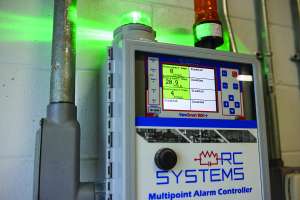
As of last October the remote control, alarm and notification system (RAFA Systems) was still being finalized. On completion Irwin expected to have alarms on “essentially everything — the SBR, blowers, filters, UV system. If anything has a fault, it will send a message so we can come in and address it. I have full access to the SBR, so I can change settings over my phone.”
Irwin staffs the facility 50 hours per week, Monday through Friday, and pops in on weekends. Helper Weinheimer works 20 hours a week. Irwin at present holds a 2A activated sludge operator license. The upgrade to an SBR means he will upgrade to 3A (second highest) in the next year and a half. Meanwhile Fisher, who holds a 3A license, will be on site a few hours per week to provide oversight as required by state regulations.
Irwin expects to need a full-time operator soon to help him run the treatment plant and the newly refurbished water system (54,000 gpd average flow), which consists of two wells, chlorine disinfection and a 300,000-gallon reservoir.
The $2.4 million water system project replaced two well pumps, added a new treatment facility, and completed a 20-year water main replacement initiative. Lateral connections from homes to the mains were covered by grants and village funds. “A 60% state Environmental Facilities Corporation grant for hardship due to the previous condition of the well pumps and treatment building is keeping the water rates well below what the state considers affordable,” Irwin says.
The Sherman team’s efforts over the years have not gone unnoticed. The plant received a 1998 Operations and Maintenance Excellence Award from the New York DEC, and a 2000 U.S. EPA Outstanding Wastewater Treatment Facility Operations and Maintenance Award.
Jay Irwin was recognized as the 2018 Wastewater Operation Specialist of the Year from the New York Rural Water Association, and he and former helper Paul Fisher won a 2021 Operator Ingenuity Solids Slicer Award for a low-cost method of reducing biosolids drying time on the beds.
With new equipment across the board in the wastewater and drinking water systems, good things surely lie ahead for the Village of Sherman.