Screening management is ever more critical as clean-water plants deal with wipes and other materials that don’t disintegrate in the collection system.
An efficient screening system saves on labor, keeps the treatment process flowing smoothly, and protects downstream equipment against fouling, unnecessary maintenance and potential damage. Now JWC Environmental (a Sulzer brand) offers the Auger Monster ALT as an all-in-one solution for screening, washing, dewatering, compacting and conveying.
The ALT is the latest evolution to the Auger Monster product line. When combined with the company’s Muffin Monster or Channel Monster dual-shafted grinders, it effectively removes wastewater solids. The company says the device is well suited for plants 10 mgd and smaller, enabling them to avoid the cost of installing a bar or perforated plate screen along with a washer/compactor.
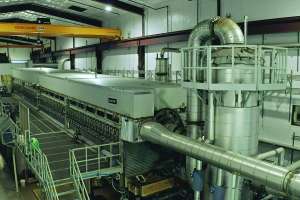
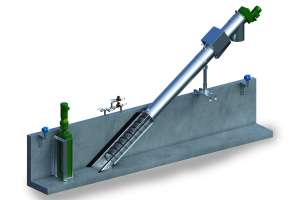
The unit can be installed with minimal construction or infrastructure changes. It operates in a manner similar to previous designs. A perforated screening trough captures solids, which are then removed and sent up an incline by a shaftless spiral auger. The debris is washed, and separated organic material is directed back to the headworks. Excess water drains by gravity.
An optional press zone squeezes out more water to yield a drier and more compact discharge. Rob Sabol, vice president of engineering with JWC, talked about the Auger Monster ALT in an interview with Treatment Plant Operator.
TPO: How serious is the problem of wipes and other trash in wastewater?
Sabol: The industry is still dealing with the increase in solids discharged to the waste stream. And given continued efforts to reduce water, the concentrations of trash are staying flat or going up. Nothing I am hearing says there has been a solution to the problem of people throwing their wipes, diapers, cloth and other things down the toilet. Keeping the pumps protected from these solids is an ongoing issue.
TPO: What specific market need is the Auger Monster ALT designed to address?
Sabol: The Auger Monster spiral screw screen is a product we have sold since 1997. With any screen, the goal is to lift unwanted solids from the waste stream. We pioneered the use of an upstream grinder so that the screen does a much better job of separating items like rags and plastics while leaving the soft organics in the channel for the biological process to take care of. The Auger Monster ALT is the next generation.
TPO: What drove the development of the new version?
Sabol: When you’ve had a product in the marketplace for a number of years. you learn about areas where customers would like to see improvement, and you want to take the next step to address that market need.
TPO: Is the compaction capability the most significant addition to the technology?
Sabol: Yes. Generally, spiral screw screens would do washing and conveying, and there would be a limited amount of compaction and dewatering just by the natural action of lifting the solids across a perforated screen and conveying them over a distance before discharge. With the ALT, we introduced a press zone. Customers had told us about issues with material stalling within press zones. We developed a solution to provide compaction and additional dewatering of the solids, but without stalling or other issues.
TPO: How is the compaction accomplished in the new design?
Sabol: We run the spiral up almost halfway through the perforated plate and then stop it. At that point the conveying action of the screw is removed, and now we’re using the action of material pushing on material to compress the solids and squeeze out additional water. That water then passes through 5 mm holes and is fed through a discharge tube into the wastewater stream. To keep those holes clean, a washing system periodically puts a spray across those holes.
TPO: Why is the press zone offered as an option?
Sabol: With our spiral screw screen, especially with a grinder upstream to precondition the solids, the discharge coming off the auger is fairly dry and will pass a paint filter test. The press zone is for customers who have a special need for a higher level of dryness. The dryness correlates to a reduction in weight, and that helps with the cost to transport to the landfill. The more we can remove weight from the solids, the more the customer’s disposal costs go down.
TPO: What other improvements have you made?
Sabol: We’ve expanded the material offering of the spiral auger. Traditionally we supplied the screw that lifts the solids in steel, but customers have told us that stainless steel is a valued option. So now we can supply the screw in 304 stainless, and by special request in 316 stainless. Also, for those concerned about the environment and sustainability, we’ve reduced the water consumption by up to 75% over the previous design. In addition, we took special care to reduce weight by removing over-engineered and nonvalue features. For example, we thinned out the transport spiral that conveys solids up to the dump container, while maintaining structural integrity. That means lower shipping cost and a unit that is lighter and easier to work with.
TPO: Were any changes made to improve maintainability?
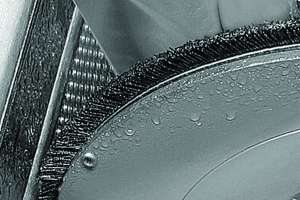
Sabol: We made significant improvements and created options with the brush that sweeps the screw clean as it turns. We now offer a single brush and three options for segmented brushes, so that if a segment of brush needs replacing, the customer can replace just that one section. That is much more economical. We’ve also made it possible to replace the brush sections within the channel, without having to lift and remove the screw.
TPO: What have you done to prove out this technology?
Sabol: The heavy development was done virtually on our CAD systems and through our engineering staff. Proving it out has involved significant factory testing. We created what’s called a zero series product, where we took the production drawings and built the first unit. The assembly work was done by a team of product development engineers who then went through the unit to find areas where we were happy with the performance and areas to improve on. That allowed us to fine-tune the product.
TPO: How much operator attention does this equipment require?
Sabol: Other than at startup, there’s really just monitoring of the system to make sure that the brush is in good condition and that the solids are moving properly. The system employs a PLC-based controller that has a factory-determined run sequence. It allows the auger to move forward, stop for periods of time, maybe reverse to break up plugs of solids or just continually move forward.
TPO: What is involved in setting up the equipment on a customer’s site?
Sabol: We dispatch our technicians to the site for startup, and they perform an evaluation on running at the optimum performance. One key to the operation on any screw screen is to operate the screen as little as possible. The more the screen remains off, the higher the capture efficiency, because material builds up on the perforated screen and starts closing off those holes. Once that material builds up, the screen is capturing at an even higher rate. By running minimally, you also increase longevity by helping to reduce wear and tear.