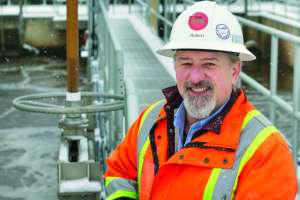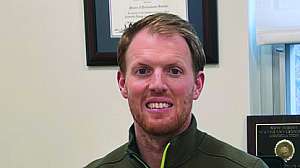
In 1982 Doug Armstrong started as an operator trainee at the South Wastewater Treatment Plant in Addison, Illinois.
At age 20, he was just looking for a better job to support his family. Little did he know that he was starting a career leading to his present role as foreman of the city’s North Wastewater Treatment Plant.
“Just out of high school, you don’t even realize these plants exist,” he says. “The thought of ever doing this was the farthest from my mind. I really didn’t think that far into the future. I was recently married. I never thought I would be 61 and still here.”
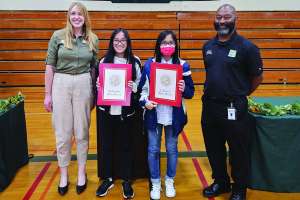
He’s not only there – he excels, as shown by his 2023 William D. Hatfield Award from the Illinois Water Environment Association.
Armstrong started with no certifications or experience but by 1989 had Class 1 (highest) Wastewater Operator certification. “I was always looking for opportunities to improve,” he says. “Addison is a pretty great place to work. People tend to stay, so moving up the ladder through attrition takes quite a while. I was chief operator for about 20 years and had to wait for another supervisor to leave before I could move up to foreman.”
One of Armstrong’s advantages is his attitude toward challenge, something he passes on to his team. “Something’s always breaking or changing,” he says. “There’s always something: all the moving equipment, the plant, the bugs. They’re always changing.
“I’m 61, and I’m not looking to retire in the immediate future. I’m involved with a lot of things, and want to give those my full attention. Maybe sometimes I’ve bitten off a little more than I can chew, but we’ve always been able to handle it. It’s just more opportunity to work with other people. Meeting new people all the time is great. You are always going to need a hand. Having your personal Rolodex is priceless.”
His most valued contacts include mentors from his long career: “My supervisor from my first day was Mitch Patterson, the foreman. He taught me the ideology, which I still believe in, of leading from the front. He pushed me to do things I wasn’t comfortable doing.
“I do that with people now. I want you to read the book and then try it. That’s the only way you’re really going to learn. I’m not going to show you how to do it, but I’ll stand there and keep you from doing something really bad, running-with-scissors-type things."
Armstrong also fondly recalls Greg Brunst, his superintendent: “He was very supportive of being part of organizations, getting involved in a bigger picture. He was very involved. So was his predecessor.”
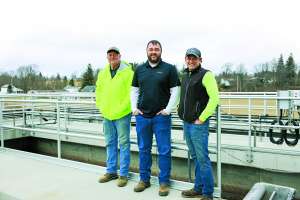
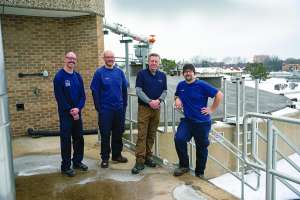
Now Armstrong passes along what he has learned to his staff, which includes: Maureen Wright, chief operator; Zach Saucier, operator; and Mike Ryan, operator (all with Class 1 certification). Zach Froats is a trainee, and Chris Nanak is a maintenance specialist.
Armstrong’s first task each morning is to sit down with the crew instead of just writing lists of tasks: “Talking it through really helps with personal interaction.”
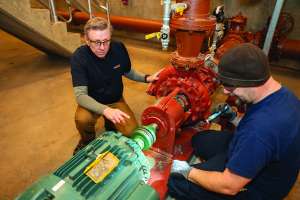
Then he walks the plant so he can observe more than lab numbers might reveal. He’s also there to help team members, working side by side with them if need be: “Someone told me once that you don’t assign a job you’re not willing to do yourself. I still try to follow that. Camaraderie and teamwork are really critical.” He preaches that work is easier and more pleasant when burdens are shared.
He also strongly advocates team members doing rounds. “I’m still old school, where you need to get your hands on it and look at it. Sure, everything is alarmed, but if the operators don’t walk around at the end of the day, they may miss issues. Something isn’t turning, an alarm isn’t showing up where it should.”
As for new challenges, “I always love them,” he says. “Something gets broken, but if we fix it together, we’re feeling some accomplishment. Or when there’s operational trouble, if we can get together and find a solution, it’s rewarding. It happens all the time. It doesn’t become stale or stagnant. Problem-solving every day — the reward for that is what I enjoy.”
Addison is in DuPage County, one of the collar counties around Chicago. The North treatment plant (5.3 mgd design) went online in the late 1980s and has reached its life expectancy. The plant has no phosphorus and nitrogen permit limits at present, but that’s about to change. In response the city is looking to consolidate the North and South plants.
“The South plant is way underdesigned for 3.2 mgd, and we’re under-designed a little bit,” Armstrong says. “So we need to consolidate them, rather than upgrade both plants to meet the nutrient requirements that are coming. By then we’ll also be dealing with PFAS. We’re also going to need biological nutrient removal.”
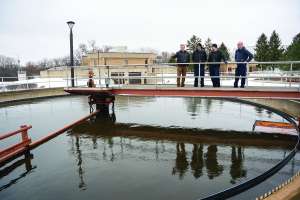
For now, although aging, the North plant works just fine, says Armstrong: “Our permit numbers are always great.” Effluent enters a basin that captures normal flows; once that fills up the excess enters a 10 million-gallon equalization basin.
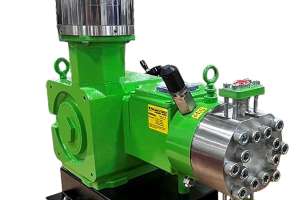
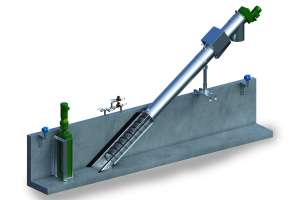
Flows pass through a Schloss bucket-style degritter followed by two 0.235-inch bar screens (Headworks). It is then pumped up to three Envirex primary clarifiers (Evoqua Water Technologies). Primary sludge is delivered by three Dorr-Oliver pneumatic piston diaphragm pumps (FLS) to the anaerobic digesters, which take primary and waste activated sludge.
Effluent from the primaries goes to first-stage and second-stage aeration and then to three Rimflo intermediate clarifiers (also Evoqua) and four Rimflo final clarifiers. Final effluent is disinfected with chlorine gas; sulfur dioxide is used for dechlorination from May through November. Effluent is discharged to Salt Creek.
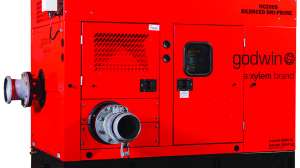
“A couple years back, we had new excess flow facilities put in,” says Armstrong. “We have three Sulzer 84 hp/6,800 gpm PLC-controlled pumps for that. The overflow process is not really automated, it just overflows a weir and fills that up.
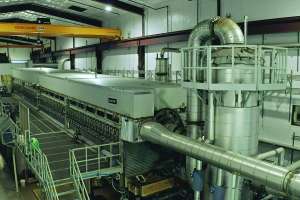
“We have some equipment that is PLC-controlled, including two Envirex primary anaerobic digesters. We just went through a complete upgrade of the solids facility. There are two Komline-Sanderson belt presses in that building.”
The North plant received and processes biosolids from the South plant. All biosolids are land-applied as Class B material.
Armstrong knows that with a full plant upgrade not far down the road, the technology train will continue to speed through the treatment plants. He does everything he can to prepare and stay current. He gets access to training and networking through the IWEA and the Illinois Association of Water Pollution Control Operators.
“We’re starting to get things into control through SCADA,” he says. “We went with Wonderware software [AVEVA], and our water department uses it as well. We updated some of the controls and went to nice touchscreens.
“It took a lot for me to get used to all the technology. Some of the younger people were much better with it than me at first. But I’ve got to embrace it. I have no choice. It’s great when it all works, but sometimes I get frustrated because I can’t just fix it when it doesn’t.”
Armstrong believes his experience and industry service earned him the William D. Hatfield Award. His mantra when speaking to Junior Achievement groups and others: “Make it a career. Don’t just make it a job. It’s way more than that. You are protecting the environment. Take some pride. You can make it what you want it to be. Get involved in industry organizations and events. Learn to work with other people and embrace that teamwork mindset.
“This industry is full of down-to-earth people. I recently found an old permit from the ’90s. It was about 10 pages long. Now ours is over 20 pages. This career is always evolving. It’s always a challenge. If you’re willing to accept that challenge, it will give back what you put into it.”