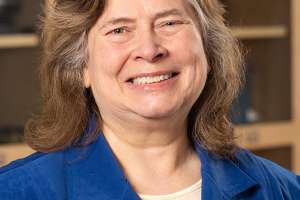
It’s easy to look at Kathy Bates as a woman pioneer.
She believes she was among the first 100 women in her home state of Wisconsin to receive a motorcycle license. She was also one of a small minority of women instructors, and women in general, in the state’s water and wastewater sector.
Bates is the program coordinator, faculty lead and an instructor in the Environmental Health and Water Quality Technology applied associate degree program at Milwaukee Area Technical College. There she teaches young people pursuing careers in a wide range of disciplines.
She instructs in the water and wastewater treatment courses, introduction to environmental health and water quality, environmental biology, environmental chemistry, environmental bacteriology and others.
She landed what she considers her dream job in 2000 in the same program where she earned her associate degree in environmental and pollution control technology. Along the way she earned her bachelor’s and master’s degrees at other universities.
Bates would like to see more students, and especially more women, in her classes. In an interview with Treatment Plant Operator, she talked about her experiences as a woman in the water professions and what it might take to attract more women to water and wastewater treatment roles.
TPO: What is the background history of your program at MATC?
Bates: It’s about the air we breathe, the water we drink, the food we eat and much more. Our program started in 1968 because jobs in treatment plants, in food safety inspection in the restaurant industry, and in other environmental and health careers required more than a high school diploma.
TPO: How did you discover water and environment as a potential career?
Bates: I’m a Milwaukee native. I graduated from Custer High School, and my goal was to be an accountant. Then life happened. My sister suggested I check out MATC. I found the program I’m in today, which then was called Environmental and Pollution Control Technology. My instructor was the late Al Lustig, and I could see his passion and commitment to the field. There was something in his classes that made the light bulb go on: “Aha, I know what I want to do one day. I want to come back and instruct in this program.”
TPO: What did it take to actually make that happen?
Bates: I needed a master’s degree and certain experience in the field. So I went on to the University of Wisconsin-Stevens Point and earned a bachelor’s degree in water resources in 1992. In 1995 I got my master’s in environmental and public health from UW-Eau Claire. I also attained a variety of certifications. Some of them I let expire, but I still hold certification as drinking water operator and a wastewater operator. I’m also a certified hazardous material manager and a registered sanitarian. I got my job here in January 2000 after Al Lustig retired, and I started working with another previous instructor of mine, Jerry Ortiz, who made my career transition easier.
TPO: At that time, were you among a very small group of women in the professions?
Bates: Yes. I was the first woman at MATC in this program. When I would go to wastewater and drinking water conferences and seminars, I was excited to see some women in the roomful of men. But when I started up conversations with them, it turned out they were support staff. They weren’t operators; they were there for their supervisors. It wasn’t until 2008 or so that I began meeting women at these events who were the engineers or operators or lab technicians.
TPO: In your view, why are the water professions so male-dominated?
Bates: First it’s visibility. Maybe when they’re going through school it’s not discussed that these opportunities are available to them. Maybe they’re not aware of the opportunities because they don’t know people in those careers. And if they do show interest in the sciences, they’re steered more toward being true biologists or true chemists, and they’re not exposed to water and wastewater treatment and operations. Then for women in child care roles, rotating shift work can be an obstacle. It can be a juggling act finding child care at all times of the day.
TPO: Have you seen a trend toward more women in your classes?
Bates: Currently, among my first-year students, I have a few more females than males. It doesn’t mean all the women are looking to go into water treatment, but about seven of them are hoping to take the drinking water certification test. One woman student has applied for a summer internship on the drinking water or wastewater side. The interest is growing as the awareness level is improving.
TPO: Does your institution actively help recruit women into your program?
Bates: College recruitment tends to push the most in-demand programs like nursing, graphic arts, IT, fire and police science. They highlight the programs that have larger numbers and the larger amount of jobs. We’re more of a niche. We bring something very important to our communities, but people don’t realize we exist until they don’t have clean drinking water coming out of their tap or they have sewage backing up in their basement. We are a hidden gem, a hidden treasure.
TPO: What can be done to raise the profile of the drinking water and wastewater professions?
Bates: I sometimes wish there could be a big billboard on the I-94/I-43 interchange in Milwaukee: “Hey, get into water treatment. Great careers providing good-quality water and protecting the environment for your community.” If these careers were really touted in a positive direction, maybe there would be more interest. And if everybody who’s employed in water and wastewater operations and laboratory would go visit their kids’ schools on career day, that might help. I am open to any suggestions and connections someone might have.
TPO: Are there intrinsically female traits that make women well suited for these roles?
Bates: I’m reminded of a former student, Georgia Paul, who worked in operations at the Milwaukee Metropolitan Sewerage District and is now 81 years old and retired. She said, “For the life of me, I can’t understand why more women are not involved, because hey, treating wastewater is no different than changing diapers. We already know how to deal with poo. Why not deal with it on a more macro scale, get paid well, and have fun doing it?” Nurturing is another relevant trait – serving the greater good, protecting public and environmental health. We’re also multitaskers, and doing operations is multitasking.
TPO: What messages do you give to your students, of either gender, to inspire them about the water and environmental professions?
Bates: I present that we’re helping to save the world, making it a better place for today and tomorrow. Some students get excited about the variety of duties. It’s not a sit-down, nine-to-five job. You’re using your brain to figure out and troubleshoot things. I also tell them in their careers to be open-minded, be flexible. Things will always change, and that helps keep things fresh. Sometimes you’re not going to get that pat on the back for what you do, but at the end of the day you get to remember that the water is cleaner or safer because of your job. People can go swimming and fishing because you helped keep pollution out of the ecosystems.
TPO: How would you describe your own satisfaction with the career you chose?
Bates: I am thoroughly delighted. For the first couple of years in my job as an instructor, I thought I was living in a dream. I get to do what I love. I’m helping others learn about the environment and public health and how to protect it. Being able to give students the same passion, knowledge, encouragement and motivation my instructors gave me, I find that very satisfying. It’s a great feeling to see the student’s confidence, skills and knowledge grow.
TPO: What do your most satisfying days look like?
Bates: My wow moments are when the graduates tell me that they’ve applied so much of what they learned in my classes to their career, that they listened to my suggestions and took advantage of opportunities, or that they encouraged a family member or friend to come into and complete the program. It brings me great joy to see my graduates working in their desired careers. I’m so proud of them.