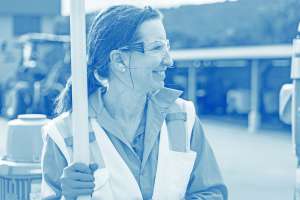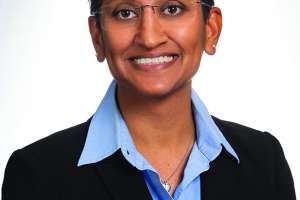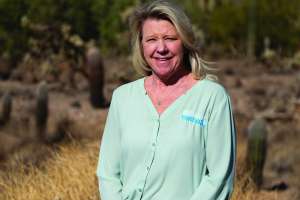
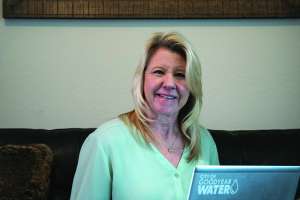
Barbara Chappell grew up as the youngest of three girls.
“Dad figured out he wasn’t going to have a boy, so I was his fishing and hunting buddy,” says Chappell, water services director in Goodyear, Arizona.
Her experiences fishing on the Phoenix area’s reservoirs, also sources of the region’s drinking water, instilled an appreciation for water resources that led to her choice of careers. She started in an entry-level position with the city of Avondale (population 91,000), progressed through various roles in operations and, with help from college degrees in engineering and public administration, moved up into leadership.
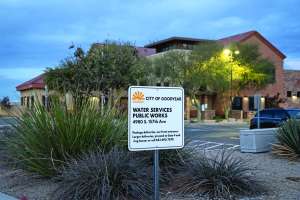
Today after eight years with Goodyear (population 105,000), she is responsible for a large and diverse infrastructure that includes water reclamation facilities, groundwater and surface water treatment systems, a nonpotable water irrigation system and more.
She has enjoyed the challenge of improving and modernizing Goodyear’s facilities and helping to develop members of her team. “One thing I am the most proud of is watching our staff promote,” she says. “We have people who I have seen go from operators to supervisors and superintendents. That makes me very happy.”
For her leadership and vision, and for instilling team members’ passion for their careers, she earned a 2024 William D. Hatfield Award.
In Chappell’s family, college wasn’t an expectation. After high school she went to work for an aerospace company overhauling and repairing fuel injectors for turbine engines. She harbored an interest in engineering, but hesitated for several years because of the time and effort it would take to pursue that career.
“Then I had a mentor say, ‘Time is going to pass. You’ll wake up one day, you’ll be 40. Wouldn’t you rather have a degree? Just go for it.’” And so she did. To gain related experience during her studies, she applied for jobs with water-related utilities, landing at Avondale in development services in 2002.
“That proved to be a very good foundation for understanding how a city grows and develops,” she recalls. “It ended up serving me very well.” Meanwhile, she pursued her water and wastewater operator certifications and consulted with water department team members. “I asked: How do I get into water? What do I need to do?” she recalls. “I did ride-alongs. I did everything I could so that when an opportunity opened, I was prepared for it.”
Her first position in water was senior operator for Avondale’s wetland treatment and groundwater recharge facility. Along the way she pursued her bachelor’s degree in civil engineering at Arizona State University, taking night classes where possible and receiving time off for daytime classes when needed. She earned a master’s in public administration from ASU through night school and online.
As befits a smaller community with limited staff, she “wore a lot of hats.” She progressed up the ranks, doing reporting for treatment facilities, working on capital projects including a wastewater treatment plant expansion, taking care of permitting and overseeing construction of a major reclaimed water pipeline.
From there she moved into regulatory compliance and led the city’s industrial pretreatment and cross-connection control programs. “All the while I was involved in water resource policy management,” she says. “My career started to get away from operations.” In 2016 she moved to Goodyear as utility operations manager. She was promoted to deputy water services director in 2019 and to director in 2023.
At Goodyear, a fast-growing western suburb of Phoenix, she inherited water and wastewater systems in dire need of upgrading. “There had been deferred maintenance,” she says. “Things were being run to failure. We didn’t have the proper redundancy in a lot of our facilities. Our drinking water supplies, in summer when we were at peak demand, were really on edge.
“Running things to failure is very stressful for operators. They know they’re going to get calls in the middle of the night because this or that piece of equipment is not going to keep running. We had to make sure they got what they needed to make a more reliable system, and in turn give them more peace and more balance between work and home life.
As part of the leadership team she advocated to the mayor and city council for funds to bring the facilities up to date. In the end the council approved a five-year, $50 million package of projects and stepwise rate increases.
“They had gone eight years or more with no rate increases,” Chappell says. “It was about explaining how no rate increases for all those years had put us in a difficult position. We also had completed an integrated water master plan with a consultant (Carollo Engineers) that included a condition assessment and a clear definition of what needed to be done and why.
“We assembled a citizens committee that helped advise the council. We had staff who stood up and testified. What we do is sometimes hard to explain in simple terms. So we broke it down. We talked about it among ourselves. We put the plan together. We were honest and transparent. Our council trusted us. They were super understanding.
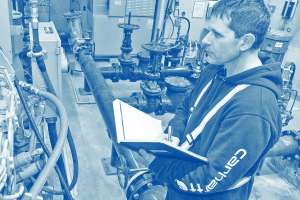
“We rehabilitated wet wells. We created an asset management program to get our equipment on a maintenance cycle. We listened to staff to understand where their pinch points were and how we could get to a more proactive operation. We installed new and rehabilitated drinking water wells so we weren’t on edge during the summer months.”
As critical as improving the infrastructure was advancing the workforce. “Goodyear has a culture of really caring for its employees,” says Chappell. “They truly believe that people are their best asset. The city gets awards every year for its wellness and safety program.”
In that environment, Chappell and her team created a professional development initiative: “It’s purely voluntary. People create their own goals and objectives, and we get them individual coaches who help hold them accountable.”
Chappell holds quarterly workshops with all the participants on topics such as giving effective presentations. Human resources staffers offer instruction on interview skills. Some team members simply want help earning higher certifications as they aspire to supervisory roles.
“Whatever they want to do, we support it,” Chappell says. “We pay for their certification exams. We give them time while they’re at work to study. We purchase materials and provide the resources needed to help them be successful.” Promotions and other achievements are celebrated with periodic all-department parties.
Chappell also takes pride in the department’s fatigue leave policy. “When people are tired and fatigued, they are more prone to accidents and hurting themselves,” she says. “Suppose someone gets called out at two o’clock in the morning to fix a water main, and they finish at 5 a.m. They just spent three hours, they didn’t get enough sleep, their shift starts at 6. Now they’re going to work from 6 to 2:30 in the heat.
“By the end of the day they’re going to be very fatigued. So we allow them to go home and get a few hours of sleep, and we pay them for that. Then they can come back and finish their shift, and they don’t lose their overtime pay.”
In day-to-day work, Chappell is responsible for multiple wastewater and drinking water facilities. Her key team members include Todd Carpenter, deputy water services director; Jose Murillo, utilities engineer responsible for capital projects and asset management; Ray Diaz, water resources and sustainability manager dealing with long-range water-supply planning and water-related legislation; Heather Saunders, support services manager whose duties include supporting the finance and budget department in setting rates and impact fees; and Nicole Adamson, management assistant.
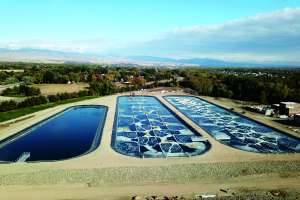
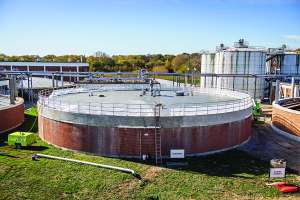
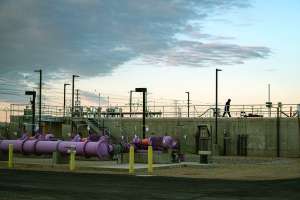
Wastewater is treated at the Goodyear 157th Avenue Water Reclamation Facility (6.8 mgd design), the Corgett Water Reclamation Facility (0.8 mgd) and the Rainbow Valley Water Reclamation Facility (0.75 mgd).
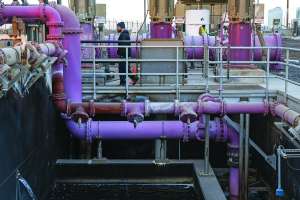
The drinking water system includes 15 wells, two 5 mgd reverse osmosis treatment facilities (Toray), three arsenic removal systems using Sorb 33 ferric oxide adsorption media (De Nora), and an 8 mgd surface water treatment plant.
The surface water plant was built to treat a supply obtained in a landmark agreement with the Salt River Project. “It was the first agreement ever entered between the Salt River Project and a city not on the project land to deliver water from the Central Arizona Project,” says Chappell. “It allowed us to get surface water within five miles of our city. Then we built a pipeline to deliver the raw water to our treatment plant.”
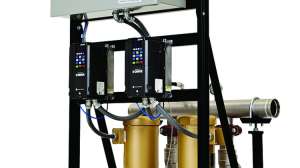
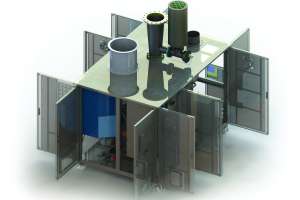
The RO treatment systems provide TDS and nitrate removal on lower-quality groundwater sources. On one well where nitrate concentration was increasing, the city deployed the Microvi biological removal technology. It uses encapsulated Nitrobacter microorganisms to convert nitrate to nitrogen gas that is safely released to the atmosphere.
The highly automated process is inexpensive to operate, has low chemical consumption and unlike RO does not produce a concentrated waste stream that requires safe disposal. “Ours was the first full-scale facility in Arizona when we built it,” Chappell says.
Management of RO reject water has been a challenge for Goodyear in that Arizona has no convenient discharge point, such as an ocean outfall. Historically, the city sent the briny waste to a water reclamation facility. But because that treatment process cannot remove TDS and salinity, uses for the reclaimed water are limited.
To solve that problem, Chappell and counterparts at the nearby city of Buckeye worked out an agreement with Arizona Public Service to add the RO reject stream to a pipeline that delivers effluent from a regional water reclamation facility to the Palo Verde Nuclear Power Plant for reactor cooling.
“Now we’re constructing a regional solution that will take the RO concentrate out of our treatment plant,” Chappell says. “It’s going to free up space in the plant that the brine has been occupying, and it’s going to help improve our effluent quality. This project is really going to benefit us and open more reuse opportunities.”
Reflecting on her career, Chappell is grateful to mentors who helped her advance in the water profession. In particular she mentions Marilyn DeRosa, who is now retired but was a deputy director for Avondale while Chappell was there; and Javier Setovich, former public works director in Goodyear and now deputy city manager in Buckeye.
Meanwhile, Goodyear continues to grow, and that means more infrastructure to build, pay for and maintain. More technology is coming, as well: “We are converting all of our water meters to advance metering infrastructure capability. I would like to advance that to having a customer portal where people can access their metering data on a real-time basis.”
As for her own future, Chappell observes, “I always dreamed that one day I would get to a director level, and now I’m here. I’m enjoying it. I’m trying to be the best I can be. My next level would be a deputy city manager, but I don’t know if I want to do something like that. I just love the water and wastewater area.
“When I’m ready to retire I think of doing consulting work, either for an engineering firm or contract consulting on projects. I’d like to use my knowledge and experience to help communities that are facing growth challenges. I enjoy solving problems and helping find innovative solutions.” To see the proof of that, one only has to look at the city of Goodyear.