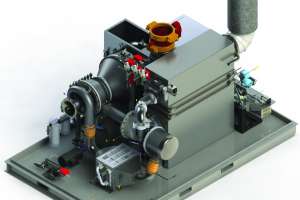
Aeration is typically the largest cost for activated sludge treatment plant operation and is a common target for efficiency initiatives.
The most common aeration technology consists of blowers powered by electric motors. Now APG-Neuros, a manufacturer of high speed turbo blowers, has developed an alternative that uses biogas to fuel a gas turbine that directly drives the impeller feeding air to the secondary treatment basins.
The biogas fuel source essentially eliminates the cost of utility electricity for aeration. The complete aeration package has a favorable economic payback when compared with electric blowers, according to the manufacturer.
In many cases, the technology makes use of biogas that otherwise would be flared. It is designed for minimal maintenance and high availability. Omar Hammoud, APG-Neuros president and CEO, talked about the technology in an interview with Treatment Plant Operator.
TPO: What is your background in the gas turbine and blower industries?
Hammoud: I spent 25 years working in the gas turbine industry, and so I know that product segment very well. Our company introduced electric high-speed turbo blowers to the wastewater industry in 2006.
TPO: What was the motivation for bringing the gas turbine blower to market?
Hammoud: As I learned about what happens at wastewater treatment plants, I became aware of discussions about energy usage, net-zero energy and the potential of biogas. I found that often they flare the biogas or use it in generator sets to produce electricity to feed to blowers. What if we were to take that biogas and feed it into a gas-turbine-driven blower?
TPO: What is the primary advantage of a gas turbine turbo blower?
Hammoud: On evaluating the technology, we found that users could save in the neighborhood of 80% on electricity versus an electric turbo blower. So for a 300 hp blower with operating cost at $200,000 to $250,000 per year, that cost would be reduced to $40,000 to $50,000.
TPO: In basic terms, how does this technology work versus an electric-drive blower?
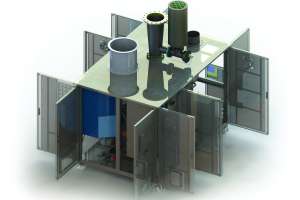
Hammoud: An electric-drive blower has a motor that spins a connected impeller to deliver the air. We replace that motor with a gas turbine that connects directly to the impeller that delivers the air. It is a very simple machine. In an electric blower, the motor needs an upstream harmonic filter, sine wave filter, transformers variable-frequency drive. With the gas turbine blower, we eliminate all these parasitic loads and extra components and go straight from biogas to air.
TPO: How does the initial price of the machine compare to an electric turbo blower?
Hammoud: It is higher, because with a gas turbine blower, you are looking at a project, not a product. We provide a biogas scrubber system and a compression system as part of our package. Heat recovery is also standard, and it is a very important attribute. The turbine exhaust comes out at 400 degrees F, and that heat can be recovered and sent to a boiler or heat exchanger. The payback on investment will typically be no more than five to six years.
TPO: What kind of gas treatment is required?
Hammoud: We have to clean the gas to ensure good combustion and long component life, but also to meet environmental requirements. We have a chiller to remove moisture and siloxanes and copper media that absorbs sulfur compounds. Our emissions of SO2 and NOX are below the limits even for Southern California, which has strictest air-quality requirements in the country.
TPO: How easy is the technology for plant personnel to operate?
Hammoud: Plant personnel can easily operate the gas turbine blower. It has an interface through a PLC and an HMI. The process is self-monitored and makes adjustments automatically. The PLC adjusts the speed and other parameters of the turbine to account for variations in the process.
TPO: What maintenance does the technology require?
Hammoud: Normally, there is no scheduled maintenance; the maintenance is based on condition. The system self-monitors and gives alerts with information about the condition of the components. We designed the gas turbine blower for a 20-year useful life. It operates continuously, and availability is 99%. We designed the blower to be modular. In conventional turbines, all the components are built on one shaft, so that if any part of the system requires maintenance, the entire turbine needs to be removed. We built our system with four modules, and each one is very easy to remove. You take a module out, put a new module in and restart the unit. With this modular approach we reduce downtime and maintenance costs.
TPO: What sizes of facilities is this technology best suited for?
Hammoud: It starts at facilities with flows from 5 to 7 mgd and from there we can accommodate larger facilities of virtually any size. We have a 300 hp unit that also can operate at 200 hp and 150 hp. The 300 hp unit can deliver approximately 6,000 cfm at 8 psig.
TPO: How was this product proven reliable and effective before its release?
Hammoud: We first went through reliability by design. We built in reliability using failure mode and effects analysis and by applying components that have been proven and materials that have been tested and operated for 20 years. We then built the first unit and tested it for more than three and one-half years. We tested all the systems and tested the entire package.
TPO: Are there examples to show how well this technology is being accepted?
Hammoud: In the Metropolitan Sewer District of Greater Cincinnati, we have an active design/construction project where they will install two units at the Little Miami Wastewater Treatment Plant around June 2025. At about the same time the Eastern Municipal Water District in California will install one unit at their Moreno Valley Regional Water Reclamation Facility.
TPO: What else is new for APG-Neuros?
Hammoud: We have nearly 2,000 high-speed turbo blowers installed in North America with about 900 customers. We have introduced the world’s largest high-speed turbo blower. At 1,500 hp, it has benefits for utilities to modernize aeration technology in the large-facility market segment. We have also developed an AI-based Advanced Aeration Control that helps run the entire aeration system. It is like a co-pilot to fine-tune the process. It accumulates data from operations, uses machine learning algorithms, analyzes data, and makes decisions to optimize the operation and reduce power consumption.