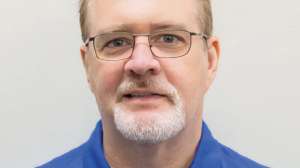
It’s a long way from working in an auto parts store to directing the water and wastewater utilities in the northern Alberta town of Athabasca.
Terry Kosinski made the transition out of necessity: He and his father decided to shutter the auto parts business where they had worked together for 10 years.
“Fortunately,” Kosinski says, “I knew a couple of guys who worked with the town, and they were looking for a utility operator for the water and wastewater system. So I threw my name in the hat, and that’s how it all started.”
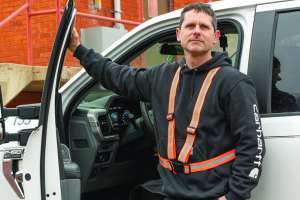
Today he is the town’s utility supervisor, responsible for water distribution, wastewater collection and wastewater treatment in Athabasca, a settlement of 2,700 people 90 miles north of Edmonton with roots that go back to Canada’s 19th century fur trading days.
Was also recognized as the 2023 Gerald Samuel Operator of Year from the Alberta Water and Wastewater Operators Association.
Although born in Edmonton, Kosinski considers himself Athabasca born and raised. “My immediate family is all from here, and my roots are pretty deep,” he says. His parents lived in the city when he was born, but his paternal grandparents were on the family farm in the nearby smaller community of Pine Creek.
“Shortly after I was born, we relocated to the farm,” Kosinski says. “I really enjoyed how we were brought up, and being in the country was where I learned to work hard.”
During Kosinski’s childhood the family grew grain and hay and raised a few cattle. His mother looked after him and older sister Angela; his father ran the farm and worked in tire sales: “Dad was the kind of guy who believed that work came first and play came second.”
Kosinski graduated from Edwin Parr Composite Community High School in 1996. “I had a real keen interest in drama class and acting,” he recalls. “But the most enjoyable part for me was being with friends. We had a super awesome graduating class. A lot of us keep in contact and are very close to this day.”
Kosinski actually began work life at age 13 with an after-school part-time job at an auto parts store. In 1998 he joined his father in running the family’s Kal Tire store and eventually became the manager.
“By 2007, it was getting too much for him, while our family’s interest in being in the tire business had run its course,” he says. “So we made the tough decision to sell the business and basically wash our hands of all of it.” He has no regrets: “I think the best choice I ever made in my life was to work with my dad.”
He admits that he went into his new position at the utility “a little blind. I was given a basic understanding of my duties during the interview and what I had to do day in, day out. I didn’t know anything about municipal operations, let alone water and wastewater systems, but I worked with a couple of guys I had known in the past, plus some new faces. So I was able to pay attention and learn that way.”
When he started his job, the town had its own water treatment plant. On the first day he began learning about the SCADA system and plant operations. “Honestly, it was overwhelming,” he says. “But I stuck with it, helped by some good staff members who were excellent teachers.”
He also studied for and earned Level 1 Water Treatment, Level 2 Water Distribution, Level 2 Wastewater Collection and Level 1 Wastewater Treatment certifications. “The more I learned about the job, the more I wanted to be in this industry,” he says. “Besides, being a water operator in the town I call home is certainly important — to give back to the community that gave so much to me.”
In 2011, the town closed its water plant, and the Aspen Regional Water Service Commission took on that service at a new facility in Athabasca. It’s still up to Kosinski to move the water.
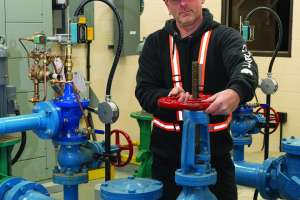
“We’ve got about 35 kilometers [22 miles] of main waterline in the ground,” he says. “There are 1,500 service connections, three reservoirs and pump houses, and one pressure-reducing station with six pressure zones in town.”
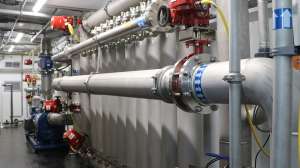
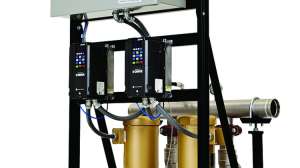
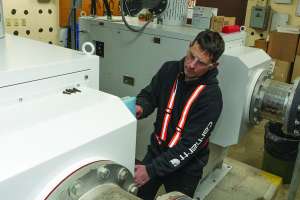
The wastewater collection system has about 30 kilometers (19 miles) of pipes of varying sizes, and one main lift station that moves about 70% of the wastewater. The remainder flows by gravity. The pumping system uses Cornell sewage pumps driven by Baldor 60 hp electric motors, along with Sulzer 3 hp submersibles. The main lift station has a backup generator (Generac) generation on site.
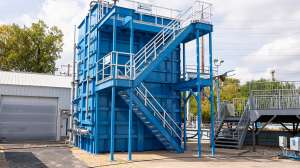
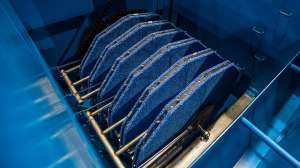
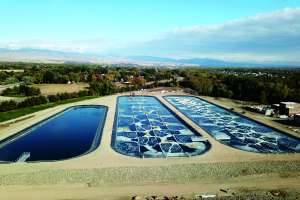
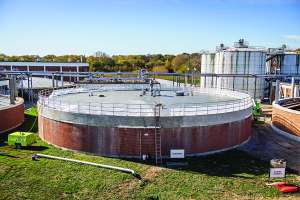
The lagoons are treated with a Nexom OPTAER system using two APG-Neuros turbo blowers to supply the fine-bubble membrane diffusers. The lagoons treat 210,000 to 260,000 gpd.
On the drinking water side, the town distributes 7.9 million to 9.2 million gallons per month. “Our pumping system uses Crane Deming and Fairbanks Nijhuis [Pentair] vertical turbine pumps driven by 12 hp electric motors,” says Kosinski. “All are setup in a lead, lag, lag 2 configuration.”
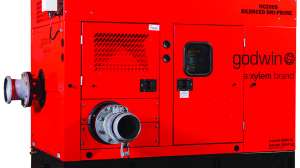
Backup power using Generac standalone diesel fueled generators or Cummins diesel standby engines provide energy or mechanical drive for continued system pressure and flow during electric utility outages or high-flow periods.
The wastewater is processed in a continuous discharge system. The receiving stream is the Athabasca River, which centuries ago was a conduit for the fur trade. “We’re an aerated treatment system with a three-cell lagoon,” says Kosinski. “The time between when the water comes in and goes out is 25-30 days.”
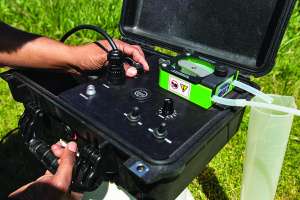
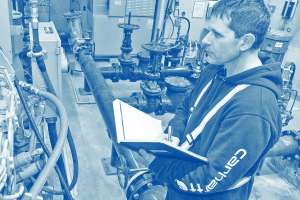
“We sample the wastewater weekly and send the samples to an accredited lab,” Kosinski says. “Our wastewater treatment process blowers, solids grinder, trash racks and aeration system all receive periodic and scheduled maintenance.
“On the water side, we conduct preventive maintenance such as a fire hydrant flushing and valve exercising, aided by our public works staff, because otherwise it’s only my partner operator Jacob Marsden and me on the job.”
The job comes with its challenges, but Kosinski prefers to start with the positives. “Number one, I like looking back and seeing that the efforts that we’ve made are making a positive change for the users of the system,” he says.
“There’s also the satisfaction of keeping the systems operating properly, and finding solutions to problems that may have existed for a number of years, or have recently surfaced, and fixing them. Seeing the results of our efforts is the biggest satisfaction in this job. I’m also able to meet fellow industry professionals, as well as contractors who share the same passion.”
As for the challenges, “It’s probably the amount of time it takes to learn the system. It’s a very time-consuming job. There are a lot of things to learn. Every day there’s something new, and you always have to find an answer, a solution, for whatever surfaces. Our water and wastewater systems never sleep.
“At any moment they can require immediate attention. I have sacrificed a huge amount of personal time to keep this system running with minimal interruption. That’s sometimes a little bit difficult to manage, but we do.”
As for his future, Kosinski has no plans to move on from his town or from the water profession: “I want to stay and finish out my career here. I truly enjoy what I do. Even if the efforts we make only have a small impact, at least it’s a bit of a change for the better.
“I have no reason to want to change my career. My family is here. I take pride in what I do. I’m proud of my town. I want to continue to give as much as I can to this position, until I just cannot physically do it any longer or until I retire if that comes first.”