
The Idaho city of Eagle has stayed with lagoons for wastewater treatment even as growth has exploded.
This affluent suburb of Boise has seen its population expand tenfold since 1990, to 33,000, with no signs of slowing. While most municipalities its size and larger embrace mechanical wastewater treatment plants, Eagle remains true to its origins.
The Eagle Sewer District was founded in 1963 and soon after brought two lagoons online. Since then a great deal has changed. In 1982 the treatment operations moved to a 40-acre site where the district adopted rapid infiltration basins, reusing its effluent as groundwater recharge instead of discharging to the Boise River.
But under regulatory changes enacted in 1996, the district was not allowed to expand its basins to accommodate higher flow. The solution was to send the excess flow to the West Boise Water Renewal Facility for final treatment before release to the river.
In 2001, the district suspended use of its basins and began sending all of its effluent to West Boise, paying for treatment based on volume, with surcharges for BOD, TSS, ammonia and phosphate above agreed-upon levels. High-quality effluent therefore remained a top priority.
Today Eagle still relies on lagoons, but with a twist: high-efficiency aerators mounted on the lagoon bottoms instead of on the surface and combine fine-bubble aeration with coarse-bubble mixing. The devices have significantly improved effluent quality, saving the district significant money by limiting treatment surcharges.
In 2017 the district needed to update the aeration equipment in its treatment lagoon to increase capacity and improve effluent quality. Lynn Moser, then general manager, questioned whether the district should add more surface aerators like its existing units or adopt newer technology.
He found his answer upon encountering MARS aerators, which manufacturer Triplepoint Environmental said offered best-in-industry aeration efficiency, proven through independent testing. Moser shared his discovery with Neil Jenkins, a project manager with the district’s consulting firm, CH2M Hill (now Jacobs).
“Because of Eagle’s increased wastewater volume, the plant had been forced to go from a 20-day retention time for treatment to 10 days,” notes Jenkins, who became district general manager in 2022. “This didn’t give the bacteria enough time to work. We needed more aeration and better mixing if we were going to get our wastewater processed properly in half the time.”
Instead of floating on the lagoon surface, the Triplepoint aerators sit on the bottom, forcing oxygen upward and throughout the lagoon. Moser liked the science and did a cost-benefit analysis comparing surface and submerged aerators. The analysis looked at:
The district found the submerged aeration system attractive for its high oxygen transfer efficiency and mixing capability, the option to add aerators in phases with increasing flow, simplicity of maintenance and the efficiency of high-speed turbo blowers. The advantages outweighed the higher capital cost, nearly twice that of the surface aeration system.
Greater efficiency for the horsepower would save significant energy, and improved treatment would easily fulfill capacity needs while reducing surcharges from West Boise.
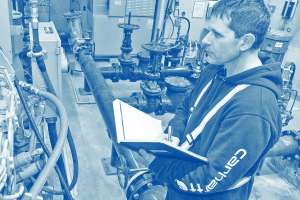
Before committing to the new technology, Jenkins and Moser performed additional due diligence. Jenkins observes, “We visited other Triplepoint customers and asked the operators what they liked about their aeration system and what could be improved. This was extremely helpful in customizing the system to better meet our requirements.”
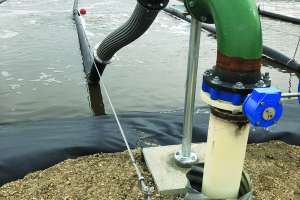
After visiting a wastewater treatment plant in La Grande, Oregon, the Eagle team decided to switch out the standard 6-inch buoys typically used to mark aerator locations for 12-inch marine-grade buoys. “The smaller buoys tend to become submerged when weighed down by rags, making it difficult to locate the aerators,” Jenkins says. “The marine-grade buoys are more robust and don’t easily submerge. They are well worth the extra cost.”
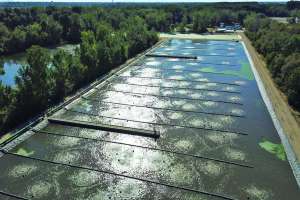
Phase 1 of the aeration project included 84 MARS units installed with 200-foot floating HDPE laterals. The pipes and hoses connected the aerators to a blower house next to the lagoon. An outside contractor did the installation with Triplepoint’s Tom Daugherty providing on-site technical support. The aerators went live in October 2017.
The impact was quickly apparent. “We reduced our BOD dramatically,” says Jenkins. “With our surface aerators we typically saw BOD5 values of 45 mg/L in summer and 60 mg/L in winter and we rarely nitrified during the year. With the submerged aerators and high-speed blowers, our BOD numbers were closer to 15 mg/L in summer and 45 mg/L in winter. During summer we saw ammonia drop from 30 mg/L to 10 mg/L as nitrification began to occur.”
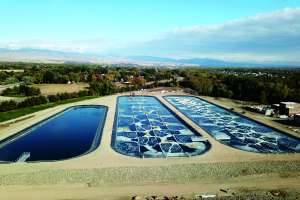
By 2019 the district was ready for a second phase of upgrades. The Idaho Department of Environmental Quality wanted the district to add treatment redundancy to avoid downtime for large-scale maintenance. That would mean adding four new lagoons, two for aeration and two for settling. Eagle also wanted to add significant capacity to meet current and future demand.
Triplepoint delivered a plan providing the ultimate in expandability, installing 120 Ares aeration and mixing aerators plus 40 capped ports for adding more aerators. “The beauty is that we can add as many aerators as we want at a time — two, 10, 20,” says Jenkins. That gives us great flexibility to meet demand while putting less pressure on our capital budget.”
A significant difference between the phases is the length of the lagoons. The Phase 1 lagoon is 200 feet long; the Phase 2 lagoons are 700 feet and required customization of the air laterals to ensure the aeration system’s long-term stability.
“The floating laterals have to be secured because in addition to feeding oxygen to the aerators, they help keep the aerators in place,” says Jenkins. “Extremes in temperature can cause the HDPE pipes to expand or contract. It’s not a big deal in a smaller lagoon, but it is for a 700-foot lagoon, as these changes can cause the aerators to shift.”
To keep the 120 aerators in place during high winds, Jenkins and Triplepoint collaborated on a matrix of cables connected to the floating laterals and running the length of the lagoons. Two cross cables in the other direction increase stability. The cable-reinforced laterals have held their position and have performed flawlessly since installation in 2021, Jenkins reports.
The new lagoons, aerators and blowers have enabled the district to send better effluent to West Boise and avoid tens of thousands of dollars in surcharges per year. In summer the district now sees effluent BOD as low as 10 mg/L and ammonia as low as 5 mg/L; winter BOD and ammonia are near 30 mg/L.
A bonus for the district and its customers was a $215,000 energy efficiency rebate from Idaho Power. “They continually look to incentivize energy efficiency projects like this,” says Jenkins. “Our board of directors was pleased to observe firsthand how investing in efficient equipment translates to immediate energy incentives and long-term energy savings.
“Upgrading our lagoons and buying good equipment for our wastewater processing has been well worth the investment. We played the long game and chose Triplepoint aeration technology for its performance and expandability. As a result, our operation is set up nicely for the future.”