An Ohio city’s initiative to reduce fugitive methane emissions at a wastewater treatment plant sprang from environmental concern, but will pay economic benefits as well.
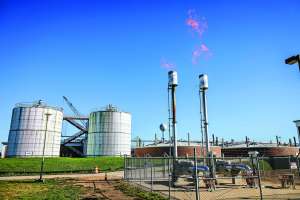
The Southerly Water Reclamation Plant in Columbus, Ohio, flares methane captured from its anaerobic digesters. The city is in the early stages of installing a combined heat and power system that will put the methane to good use. The CHP system, along with other changes, are expected to capture 90% or more of the plant’s fugitive methane.
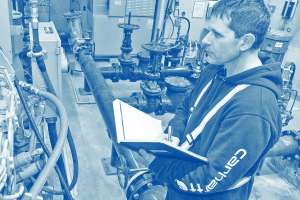
“The idea now is we want to use every molecule of methane we’re producing to generate power and heat,” says Tyler Schweinfurth, a chemical engineer and project manager for the Columbus Department of Public Utilities.
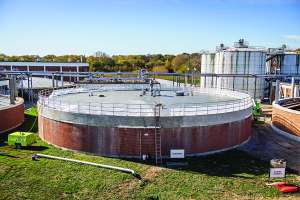
In late 2022, the city was looking at how much methane the Southerly plant could produce in its six digesters plus a planned seventh digester. Team members were performing a mass balance to determine if additional capacity was needed. The Brown and Caldwell consulting firm found a major disparity between the methane captured in a digester with a fixed cover and those with floating covers.
“We expected that we’d have a little bit of methane or biogas coming out the annular space of the floating covers, but the consultants said we’re losing 20-30% of our biogas out of those covers, while Digester 6 was capturing almost everything,” Schweinfurth says. The escaping methane had bad implications for the city’s climate action plan, which has a goal of achieving carbon neutrality by 2050. It also was a safety concern.
“We have ‘No Smoking’ signs all the way around the digesters,” says Schweinfurth. “But it’s one thing to just say no smoking because we’re producing gas. It’s another thing to say no smoking because we’re releasing gas. If you go down the list of all the health and safety issues with methane release, none of it is good.”
The consultants convinced the utility to use optical gas imaging (Konica Minolta) to identify biogas leaks around the plant and to engage a drone-operating company (Explicit) to measure the fugitive methane.
The techniques led to some surprising discoveries. Fugitive methane was coming from the biosolids holding facility, because the Class B solids weren’t completely digested when pumped into the tanks. Fugitive methane was also found around the dewatering centrifuges.
“There are still volatile solids in there that are not fully reduced,” Schweinfurth says. “We’re sending it to our centrifuges, and the centrifuges are off-gassing methane. We actually caught this on camera in these different locations. We got it quantified, and it was shocking.”
The investigation added to the urgency to increase biosolids capacity, although the solids-handling limits also were causing operating problems for the wastewater treatment process.
“Our focus when we’ve upgraded our treatment facilities in the past has been on the wet stream, and the solids-handling area has kind of been an afterthought,” says Schweinfurth.
“Now we’re finding that we can’t get good operation out of our secondary clarifiers because we’re holding so many solids back. We don’t have the ability to push those solids out to our digesters because we just don’t have the capacity to take it. That’s causing operational issues on the wet stream.”
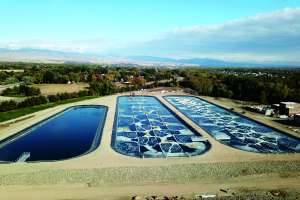
The Southerly plant (114 mgd average, 330 mgd peak design, 440 mgd with chemically enhanced primary treatment) serves the southern and eastern parts of Columbus. Biosolids are beneficially used by land application or composting. Effluent discharges to the Scioto River. The plant has acid-phase digestion as well as methane-phase digestion.
Biosolids spend no more than 1.8 days in the acid-phase digesters. “Those acid-phase digesters are producing the volatile fatty acids needed for digestion and getting rid of a lot of the hydrogen sulfide in those tanks,” says Schweinfurth. “So we have a very methane-rich gas byproduct from the methane-phase digesters. Most of our H2S is actually coming out in those acid-phase digesters.”
The biosolids spend 13-15 days in the methane-phase digesters. Schweinfurth would like to increase that to 23-28 days to provide more complete digestion, but the digester do not have adequate capacity.
Before the fugitive methane project started, Digester 7 was under construction. Now, two more will be added. All the existing digesters plus the new ones will be fitted with concrete covers instead of floating covers to mitigate methane losses.
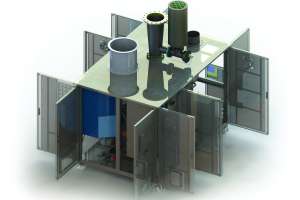
The biosolids storage facility has biofilters to control odors, but they do not mitigate fugitive methane. Now plans are to add a vapor combustion unit that will treat air from the biosolids handling area and the centrifuges as well as from the acid-phase digestion tanks.
“It’s like something you might see around an oil refinery,” Schweinfurth says. “That’s going to handle the lower-methane-content gas, because we can’t burn that in the CHP. We’re going burn it off in the vapor combustion unit with our sour gas from the acid-phase digesters.”
Plans also call for installing higher-rated pressure and vacuum relief valves on digesters so that they can operate at higher pressures before the valves begin to release gas. The fugitive methane investigation found the existing valves were releasing methane well before they reached their rated pressure of 30 inches of water.
Most of the project’s contracts were to be awarded in the first quarter of 2025. The contract for installing cast-in-place concrete digester covers was awarded to Kokosing Construction Co., based in Columbus.
Schweinfurth estimates that when the project is completed — including the added capacity, the concrete covers, the vapor combustion unit, the higher-rated valves and the CHP system—the plant’s fugitive methane will be reduced enormously.
The cost is estimated at $443 million. Schweinfurth expects the project to qualify for a 50% rebate from the Inflation Reduction Act. The CHP system is to begin operation in 2030. Fugitive methane could be further mitigated by installing a regenerative thermal oxidizer for the airflow from the biosolids storage tanks, but the benefit did not justify the cost.
“That was only going to get us another 4% reduction,” Schweinfurth says. “We’re at 91% to 93% with the changes we’re already making. We’re going from potentially over 100 kg an hour of methane being released down to about 5 kg an hour.”